FAQ
About CARE
About EOPS
About NextUp
Apply to Delta College
ASL
Depending on where you start, you can finish in one or two years.
Depending on where you start, you can finish in one or two years.
Depending on where you start you can finish in one or two years.
Blue Phone Questions
Crime Questions
Culinary Arts Uniforms
Degree FAQ
Yes, you can order a replacement, or an electronic signed and certified PDF copy of your diploma. Cost and shippings times are available of the Diploma Replacement and eDiploma Services Page
Diploma Reprint / Replacement and eDiploma Services
San Joaquin Delta College allows the earning of multiple degrees.
Each degree is evaluated independently of any others. Each degree can use a different General Education pattern. Each major can use a different catalog year as long as catalog rights exist to that catalog.
There are some exceptions:
- The Interdisciplinary Studies: Mathematics & Science degree changed from being an Associate In Arts degree to an Associate in Science degree in the 2010 catalog. These are considered the same degree so only one can be awarded.
- The Business: Specialized Certificate Majors AA degree from the 2008 catalog has virtually the same requirements as the Business AA in the 2009. Even though the names are different, these are considered the same degree so only one can be awarded.
- A different catalog year cannot be used to earn a degree that has already been earned. That is, if the AA in Natural Sciences was awarded from the 2007 catalog …it cannot also be awarded from the 2009 catalog.
- The Interdisciplinary Studies: Arts, Humanities, and Social Sciences degree changed from being the Interdisciplinary Studies: Arts and Humanities degree. These are considered the same degree so only one can be awarded.
Dual Enrollment FAQs
Dual Enrollment/College Early Start USE THIS
The are no costs associated with courses under the Dual Enrollment program, so you will not need financial aid. You may use financial aid for courses under the College Early Start program; nonetheless, financial aid has eligibility limits that might affect the student once he graduates from high school and wants to attend college as an adult. Students and parents should consider the pros and cons of using financial aid while the student is still in high school.
A student should discuss the situation with the instructor. If a student would like to request a change of grade, he/she will need to complete the Petition for Change to Academic Record Form and send it to: San Joaquin Delta College Admissions and Records Office Attn: (i.e. Admission, Evaluations, Grade Change, etc.) 5151 Pacific Avenue, Box 102 Stockton, CA 95207
Most dual enrollment courses are offered in-person. However, we also offer fully online classes under dual enrollment. Please check with your school counselor about the delivery method of your classes. Online classes are delivered via Canvas (a learning management system)
To access your online class(es), refer to our Canvas guides and videos. If you need more help, you can always reach out to us!
Please keep in mind that you may not be able to access your Canvas course until the start date. Not all instructors open the classes before the start of the term. Do not delay logging on and participating! Lack of going to class and participating in discussions and submitting assignments will result in your being dropped from the course by the instructor, without notice.
Please provide your name and birthday to look up if you are in MyDelta. Perhaps you are set up but never received the email. If you are not in the system, please provide a screenshot of the confirmation number that you received when you applied and send it to Judy Perez in Admissions.
If at all possible, please assist your parent/guardian to get a gmail or Yahoo! email account. Alternatively, you may enter your email address, but include your parent’s/guardian’s full name.
The confirmation email for the parent will come to your email, once you complete and submit the form. Call your parent/guardian over to sign the form and click on Finish. It will then go to your High School Official Designee for the final signature.
In most likelihood, it’s not signed by everyone yet or it’s not processed. Once you complete your CES form, it goes to your parent for a signature, then to your counselor and your principal. Then, it’s routed back to Delta to process and remove your CES hold. You can contact collegeearlystart@deltacollege.edu to inquire about the status of your CES form and if it’s "stuck" in the process.
No, this will not affect your chances of getting enrolled into classes or waiving your tuition and fees. High school students are required to complete the California College Promise Grant (CCPG) Application as part of the application process; however, you will not be responsible for any fees, regardless of your parents’ income and CCPG eligibility. High school students are required to complete this fee waiver application once every academic school year.
No, no assessment tests are required. If you will enroll in ENGL C1000 or STAT C1000, you must fill out an additional clearance request found at this link.
If you are currently taking ENGL C1000, you can go ahead and enroll in English 1B for next term. The system will allow you to enroll. However, prior to the start of next term’s classes, Admissions runs a check against grades. If you did not pass with a C or better, you will get dropped from English 1B.
To Login to MyDelta:
Go to the MyDelta Portal Your username is your Delta College Student ID number (included in a welcome message after you applied for Admission). Your password is SJdc! plus your 6 digit birthdate (SJ in caps and dc in lower case).
Example: If your birthdate is 06/04/1995 your password is SJdc!060495. Passwords are case sensitive (“S” and “J” must be capitalized). Once you’re logged in to MyDelta, go to Profile > Contact Details to see your new Delta College email address. Moving forward, this will be the only email address used to contact you.
To enroll in the Delta College Dual Enrollment Program, you must:
- Be age 13 and older.
- Be enrolled in the 9th, 10th, 11th or 12th grade.
- Be attending a high school that is participating in the Dual Enrollment Program with Delta.
- Complete a College Early Start form with high school counselor and obtain all required signatures from parent and school designee.
Dual Enrollment courses are taken on high school campuses and are geared towards college transfer and career readiness. Course options are selected by your school. Through Dual Enrollment, you are a Delta college student on an accelerated path to a degree or certificate! Students from districts who are dual enrollment partners with Delta College are not required to be in any special academic programs to take the dual enrollment courses. All students in good standing with the high school may enroll.
Courses are free – you don’t have to pay for any fees, tuition, textbooks or classroom / lab materials. You take classes on your high school campus, ideal for those that are not able to get to the Delta campus. Dual enrollment courses are not open to the public. Only students within the same high school district may register. Save money! Dual enrollment can shorten a college trajectory by at least 1 year and save $5,324. You may register for up to 15 units per term.
If you are taking dual enrollment courses, you will not incur any costs for textbooks or classroom materials, nor any tuition and fees. High school pupils enrolled in courses offered through a CCAP (dual enrollment) agreement to high schools shall not be assessed or charged a fee prohibited by EC § 49011, including a fee charged to a pupil, or a pupil’s parent or guardian, as a condition for course registration or for textbooks, supplies, materials, and equipment needed to participate in the course. EC §§ 49010 et seq.; 76004(f) . The above applies only to dual enrollment courses. If you are enrolled in Delta College courses open to all students (not just to your high school), you are responsible for the cost of textbooks. Effective fall 2020, you are not charged any tuition or fees, however.
You have to be 18 to rent textbooks. However, your parent can rent the book for you. So, when ordering online the name has to be the parent but please make sure they put your Delta ID number on the rental request.
Delta-certified instructors teach all dual enrollment courses. In most cases, the instructor will be an existing Delta faculty member who will travel to teach at the high school campus. In some cases, the instructor will be a high school teacher who has been hired and certified by Delta to teach Dual Enrollment courses.
You may take up to 15 units per semester, pending continued principal or designee approval. Your counselor may recommend that you take fewer units based on assessment of your maturity level and academic readiness. If you enroll in dual enrollment and other Delta College courses as a College Early Start student, you can take up to 11 units combined per semester.
Each school district will individually determine if these courses will count for high school credit.
Course requirements and expectations will be clearly outlined by each faculty member at the beginning of the class. It is your responsibility to ensure that you are able to meet the standards set for a college level course. It is worth noting that the grades you earn while taking Dual Enrollment and College Early Start courses will be added to your official college transcript. It is a good idea to assess your ability to be successful in the course at the start of the term and drop early, if needed, as to not affect your college transcripts.
You can drop a course in your MyDelta Student Portal. A student may also discuss dropping with the instructor who MAY provide assistance in dropping. Reminder: It is the student’s responsibility to drop a course – including knowing the dates for dropping without a “W” as well as to drop without a grade (but with a “W”).
Weekday Help
Submit a Help Ticket Submit a ticket to the Delta Student Help Desk for help with login issues and/or other issues related to your Canvas courses, email access or MyDelta.
Call (209) 565-1050
AVAILABLE Mon – Thurs: 8:30 am -5:30 pm Fri.: 8:30 am – 5:00 pm
Canvas LiveChat, Email and More
Canvas Student Portal for Delta Students
To access support, click on Contact Support upon visiting the above link. Canvas staff is available to answer how-to questions or to report problems with Canvas. Please note that they cannot resolve login issues, as accounts are established locally at Delta College.
Delta College’s Disability Support Programs and Services is available to all Delta College students with a verified disability. Visit the DSPS page for information on how to receive services.
Online Learning/Canvas
Delta online courses are asynchronous. There are no required in-person or live Zoom meetings. The only exception to holding live meetings is for courses with hands-on labs or performance arts practice sessions.
Your instructors may choose to hold Zoom lectures, but have been asked to make them optional and record them for your later viewing.
You will read or view lectures, take tests/quizzes, participate in discussions, etc. in your Canvas classroom(s). Plan and schedule time to ‘go’ to class regularly, complete assignments, and participate. There are open and close dates to assignments and strict due deadlines. Do not miss them. These are college courses and your grades will affect your GPA and college transcripts.
Please see our Canvas videos and guides.
Students can access Canvas from any browser on your Android/iOS device. However, mobile browsers are not supported, and features may not function as expected compared to viewing Canvas in a fully supported desktop or laptop browser.
If you need to use Canvas on your mobile phone device, you should download and install the “Canvas Student Mobile App”.
Download App To install the Canvas Student mobile app, see the instructions linked below
ANDROID USERS
Help here: How do I download the Canvas Student app on my Android device?
IMPORTANT! After installing the app, you will be prompted to find your school. To find San Joaquin Delta College, click “Find my school” in the app and search for either San Joaquin Delta College or sjdc.instructure.com, then simply log in with your Canvas username and password.
Read more about the Android app in the Canvas Student App – Android User Guide.
iOS (Apple) USERS:
Help here: How do I download the Canvas Student app on my iOS (Apple) device?
IMPORTANT! After installing the app, you will be prompted to find your school. To find San Joaquin Delta College, click “Find my school” in the app and search for either San Joaquin Delta College or sjdc.instructure.com, then simply log in with your Canvas username and password.
Read more about the iOS app in the Canvas Student App – iOS User Guide.
If you have questions about your grades or anything class-related, you should be communicating with your professors.
You can email your professors through Canvas or contact them with the contact information they provided in the class syllabus.
You can find out what your Delta email address is by logging into your account in MyDelta. To learn how to log into your Email, click on this link.
With your Delta College Email, you have access to all of Office 365, including the following applications: Outlook mail, OneDrive, Word, Excel, PowerPoint, OneNote, Microsoft Teams. Download Microsoft Office products onto your computer, phone, or tablet and take these tools with you wherever you go!
Learn how to access Office 365 on the web or your phone. Review videos and user guides on the above applications. Contact the Mustang Tech Squad for questions and help!
Not all instructors send out welcome messages, but you are expected to log into the course on the first day of classes. Failure to log on and participate actively may result in your being dropped from the course.
For information on what your Canvas login is, please review our help guides.
If you experience difficulties logging on, contact our help desk.
Dual Enrollment/College Early Start Admissions
ECP FAQ
Yes, because this is a cohort style program, all courses are pre-selected.
Yes.
English Program
EPIC
ESL
Please click on this link to start the ESL Guided Self-Placement Tool.
You can pay for your classes with a credit card (VISA or Mastercard), cash, check, or money order.
Delta College offers child care programs on campus. Check with the Child Development Center.
A unit is a measure of college credit based on one unit for each lecture hour per week or for every two to three laboratory hours per week.
First, complete the Delta College application for admission. You can do so on your computer at home or in the ESL Lab in Holt 201.
If you need help while completing the application, please contact the ESL Lab. We're here to help!
After you finish the application, please follow the ESL Guided Self-Placement process.
After you've applied to Delta, you'll want to take the ESL Guided Self-Placement.
The placement results are usually available within 3-4 days when both assessments are completed. Please be sure to check your email regularly and answer your phone if the ESL Lab calls to give you your results. If you have any questions about your results, contact the ESL Lab.
After you've applied to Delta College and taken the placement assessment, you'll need to enroll in classes.
Come to the ESL Lab in Holt 201 and our staff will help you with your schedule and the necessary paperwork.
We believe you will be most successful if you take all of the classes that are recommended to you. If you have any questions or concerns about this, please contact the ESL Lab.
Payment must be made before classes begin. International and non-resident students can make arrangements for payments at the Delta Connect Center in the DeRicco Building.
Reminder: You can also take noncredit courses for free!
If you feel the classes are too easy or too difficult for you, please speak to your instructor as soon as possible.
You must notify your instructor immediately.
If you have to drop from the program, you must inform the ESL office, and the staff will help you with the required paperwork. If you drop the classes before the refund date, you are eligible for a refund. (This date is different each semester.)
Yes, as long as they do not conflict with your ESL program and you meet the prerequisites for the class.
The first three levels of the ESL program are 11 units. To reach full-time status (12 units), you could enroll in a physical education course for an additional 1 unit. Courses in other disciplines are also available.
Residents pay $46.00 per unit.
Non-residents pay $278.00 per unit.
Reminder: Noncredit ESL classes are available for free!
Our ESL programs are 11 units at the first three levels.
Residence is that location with which a person is considered to have the most settled and permanent connection; it is also that place where that person intends to remain and, during absences, intends to return. Residence results from the union of physical presence with the intent to remain at that place for an indefinite period of time.
To qualify as a resident of California, you must show proof of residency for one year.
- Questions about residency can be answered in the ESL Office: Holt 201.
- Reminder: ESL's noncredit courses have no residency requirements!
- People capable of establishing residence in California must be physically present in California for two years or one year if they have supporting evidence of a declaration of intent that is dated one year prior to the residence determination date to be classified as a resident student (see Intent and Residence Determination Date below).
- Physical presence within the state solely for educational purposes does not constitute establishing California residence regardless of the length of that presence.
Intent to establish California residence may be manifested in many ways:
- Having active membership in service or social club.
- Being the petitioner for a divorce in California.
- Establishing and maintaining active California bank accounts.
- Licensing from California for professional practice.
- Maintaining permanent military address or home record in California while in the armed forces.
- Owning of residential property or continuous occupancy of rented or leased property in California.
- Paying of California state income tax as a resident.
- Possessing a California driver's license.
- Possessing a California motor vehicle license plate.
- Registering to vote and voting in California.
- Showing California as home address on federal income tax form.
The residence period which a student must meet to be classified as a resident does not begin until the student is present in California and has manifested clear intent to become a California resident.
As set by the District's governing board, the residence determination date is that day immediately preceding the opening day of instruction of the semester or summer intersession, during which the student proposes to attend college.
It is the student's responsibility to demonstrate clearly both physical presence in California and the intent to establish California residence.
American citizens or permanent residents of the USA who have not resided in California for more that the required period immediately preceding the residence determination date will be subject to the non-resident tuition fee as set forth by the College prior to the start of each academic year.
Reminder: Noncredit ESL courses have no residency requirements and are free!
An person who is in the USA under a non-immigrant classification such as B, C, D, F, G, H, J, or M cannot gain a resident status since the law relating to them provides that they are required to maintain a residence in another country and are only allowed to remain in the USA temporarily.
- Persons with F, G, and M status may be admitted to the College as full-time students subject to admission to the College's International Student Program.
- Persons whose non-immigrant status are other than F, J, and M should obtain assistance from the Admissions Office. A change in non-immigrant status is the responsibility of the student.
ESL Getting Started
Please click on this link to start the ESL Guided Self-Placement Tool.
First, complete the Delta College application for admission. You can do so on your computer at home or in the ESL Lab in Holt 201.
If you need help while completing the application, please contact the ESL Lab. We're here to help!
After you finish the application, please follow the ESL Guided Self-Placement process.
After you've applied to Delta, you'll want to take the ESL Guided Self-Placement.
The placement results are usually available within 3-4 days when both assessments are completed. Please be sure to check your email regularly and answer your phone if the ESL Lab calls to give you your results. If you have any questions about your results, contact the ESL Lab.
After you've applied to Delta College and taken the placement assessment, you'll need to enroll in classes.
Come to the ESL Lab in Holt 201 and our staff will help you with your schedule and the necessary paperwork.
ESL Costs
You can pay for your classes with a credit card (VISA or Mastercard), cash, check, or money order.
Delta College offers child care programs on campus. Check with the Child Development Center.
Payment must be made before classes begin. International and non-resident students can make arrangements for payments at the Delta Connect Center in the DeRicco Building.
Reminder: You can also take noncredit courses for free!
You must notify your instructor immediately.
If you have to drop from the program, you must inform the ESL office, and the staff will help you with the required paperwork. If you drop the classes before the refund date, you are eligible for a refund. (This date is different each semester.)
Residents pay $46.00 per unit.
Non-residents pay $278.00 per unit.
Reminder: Noncredit ESL classes are available for free!
ESL About Classes
A unit is a measure of college credit based on one unit for each lecture hour per week or for every two to three laboratory hours per week.
We believe you will be most successful if you take all of the classes that are recommended to you. If you have any questions or concerns about this, please contact the ESL Lab.
If you feel the classes are too easy or too difficult for you, please speak to your instructor as soon as possible.
Yes, as long as they do not conflict with your ESL program and you meet the prerequisites for the class.
The first three levels of the ESL program are 11 units. To reach full-time status (12 units), you could enroll in a physical education course for an additional 1 unit. Courses in other disciplines are also available.
Our ESL programs are 11 units at the first three levels.
Evaluation FAQs
San Joaquin Delta College does not evaluate foreign transcripts nor is credit granted for foreign coursework. Students who wish to have foreign coursework recognized for the purpose of meeting prerequisite requirements must have the entire transcript or the individual course evaluated by an outside transcript evaluation service and file a Matriculation Appeal Petition for each course they wish to enroll in. Matriculation Appeal Petitions should be submitted to the Admissions & Records Service Window, located on the first floor of the DeRicco Student Services Building.
For another college’s courses to be considered for transfer to Delta – that college must have a “regional accreditation” just as Delta has. This means that the other college must be accredited by one of the following: MSA = Middle States Association of Colleges and Schools NASC = The Northwest Association of Schools and Colleges NCA = North Central Association of Colleges and Schools NEASC-CIHE = New England Association of Schools and Colleges, Inc./Commission on Institutions of Higher Education NEASC-CTCI = New England Association of Schools and Colleges, Inc./Commission on Technical and Career Institutions NWCCU = Northwest Commission on Colleges and Universities SACS-CC = Southern Association of Schools and Colleges/Commission on Colleges WASC-Jr. = Western Association of Schools and Colleges/Accrediting Commission for Community and Junior Colleges WASC-Sr. = Western Association of Schools and Colleges/Accrediting Commission for Senior Colleges and Universities
General Information
Graphic Arts Tech Requirements
Immigration Enforcement Questions
Information for Undocumented Students
International Student Program FAQs
Please refer to the following webpage to see who can study under certain visa classifications:
https://www.ice.gov/doclib/sevis/pdf/Nonimmigrant%20Class%20Who%20Can%20Study.pdf.
If you are seeking a change of status to F-1, please be sure to inform us at international@deltacollege.edu after you have submitted the international application for admission.
Student housing options are apartment rental, either alone or with a roommate. SJDC does not have on-campus housing. Please see the housing information in Helpful Links.
Only one class or three credits during each term or semester may count toward a full course of study for an F-1 student if the class is taken online or through distance learning.
Interpreting Captioning Information for Professors
Learning Disabilities
Parking Information
Registration FAQ
Education Code section 68075.6 grants an immediate nonresident tuition fee exemption to eligible Special Immigrant Visa (SIV) holders and refugee students who settled in California upon entering the United States. This exemption is granted for one year from the date the student settled in California upon entering the United States.
This exemption applies to the following:
Iraqi citizens or nationals (and their spouses and children) who were employed by or on behalf of the United States Government in Iraq (Pub.L. No. 110-181, § 1244)
Afghan and Iraq translators (and their spouses and children) who worked directly with the United States Armed Forces (Pub.L. No. 109-163, § 1059)
Afghanistan nationals who were employed by or on behalf of the U.S. government or in the International Security Assistance Force {ISAF} in Afghanistan (Pub.L. No. 111-8, § 602)
Refugee students admitted to the United States under Section 1157 of Title 8 of the United States Code.
These exemptions only apply to those who settled in California upon entering the United States. (Ed. Code, § 68075.6, subd. (b)(1).) Students who settled elsewhere in the United States, and then moved to California would not be eligible for this exemption and would be required to either establish residency or pay nonresident tuition. Under Education Code section 68122, T and U visa holders are also exempt from nonresident tuition by extension of Assembly Bill 343.
Assembly Bill 343 also states that the exemption for a student is only available for the maximum time it would take for the student to establish residency. (Ed. Code, § 68075.6, subd. (b)(1).) That time, and therefore any nonresident tuition exemption, will expire one year from the date the student settled in California upon entering the United States. (Ed. Code, § 68017.) Upon expiration of the nonresident tuition exemption, the student will either have established residency in California, or will have an intention to reside elsewhere, and be subject to nonresident tuition.
Students who believe they fit the above criteria may complete a Residency Reclassification Petition (Admissions & Records Forms site under "Admissions Forms") and submit copies of supporting documentation to the Admissions & Records Office to determine their eligibility for the above exemption waiver or California residency reclassification or non-resident classification.
Students under 19 years of age and unmarried derive California residency from their parents. The parents must meet the eligibility requirements and provide required documentation demonstrating physical presence in California and intent to make California their permanent residence. Students under 19 years of age who have been classified as a non-resident will need to complete a Residency Reclassification Petition (Admissions & Records Forms site under "Admissions Forms") and submit copies of supporting documentation to the Admissions & Records Office.
Students who have left California to attend an out of state College or University within the last 2 years will be required to show proof of retaining their California residency. Students who have been classified as a non-resident for attending an out of state College or University will be required to complete a Residency Reclassification Petition (Admissions & Records Forms site under "Admissions Forms") and submit all three of the following documents:
- Copy of your parent’s California Resident Tax Return (Form 540) indicating that you are being claimed as a dependent and, if applicable, your CA state income tax return for the prior tax year.
- Verification that you were or are attending college as a Non-Resident (For example: tuition bills or a letter from the Registrar stating what your categorization for tuition purposes is and what your permanent home of record is). Please note if the university/college is “private”, online, off-site campus located in California or correspondence/distance learning, you must provide a letter from the Admissions and Records Office verifying the permanent home of record you reported.
- Copy of your Valid California Driver’s License or Identification Card.
Active Duty Members (including spouse and dependent children) Stationed in California:
Students who are members of the armed forces of the United States domiciled or stationed in California on active duty are entitled to resident classification for purposes of determining the amount of tuition and fees for the duration of their attendance at a community college as long as they remain on active duty as of the residence determination date. (Service in the California National Guard does not constitute being a member of the armed forces of the United States for Education Code sections 68074 and 68075.)
Dependents of Active Duty Military Members EC 68074; T5 54041
A student who is a natural or adopted child, stepchild, or spouse and who is a dependent of a member of the armed forces of the United States domiciled or stationed in California on active duty is entitled to resident classification for the purposes of determining the amount of tuition and fees. There is no limitation on the length of the resident classification. If that member of the armed forces, whose dependent is in attendance at a community college, is thereafter transferred on military orders to a place outside this state where the member continues on active duty or is thereafter retired as an active member of the armed forces of the United States, the student dependent shall not lose his or her resident classification so long as he or she remains continuously enrolled at that community college.
Students who believe they fit the above criteria may complete a Residency Reclassification Petition (Admissions & Records Forms site under "Admissions Forms") and submit copies of supporting documentation to the Admissions & Records Office.
Requested supporting documentation consists of the following:
- Copy of Active Duty Stationing Orders
- Copy of Military ID and state ID or Driver’s License
Veterans or dependents of an eligible Veteran who meet the following requirements shall be exempt from paying nonresident tuition at San Joaquin Delta College. A “covered individual” for purposes of compliance with the VACA Act and Education Code Section 68075.7 is defined as:
A student who lives in California and uses education benefits under Chapter 30, 31, 33, or 35 is granted a waiver of non-resident tuition regardless of his/her formal State of residence. Under the provision of Isakson and Roe Veteran Health Care and Benefits Improvement Act of 2020, section 1005, the requirement for covered individuals to enroll in a course at a public institution of higher learning within three years of being discharged to receive in-state tuition is no longer required effective August 1, 2021.
- A covered individual is defined as:
- A veteran, or
- A spouse or dependent child using transferred benefits, or
- A spouse or dependent child of a person whose active-duty transferor dies, on or after September. 11, 2001, in the line of duty, or
- A spouse or dependent child using transferred benefits and the transferor is serving on active duty effective for courses, semesters, or terms beginning after July 1, 2017;
- Effective August 1, 2022, a spouse or dependent child using Chapter 35 Dependent Educational Assistance (DEA) will be eligible for in-state tuition rates.
Students who initially qualify under the applicable requirements above maintain "covered individual" status as long as they remain continuously enrolled.
Under this exemption, students are NOT eligible to receive a California College Promise Grant (Formerly BOG waiver). Students will still be classified as a non-resident but given an exemption from paying non-resident tuition.
How to apply for AB 13 (VACA) exemption
To apply for AB13 (VACA) California Nonresident Tuition Exemption for Eligible Veterans & Dependents you must:
- Complete and sign the AB13 (VACA) Affidavit form
- Attach all applicable documentation:Copy of DD214 Certificate of Release or Discharge from Active Duty.
- Certificate of Eligibility (COE) from VA confirming the approval of education benefits for student.
- Please submit to the Admissions and Records Service Window, DeRicco Building 1st floor in the Delta Connect Center or mail to:
San Joaquin Delta College
Admissions & Records Office - Residency
5151 Pacific Avenue, Box 102
Stockton, CA 95207
California Nonresident Tuition Exemption Form for Eligible Veterans & Dependents
California Education Code 68075.5 entitles a student who was a member of the Armed Forces of the United States stationed in California on active duty for more than one year prior to being discharged shall be exempt from paying nonresident tuition for the length of time he or she lives in this state after being discharged up to the minimum time necessary to become a resident. The one-year exemption shall be used while the student lives in this state and within two years of being discharged.
How to apply for this exemption:
- Please complete the Military Exemption Affidavit form, sign and attach a copy of your DD214 Certificate of Release.
- Please submit to the Admissions and Records Service Window, DeRicco Building 1st floor in the Delta Connect Center or mail to:
San Joaquin Delta College
Admissions & Records-Residency
5151 Pacific Avenue, Box 102
Stockton, CA 95207
Reporting Questions
Spanish
| Option | Span 1 | Span 2 | Span 3 |
Span 4 |
| (A) | Fall | Spring | Fall | Fall |
| (B) | Summer |
SUMMER |
Fall | Fall |
| (C) | Spring | SUMMER |
Fall | Fall |
| (D) | SUMMER |
Fall | Spring | Spring |
Traffic Questions
Transfer Credit
Transfer Credit FAQs
Vehicle Tow FAQ
Accreditation
Accreditation is a quality assurance process that helps ensure colleges and universities meet established standards for educational quality, institutional effectiveness, and student support.
Through accreditation, colleges participate in regular reviews conducted by their peers in higher education. These reviews evaluate how well an institution fulfills its mission, supports student learning and achievement, and continuously works to improve its programs and services.
Accrediting organizations establish standards of good practice and evaluate institutions to determine whether they meet those standards. Accredited status demonstrates that a college has successfully completed this comprehensive review process and is committed to maintaining high standards of quality and continuous improvement.
For community colleges in California, accreditation provides students, families, employees, and the public with confidence that the institution's educational programs and services meet recognized standards of quality.
The College’s programs are fully accredited or approved by professional organizations and/or national and state agencies including:
The Accreditation Commission for Education in Nursing (ACEN)
3343 Peachtree Road NE, Suite 850
Atlanta, GA 30326
Phone: (404) 975-5000 | Fax: (404) 975-5020
Web: http://www.acenursing.org/
Commission on Peace Officer Standards and Training (POST)
860 Stillwater Road, Suite 100
West Sacramento, CA 95605
Phone: (916) 227-3909
Web: https://post.ca.gov
California Board of Registered Nursing (BRN)
1747 North Market Blvd., Suite 150
P.O. Box 944210
Sacramento, CA 94244-2100
Phone: (916) 322-3350
Web: www.rn.ca.gov
Board of Vocational Nursing and Psychiatric Technicians (BVNPT)
2535 Capitol Oaks Drive
Suite 205
Sacramento, CA 95833
Phone: (916) 263-7800
Web: https://www.bvnpt.ca.gov/
National institute for Automotive Service Excellence (ASE)
1503 Edwards Ferry Rd., NE, Suite 401
Leesburg, Virginia 20176
Phone: (703) 669-6650
Web: https://www.aseeducationfoundation.org
San Joaquin County Emergency Medical Services Agency (SJCEMSA)
505 W. Service Road
French Camp, CA 95321
Phone: (209) 468-6818
Web: https://www.sjgov.org/department/ems
CNA
The Nurse Assistant Training program application is an online application. There will be a random selection for the program. Selected candidates will be notified through their Delta College Student email and will be sent an information packet, which will include the course code number for registration into the class. The clinical requirements in the packet include: Background and Drug screen Physical Assessment One negative TB skin tests within the past 12 months or one Chest X-ray submitted with a TB Annual Symptom Review with in the last 24 months Flu shot during flu season (October - March) Malpractice Insurance Fingerprinting The following are recommended immunizations but not required: 2MMR's or Mumps Titre, Rubeola Titre and Rubella Titre Tetanus, Pertussis & Diptheria (Tdap) Hepatitis B Titre or Hep B Series (followed by a Titre) Hepatitis C Titre Varicella Titre CPR Certification at one of the following levels is recommended but not required: BLS for Healthcare Providers - American Heart Association CPR/AED for the Professional Rescuer - American Red Cross CPR/AED for the Professional Rescuer - American Safety & Health Institute CPR online courses are NOT acceptable.
While it is not possible to give specific costs for each individual, a listing of typical costs follows below: Tuition: 7 units @ $46 per unit $322 Textbooks $90 Clinical Requirements: TB skin test, flu shot, physical exam or Health Assessment (specific costs may vary) Background and Drug Screen (approximately $130) Scrubs and supplies (specific costs may vary) Fingerprinting (cost covered by Delta College) Malpractice Insurance (approximately $28) American Red Cross Testing $110
EMT
While it is not possible to give specific costs for each individual, a listing of typical costs follows below:
- Tuition: 8 units @ $46 per unit $368
- Textbooks: $74
- Clinical Requirements (specific costs may vary): CPR, TB, immunizations, physical, TDAP, flu and COVID
- Background and Drug Screen: $98.75
- Uniform: $110
- Supplies (specific costs may vary): Black cargo pants, watch with second hand, shoes (solid black), black belt, stethoscope, and blood pressure cuff
- NSO Professional Liability Insurance: $27
Mustang Tech Squad
MyDelta Dashboard
MyDelta for Faculty
To access the Faculty Center:
Login into MyDelta directly or use okta / MyDelta Dashboard
- If you logged in using MyDelta Dashboard, select the MyDelta Tile.
Nursing Application Process
Nursing Program Admissions
Yes, applicants applying for admission to the ADN program are required to have a current Application for Admission on file with our college. All applicants to the ADN program must have an active Delta College student I.D. number and Delta College email address. All correspondence from the college will be sent to the Delta College email account. Learn More About Delta College Admissions
You will be required to take coursework that is unique and exclusively required to earn a nursing degree from our program. Students may need to see an Academic Counselor to determine which additional courses they need to take to earn the nursing degree.
The most common reasons students are disqualified are:
- Prerequisites were taken at another college/university and the course descriptions were missing or the descriptions submitted were the wrong course description.
Course descriptions are required for all prerequisite coursework completed at regionally accredited college/universities, other than San Joaquin Delta College. - Wrong course and grade listed for the prerequisite in the online application. We use the FIRST passing grade for science prerequisites. If you took Anatomy at University ABC in Fall 2001 and passed with a “C” and then repeated the same course at XYZ Community College in Spring 2008 and passed with an “A”, we will use the first passing grade (C) from Fall 2001. That is the course description you would need to submit.
- Incorrect or incomplete information reported on the application.
- Documentation is missing or is insufficient to support application information.
- Official transcript missing or transcript is not “official”. An official transcript means the transcript is submitted in a SEALED envelope from the college/university. If the envelope has been opened or the seal broken, the transcript is not “official.”
Applicants invited to submit documentation will be required to submit official transcripts for ALL lower and upper division courses completed at any and all regionally accredited U.S. institutions, regardless of applicability to nursing requirements. All required official transcript(s) must be submitted as part of the ADN Supporting Documentation packet even if transcripts have been previously sent to the college for any purpose or at any other time.
Do NOT send official transcripts to the Health Science Division Office. Prerequisite course is not equivalent to San Joaquin Delta College course(s). Many students presume the course they took at another school is equivalent to Delta College prerequisite. If you are unsure, ask for assistance from a counselor before you complete your online application or request that your transcript be evaluated for equivalency by San Joaquin Delta College before you apply to the program. If you chose this option, be sure you allow several months for your transcript to be evaluated by our college! - Prerequisite courses are “In Progress” or final grade not posted to the official transcript. We do not accept “In Progress” coursework. If you completed a course but your final grade is not posted to your transcript, you will be disqualified.
Office 365
Psych Tech
How much does the program cost?
The Psych Tech Program at Delta College is designed to be a low-cost pathway into a high-demand career in mental health and psychiatric nursing.
Estimated Student Out-of-Pocket Costs:
- Tuition Prerequisites (11 units), Psych Tech Core Units (45 units) - $2,576
- Textbooks: $1,500
- Clinical Requirements $1,000
- State Licensing & Application Fees: $500
Estimated Total: $4,500-$5,600
Other Estimated Program Cost (includes required program expenses)
- Technology (computer & iPad);
- Standardized testing and study-related expenses
- Two sets of Uniform A and B;
- Program approved shoes;
- Medical equipment and consumable medical supplies;
- Malpractice insurance and hospital required subscriptions.
Rad Tech
WiFi
Interpreting and Captioning
POST Academy
You should contact the college’s Veteran’s Office for information: SJ Delta College - Veterans Services
You should contact the college’s Financial Aid Office for information: Financial Aid. Should you wish to contact WorkNet for information regarding possible support services for the academy, you can visit their webpage or call (209) 954-5728. Stop by their office in the DeRicco Building Room 208.
Student Incident Referral Forms - Bias Incident Reporting
A: This glossary offers definitions for terminology frequently associated with bias and bias incidents. While it aims to provide clarity, it is not comprehensive. The SAFE Team acknowledges that language is nuanced and that the meanings of these terms may evolve over time. Your understanding and engagement are important as we work toward a more inclusive environment. If you have questions or suggestions for additional terms, please feel free to share.
- Assess: The SAFE Team is committed to assessing all reports received within 48 business hours.
- Bias: A tendency to favor or disfavor a person, group, or thing compared to another, typically in a manner that is considered unfair. Biases can be either conscious (explicit) or unconscious (implicit) and may manifest in attitudes, behaviors, or judgments. Additionally, bias can become institutionalized when it is embedded in policies, practices, and structures, leading to systemic advantages or disadvantages for certain groups.
- Bias Incident: Any hurtful, discriminatory, or harassing act directed at individuals or groups based on their perceived or actual identity (e.g., race, ethnicity, religion, gender, sexual orientation, disability). An act is considered a bias incident even if it does not qualify as a crime under federal, state, or local laws, and regardless of whether it violates District policies.
- Complainant: An individual who submits a complaint alleging that a student, faculty, staff member, or community member has violated District policy related to bias. A complainant can also be any student, faculty, or staff member who believes they have been a victim or negatively impacted by the misconduct of another, regardless of whether they personally filed the complaint or someone else did on their behalf.
- Creed: A set of beliefs, principles, or aims that guide an individual’s or group’s thoughts, behaviors, and actions. A creed can be personal, philosophical, or religious, and often serves as a foundational framework for decision-making and interactions.
- Discrimination: Unfavorable or unfair treatment of an individual or group based on their membership in a protected class, as defined by federal and/or state statutes. Protected classes may include race, ethnicity, gender, sexual orientation, religion, age, disability, or other legally recognized categories.
- Ethnicity: The shared cultural characteristics of a group of people from a specific geographic region, including their language, heritage, traditions, religion, and customs. Ethnicity often encompasses a sense of shared identity and common ancestry.
- Gender: A complex social construct that encompasses identity, expression, and social elements related to masculinity, femininity, and other gendered experiences. Gender includes:
- Gender Identity: How individuals perceive and identify themselves (e.g., male, female, non-binary).
- Gender Expression: How individuals present themselves through appearance, behavior, and language.
- Social Gender: The expectations and norms society associates with gender.
- Gender Roles: The roles and behaviors considered appropriate for individuals based on their perceived gender.
- Gender Attribution: How others perceive and categorize an individual’s gender.
- Harassment: Involves unwelcome conduct based on an individual’s membership in a protected class (e.g., race, gender, religion, disability, etc.) and must be sufficiently severe or pervasive such that it interferes with an employee’s ability to perform their job or denies or limits a student’s ability to participate in or benefit from the College’s programs or activities.
Implicit/unconscious bias: Occurs outside of conscious awareness and is not deliberate or intentional. Can influence perceptions, decisions, and behavior without the individual being aware of it. Often contradicts one’s consciously held beliefs and values. For instance, someone might consciously value fairness and equality but may unconsciously associate certain traits or abilities with specific groups of people based on stereotypes.
Implicit biases are shaped by cultural norms, media representations, and personal experiences. They can manifest in areas like hiring decisions, performance evaluations, and everyday interactions, potentially leading to unintentional discrimination or unequal treatment.
Microaggressions: Brief and commonplace interactions—verbal, behavioral, or environmental—that may seem minor in isolation but can have a cumulative impact over time. Typically subtle, indirect, and often unintentional. The individual committing a microaggression might not be aware of its impact or may not intend to harm. Often occur in ambiguous situations where there are alternative explanations, making it challenging to address or confront. Deny or minimize the importance of identity aspects such as race, ethnicity, gender identity, sexual orientation, disability, religion, national origin, etc., in a way that subtly invalidates or undermines the experiences of marginalized groups.
Microaggressions can manifest as seemingly positive comments (e.g., “You speak English so well!” to someone who is assumed to be a non-native speaker) or as dismissive actions (e.g., overlooking someone’s ideas in a meeting). Though individually these actions may appear harmless, their cumulative effect can contribute to feelings of exclusion or marginalization.
National origin: The country or geographic region where a person or their ancestors come from. This can include the nation of birth, ethnicity, or cultural heritage. It encompasses not only a person’s own place of birth but also the national origin of their family, ancestors, or ethnic group, which might influence their identity or be a basis for discrimination.
National origin is considered a protected characteristic under many anti-discrimination laws (e.g., Title VII of the Civil Rights Act in the U.S.), which means that discrimination or harassment based on a person’s national origin is prohibited in employment, education, and other areas.
Protected class: Groups of people who share specific characteristics that are safeguarded against discrimination, harassment, and unfair treatment under various federal, state, and local laws, as well as institutional policies. The concept of protected classes aims to ensure equal treatment and opportunities for individuals regardless of their identity or personal attributes.
The specific characteristics that define protected classes may vary slightly depending on jurisdiction and policy, but they typically include:
Race and Color
Religion
Sex (including pregnancy, sexual orientation, and gender identity/expression)
National Origin
Age (generally 40 and older under federal law)
Disability (physical or mental)
Veteran Status
Genetic Information
Delta College also include additional protections beyond those mandated by law to promote diversity, equity, and inclusion within our community.
- Race: The categorization of people into different groups based on perceived or actual physical characteristics (e.g., skin color, facial features, hair texture) that are associated with genetic ancestry. It is a social construct rather than a biological fact, as there is more genetic variation within racial groups than between them. Despite this, race has real social implications because of how societies use it to classify, stereotype, and treat individuals and groups. Sociologists and anthropologists study race to understand how these classifications influence social dynamics, power structures, and inequalities. For example, terms like African-American, Asian, or Caucasian are used not only to describe physical attributes but also to reflect social identity and experiences.
While race is often conflated with ethnicity, the two are distinct: ethnicity relates more to cultural factors like language, nationality, and traditions, whereas race focuses on physical traits as a basis for social categorization.
- Retaliation:
- Adverse actions taken against an individual who engages in protected activities. These activities may include:
- Seeking information about potential violations of university policies.
- Complaining in good faith about perceived violations, even if the complaint is later found to be unsubstantiated.
- Participating in an investigation related to complaints about policy violations.
- Filing a complaint with or participating in investigations conducted by federal, state, or local authorities concerning violations of laws or regulations.
- Retaliation can manifest in various forms, such as:
- Negative performance evaluation.
- Demotion or termination of employment
- Exclusion from programs or activities
- Harassment or intimidation
- It is important to note that retaliation is illegal under many federal and state laws, as well as under Delta College’s policies, because it discourages individuals from exercising their rights to report wrongdoing or seek recourse for discrimination or harassment.
Overall, protecting individuals from retaliation is critical to fostering a safe and supportive environment where people feel empowered to speak out against injustice or violations of policy.
- Adverse actions taken against an individual who engages in protected activities. These activities may include:
- Response and Action: Refers to the SAFE Team’s commitment to:
- Review and assess each report of bias incidents thoroughly to understand the nature of the incident and its impact on the involved parties and the larger community.
- Determine the appropriate course of action, which may include:
- Assessing the incident to understand its severity and context.
- Following up with the involved parties to gather more information, provide support, or clarify any misunderstandings.
- Supporting individuals and community members affected by the incident, whether they are direct targets, bystanders, or those indirectly impacted.
- Support mechanisms can take various forms, such as:
- Facilitated dialogues to address misunderstandings or to promote understanding between the parties involved.
- Mediation to resolve conflicts and repair harm caused by the incident.
- Educational outreach programs or workshops to raise awareness, prevent future incidents, and promote an inclusive community.
The ultimate goal of the SAFE Team is to create a safe and supportive environment where individuals feel heard, incidents are addressed constructively, and the community learns and grows from these experiences.
- Respondent: Any student, faculty, or staff member who has been accused of violating the College’s policies concerning bias, discrimination, or harassment. The Respondent is the individual or group against whom a formal complaint or report has been made, and who will participate in the investigation and resolution process as outlined by the College’s policies.
The Respondent has the right to a fair and impartial investigation and is typically provided with information about the nature of the complaint, the procedures that will follow, and any resources available to them during the process.
- Sex:
- A set of biological, chromosomal, and anatomical characteristics that classify humans as male, female, or intersex. These characteristics typically include:
- Chromosomes (e.g., XX for females, XY for males)
- Hormones (e.g., estrogen, testosterone)
- Anatomical features (e.g., reproductive organs, secondary sexual characteristics)
- Sex is distinct from gender, which relates to the roles, behaviors, and identities that societies and cultures ascribe to individuals. While sex is a biological concept, gender is a social construct that encompasses identity, roles, and expectations.
- Although sex and gender are often used interchangeably, understanding the difference is important for clarity. For instance, someone’s gender identity (how they see themselves) might not align with their sex assigned at birth, which can influence discussions around topics like gender diversity and inclusion.
- A set of biological, chromosomal, and anatomical characteristics that classify humans as male, female, or intersex. These characteristics typically include:
By keeping the definitions separate, it helps highlight that discussions around sex focus on biology, while discussions around gender address sociocultural dimensions.
- Sexual orientation: An individual’s physical, emotional, and/or romantic attraction to others, which may involve specific genders and/or sexes. It describes whom a person is drawn to and wishes to form relationships with, whether these are emotional, romantic, or sexual in nature.
- Common examples of sexual orientations include:
- Heterosexual: Attraction to people of the opposite sex or gender.
- Homosexual: Attraction to people of the same sex or gender.
- Bisexual: Attraction to more than one sex or gender.
- Pansexual: Attraction to people regardless of sex or gender.
- Asexual: Lack of sexual attraction to others, though an asexual person may still experience emotional or romantic attraction.
- Common examples of sexual orientations include:
Sexual orientation is an intrinsic part of a person’s identity and can be fluid over time. It is separate from other aspects of identity, such as gender identity (how one sees themselves) and gender expression (how one presents their gender to others).
Understanding and respecting diverse sexual orientations is fundamental to fostering an inclusive and supportive environment.
- Socioeconomic status (SES): The social standing or class of an individual or group, which influences their access to resources, opportunities, and overall quality of life.
- SES is often assessed through a combination of factors, including:
- Education: Level of education attained, which can affect job opportunities and income potential.
- Income: Earnings from employment or other sources, which determines financial stability and access to goods and services.
- Occupation: Type of job held, which often correlates with income and social prestige.
- SES can also encompass other dimensions, such as:
- Wealth: Assets owned, which can provide a buffer against economic hardship.
- Social connections: Networks of relationships that can provide support and access to opportunities.
- SES is often assessed through a combination of factors, including:
Understanding SES is important for analyzing social inequalities, as it can influence health outcomes, educational attainment, and overall life opportunities. Disparities in ESE often reflect broader systemic issues, including discrimination, access to quality education, and economic mobility.
Transcripts
San Joaquin Delta College does not evaluate foreign transcripts nor is credit granted for foreign coursework. Students who wish to have foreign coursework recognized for the purpose of meeting prerequisite requirements must have the entire transcript or the individual course evaluated by an outside transcript evaluation service and file a Matriculation Appeal Petition for each course they wish to enroll in. Matriculation Appeal Petitions should be submitted to the Admissions & Records Service Window, located on the first floor of the DeRicco Student Services Building.
For another college’s courses to be considered for transfer to Delta – that college must have a “regional accreditation” just as Delta has. This means that the other college must be accredited by one of the following: MSA = Middle States Association of Colleges and Schools NASC = The Northwest Association of Schools and Colleges NCA = North Central Association of Colleges and Schools NEASC-CIHE = New England Association of Schools and Colleges, Inc./Commission on Institutions of Higher Education NEASC-CTCI = New England Association of Schools and Colleges, Inc./Commission on Technical and Career Institutions NWCCU = Northwest Commission on Colleges and Universities SACS-CC = Southern Association of Schools and Colleges/Commission on Colleges WASC-Jr. = Western Association of Schools and Colleges/Accrediting Commission for Community and Junior Colleges WASC-Sr. = Western Association of Schools and Colleges/Accrediting Commission for Senior Colleges and Universities
Grants
A Cal Grant award is money for college which students will not need to repay.
To qualify, students must meet specific eligibility and financial requirements, as well as any GPA requirements. Eligibility is based on the student's FAFSA responses, their verified Cal Grant GPA, their residency, and whether they're a recent high school graduate or not.
There are three types of Cal Grants:
- Cal Grant A: Cal Grant A award is not available at California Community College (CCC). If you receive Cal Grant A but decide to attend CCC, your award will be held up in reserve for up to two years until you transfer to a four-year institution or attend private colleges. Exception: see Students with Dependent Children.
- Cal Grant B: up to $1648 for an access award (living allowance) ONLY to help pay for books, supplies, and other college costs at CCC. The awards are available at CCC as well as UC, CSU and private colleges. The award is higher if you receive it at UC/CSU/Private college (Access Award and Tuition/Fee Assistance starting second year). It is recommended that you save some of your eligibility for use at UC/CSU. You must enroll in a program that requires at least 24 semester credits or more.
- Cal Grant C: up to $1094 for students enroll in an approved Occupational/Technical Program at least 4 months in length to be used to pay for books, supplies, equipment, and other college costs.
NOTE: Students with dependent children under the age of 18: Cal Grant students who provide more than 50% or more financial support to a dependent child who is less than 18 years old by July 1, 2022 for the 2022-23 award year may be eligible for an access award of up to $6000 for Cal Grant A/B and up to $4000 for Cal Grant C at UC, CSU, and CCC. More information about Cal Grant amounts can be found at csac.ca.gov/post/what-are-cal-grant-award-amounts
Grants - Cal Grant
A Cal Grant award is money for college which students will not need to repay.
To qualify, students must meet specific eligibility and financial requirements, as well as any GPA requirements. Eligibility is based on the student's FAFSA responses, their verified Cal Grant GPA, their residency, and whether they're a recent high school graduate or not.
There are three types of Cal Grants:
- Cal Grant A: Cal Grant A award is not available at California Community College (CCC). If you receive Cal Grant A but decide to attend CCC, your award will be held up in reserve for up to two years until you transfer to a four-year institution or attend private colleges. Exception: see Students with Dependent Children.
- Cal Grant B: up to $1648 for an access award (living allowance) ONLY to help pay for books, supplies, and other college costs at CCC. The awards are available at CCC as well as UC, CSU and private colleges. The award is higher if you receive it at UC/CSU/Private college (Access Award and Tuition/Fee Assistance starting second year). It is recommended that you save some of your eligibility for use at UC/CSU. You must enroll in a program that requires at least 24 semester credits or more.
- Cal Grant C: up to $1094 for students enroll in an approved Occupational/Technical Program at least 4 months in length to be used to pay for books, supplies, equipment, and other college costs.
NOTE: Students with dependent children under the age of 18: Cal Grant students who provide more than 50% or more financial support to a dependent child who is less than 18 years old by July 1, 2022 for the 2022-23 award year may be eligible for an access award of up to $6000 for Cal Grant A/B and up to $4000 for Cal Grant C at UC, CSU, and CCC. More information about Cal Grant amounts can be found at csac.ca.gov/post/what-are-cal-grant-award-amounts
- Complete and submit the online Free Application for Federal Student Aid (FAFSA). For a Cal Grant, the FAFSA must be completed and filed with the federal processor by March 2* of each year.
- File a verified grade point average (GPA) with the California Student Aid Commission by no later than March 2*.
- DACA/Undocumented students who meet AB540 requirements must complete the CA Dream Act Application by March 2 deadline.
Once you submit your completed FAFSA/CADAA and high school/college GPA, CSAC will consider you for the appropriate Cal Grant award based on GPA, financial need and college of attendance.
*Missed the March 2 deadline? There is a secondary deadline for a new Cal Grant Community College Entitlement Award is for students attending California Community College . Submit the GPA and FAFSA/CA Dream Act Application before the September 2 deadline to be considered for this specific Cal Grant.
GPA Submission
It is the student's responsibility to ensure GPA was submitted by the deadline. Students can check on the status by creating an account on www.csac.ca.gov "WebGrants for Students" to confirm GPA was received at least 2 weeks before the deadline.
Delta College submits GPA electrically at least 2 weeks before the deadline if you meet all of these requirements:
- You have provided a valid Social Security Numbers to Admissions and Records prior to the date the school submit the GPA verification (not required for undocumented students*); and
- You have completed at least 24 degree applicable/transferable credits at Delta College (considered for Entitlement and Competitive Cal Grants) or 16 degree applicable/transferable credits at Delta College but less than 24 credits (considered for Competitive Cal Grant B only); and
- You have completed at least one semester at Delta College within the past 5 years.
Note: GPA verification for student without SSN will be submitted separately if the student meets units requirements. DACA students who provided DACA SSN or any student who has submitted an invalid SSN must check in with the school to have GPA submitted manually before the deadlines.
If you do not have enough credits at Delta College, but have previously attended other colleges, you must confirm whether your prior school will file your GPA for you, or obtain a Cal Grant GPA Verification Form, get it certified by a school official at your prior college, and mail it yourself.
Seniors in high school or one year out of high school students should check with your high school for GPA submission.
Submitting all the required items does not mean you are guaranteed to receive a Cal Grant. Your eligibility will be determined by the California Student Aid Commission after the required items have received. Please visit California Student Aid Commission web page to learn more about the process and requirements at www.calgrants.org.
You must:
- Submit the FAFSA or CADAA application and your verified Cal Grant GPA by the deadline
- Be a U.S. citizen or eligible noncitizen or meet AB540 eligibility criteria
- Be a California resident for 1 year
- Attend a qualifying California college
- Not have a bachelor’s or professional degree
- Have financial need at the college of your choice
- Have family income and assets below the minimum levels
- Be enrolled or plan to enroll in a program leading to an undergraduate degree or certificate
- Be enrolled or plan to enroll at least half time
- Not owe a refund on any state or federal grant or be in default on a student loan
- Not be incarcerated
- Maintain the Satisfactory Academic Progress standards as established by the school.
Recipients who do not meet the standards are ineligible for Cal Grant payment and will not use eligibility during the terms they are ineligible for payment.
After you apply, you can track the status of your Cal Grant application online by using WebGrants for Students. Log on to set up your personal, confidential account.
If you met the Cal Grant application requirements and qualify for a Cal Grant, you’ll receive an award letter, also known as the California Aid Report, or CAR. If you qualify for a Cal Grant Entitlement award and your application was received on time and needs no corrections, you should receive a CAR by the end of March or early April. If you have not heard from the Commission by April 30, please call toll free 888.224.7268 or email studentsupport@csac.ca.gov to check your application.
If you’re applying for a Cal Grant Competitive award (you aren’t a high school senior and you didn’t graduate from high school the previous year or you plan to attend a California Community College and missed the March 2 deadline), you should receive a CAR by the end of May. If you have not heard from the Commission by mid-June, please call toll free 888.224.7268 or email studentsupport@csac.ca.gov to check on the status of your application.
If you’re applying to renew your Cal Grant, you should receive your notification for renewal by mid-July. If you are a renewal Cal Grant student and you have not heard from the Commission by August 1, please call toll free 888.224.7268 or e-mail studentsupport@csac.ca.gov.
Grant C award offers will be made by the end of June.
Students' files must be completed before their aid can be determined and packaged.
- If a file is selected for verification by the Department of Education (FAFSA)/CSAC (DACAA), the student will need to complete all assigned tasks on their Student Form account and their assigned case manager must verify all information and make any necessary corrections before completing the file.
- If a file is not selected but there is conflicting information, financial aid specialists will need to resolve any conflicting information by assigning additional tasks on the Student Form account.
- If a file is not selected and no conflicting information, the file will be flagged completed by default and will be packaged automatically.
- For Dream Act students, in addition to completing verification through their Student Forms account (if selected), the student must file an AB540 affidavit with Admissions and Records
If you meet all requirements, the award will be posted on your My Delta, under "Offer Letter."
Once a file is complete, Cal Grant will be packaged as an estimated status and will be updated to accepted status once the disbursement date comes and students meet all eligibility criteria.
Cal Grant awards can only be released once the fiscal’s year budget has been passed by the Legislature and signed by the Governor. Cal Grant refund dates are pre-scheduled prior to the academic year starts.
Cal Grant is disbursed once per semester for Fall and Spring ONLY and after the institution’s census date for full length courses. Students must maintain enrollment in at least 6-plus Title IV units at the time Cal Grant funding is disbursed. To receive the maximum award, students must enroll full time.
The first Cal Grant disbursement will occur four weeks into the term and is based on the active enrollment status at the time of disbursement. After the first disbursement, the Cal Grant will be disbursed biweekly throughout the term as students become eligible for the funds.
For disbursement made after term completion, the award will be based on the number of units completed for the term including Fs and Is.
As a new Cal Grant A/B recipient, you may receive up to the equivalent of four years of full-time grant payments if you are a first-time college student. The duration of your eligibility may be adjusted based on the education level listed on your application.
Your education level is determined below:
- Freshman: A student who has earned 0 to 29.5 units;
- Sophomore: A student who has earned 30 units or more
Cal Grant C recipient can receive up to two years of full-time grant payments.
Refunds are applied directly toward your account balance and a credit balance will be transferred to BankMobile.
Cal Grant funding is limited to four academic years. In order to graduate in four years, you must complete 15 units or more per semester or the equivalent quarter units. Create a plan with your academic counselor to ensure you will graduate in four years.
Note: Cal Grant award amounts are disbursed based on the number of units you are actively attending at the time of the Institutional Census date
Federal Work-Study
The Federal Work Study (FWS) is a program funded by the federal government which helps students with financial needs to find a part-time job on campus or in the community. For more information, view the Federal Work Study Policy.
Loans
Scholarships
Veterans Benefits FAQ
Veterans General Questions
ESL Courses
Level 1 is not offered at Delta College. But don't worry! These courses are offered through local adult schools. You can start there, and then enroll at Delta.
- Stockton School for Adults: (209) 933-7455
- Manteca Adult School: (209) 858-7330
- Lodi Adult School: (209) 331-7605
- Tracy Adult School: (209) 830-3384
These courses are available at Delta College!
- ESL 80 /180 - Speaking/Listening (3 units): This course is designed to develop listening comprehension and speaking skills. Audio equipment and computers are available to aid the student in developing language proficiency.
- ESL 81/181 - Grammar (3 units): This course focuses on grammar and sentence structure, vocabulary, and paragraph writing.
- ESL 82/182 - Reading/Writing (5 units): This course focuses on reading strategies, comprehension, and paragraph writing.
If you need to rent a computer for the semester, please contact ESL.Lab@deltacollege.edu for help.
These courses are available at Delta College!
- ESL 83/183 - Speaking/Listening (3 unit): This course is designed to develop listening comprehension and note-taking skills of spoken English in academic situations. Audio equipment and computers are available to aid the student in developing language proficiency.
- ESL 84/184 - Grammar (3 units): This course focuses on grammar and sentence structure, vocabulary, and paragraph and short-essay writing.
- ESL 85/185 - Reading/Writing (5 Units): This course focuses on reading strategies, comprehension, and paragraph and short-essay writing.
- If you need to rent a computer for the semester, please contact ESL.Lab@deltacollege.edu for help.
If you need to rent a computer for the semester, please contact ESL.Lab@deltacollege.edu for help.
These courses are available at Delta College!
- ESL 86/186 - Speaking/Listening (3 units): This course is designed to develop listening comprehension and note-taking skills of spoken English in academic and professional situations. Audio equipment and computers are available to aid the student in developing language proficiency.
- ESL 87/187 - Grammar (3 units): This course focuses on grammar and sentence combining, vocabulary, and paragraph and essay writing.
- ESL 88/188 - Reading/Writing (5 units): This course focuses on reading strategies, fluency, comprehension, and paragraph and essay writing.
If you need to rent a computer for the semester, please contact ESL.Lab@deltacollege.edu for help.
These courses are available at Delta College!
- ESL 89/189: This course solidifies the student's foundation in academic English. It focuses on complex grammar and language structures applicable to academic writing by focusing on academic language used to write expository essays. This course also provides students with advanced strategies for editing their own writing.
- ESL 59/159: This course solidifies the student's foundation in English in preparation for higher employment or for success in a vocational or academic program. It focuses on advanced reading strategies, fluency, academic vocabulary, and essay writing. An emphasis will be placed on composing coherent, logical, expository essays based on a thorough analysis of complex texts, as well as utilizing advanced English language structure and vocabulary.
If you need to rent a computer for the semester, please contact ESL.Lab@deltacollege.edu for help.
After completing ESL 59/159, you should take English C1000E.
- ENG C1000E - Reading and Composition with support: This course is a transfer-level, college freshman English composition course comparable to those courses offered by the state college systems.
You may sign up for any open English C1000E course.
Transfer-level English is within your reach! You can do this!
ESL Residency
Residence is that location with which a person is considered to have the most settled and permanent connection; it is also that place where that person intends to remain and, during absences, intends to return. Residence results from the union of physical presence with the intent to remain at that place for an indefinite period of time.
To qualify as a resident of California, you must show proof of residency for one year.
- Questions about residency can be answered in the ESL Office: Holt 201.
- Reminder: ESL's noncredit courses have no residency requirements!
- People capable of establishing residence in California must be physically present in California for two years or one year if they have supporting evidence of a declaration of intent that is dated one year prior to the residence determination date to be classified as a resident student (see Intent and Residence Determination Date below).
- Physical presence within the state solely for educational purposes does not constitute establishing California residence regardless of the length of that presence.
Intent to establish California residence may be manifested in many ways:
- Having active membership in service or social club.
- Being the petitioner for a divorce in California.
- Establishing and maintaining active California bank accounts.
- Licensing from California for professional practice.
- Maintaining permanent military address or home record in California while in the armed forces.
- Owning of residential property or continuous occupancy of rented or leased property in California.
- Paying of California state income tax as a resident.
- Possessing a California driver's license.
- Possessing a California motor vehicle license plate.
- Registering to vote and voting in California.
- Showing California as home address on federal income tax form.
The residence period which a student must meet to be classified as a resident does not begin until the student is present in California and has manifested clear intent to become a California resident.
As set by the District's governing board, the residence determination date is that day immediately preceding the opening day of instruction of the semester or summer intersession, during which the student proposes to attend college.
It is the student's responsibility to demonstrate clearly both physical presence in California and the intent to establish California residence.
American citizens or permanent residents of the USA who have not resided in California for more that the required period immediately preceding the residence determination date will be subject to the non-resident tuition fee as set forth by the College prior to the start of each academic year.
Reminder: Noncredit ESL courses have no residency requirements and are free!
An person who is in the USA under a non-immigrant classification such as B, C, D, F, G, H, J, or M cannot gain a resident status since the law relating to them provides that they are required to maintain a residence in another country and are only allowed to remain in the USA temporarily.
- Persons with F, G, and M status may be admitted to the College as full-time students subject to admission to the College's International Student Program.
- Persons whose non-immigrant status are other than F, J, and M should obtain assistance from the Admissions Office. A change in non-immigrant status is the responsibility of the student.
CalWORKs Work Study
Federal Work Study is one of several federal grants offered through Financial Aid Office. In order to be considered for FWS, students must apply for and be eligible to receive federal financial aid. Federal Work Study offers students the opportunity to earn money through part-time employment.
Eligible students are offered Work Study on a first-come, first-served basis, while funding lasts. Priority is given to current CalWORKs Work Study students. A waiting list is generated for others who meet the requirements listed above and are interested in applying.
For additional information about CalWORKs Work Study, please feel free to reach out to our CalWORKs LiveChat and schedule an appointment.
Phone: (209) 954-5151 ext. 6209
Veterans Forms
New students and students changing their program who wish to use education benefits and services offered at the Veterans Resource Center should download and complete the VRC Student Intake Form. Completed forms should be emailed to vrc@deltacollege.edu
The student responsibility contract outlines the do’s and don’ts as a veteran student utilizing education benefits at Delta College.
Download Student Responsibility Contract Form
All students utilizing VA educational benefits must complete the certification form every semester. Failure to do so may result in a delay in the processing of your benefits, which could affect your basic allowance for housing (BAH). Please ensure this form is submitted promptly to avoid any disruptions in your benefits.
Student Education Plan for students using VA educational benefits
All students utilizing VA educational benefits must have a comprehensive Student Education Plan (SEP) completed by the end of their first semester of using VA benefits. This SEP ensures that students are on track to meet their educational goals promptly, and in compliance with VA regulations.
To complete this requirement, please contact the Veterans Resource Center (VRC) to schedule a counseling appointment. Failure to complete the SEP by the specified timeframe may impact your ability to continue receiving VA educational benefits.
The Admission and Record's Evaluation Request including instructions
Veterans Benefits Programs
The Post 9/11-GI Bill® (CH 33) provides financial support for education and housing to individuals with at least 90 days of aggregate service on or after September 11, 2001, or individuals discharged with a service-connected disability after 30 days. You must have received an honorable discharge to be eligible for the Post 9/11 GI Bill®. This benefit provides up to 36 months of education benefits, and generally benefits are payable for 15 years following your release from active duty.
The Post 9/11 GI Bill® also offers some service members the opportunity to transfer their GI Bill® to dependents. Please refer to: https://www.va.gov/education/transfer-post-9-11-gi-bill-benefits/ for more information. More information regarding educational benefits may be obtained by visiting the Department of Veterans Affairs at www.gibill.va.gov. To check on your status and/or receive information on your monthly rate, call 1-888-442-4551.
Harry W. Colmery Veterans Educational Assistance Act (Forever GI Bill®)
- Applies to Post-9/11 GI Bill®, DEA, Active Duty/Reserve Component, and Fry Scholarship recipients
- Removes the 15-year time limit on Post-9/11 GI Bill® for those discharged on or after January 1, 2013
- Restores benefits to those affected by school closures under certain conditions
- Purple Heart recipients on or after September 11, 2001, now qualify for 100% Post-9/11 GI Bill®
- Additional months of benefits for STEM programs enrollees
- Refer to www.va.gov or www.va.gov/education/how-to-apply/ to check on the status and/or receive information on your benefits, or call 1-888-442-4551
(GI Bill® is a registered trademark of the U.S. Department of Veterans Affairs (VA))
The Montgomery GI Bill® establishes a program of educational benefits for eligible persons entering military service after June 30, 1985. Military pay is reduced each month for the first 12 months of duty service in order to establish an educational fund. The maximum entitlement is 36 months of full-time benefits. Monthly benefit rates are determined by the Department of Veterans Affairs. Benefits terminate 10 years after the date of separation from service.
While receiving benefits, you will be required to verify your attendance each month via WAVE (Web Automated Verification of Enrollment). You may also utilize the automated verification system by calling 1-877-823-2378. You may use these systems on the last calendar day of the month to be verified. Payment will normally be made within 3 to 5 days if you use direct deposit, and 7 to 10 days if you have the checks mailed to you.
Refer to www.va.gov or www.va.gov/education/how-to-apply/ to check on the status and/or receive information on your benefits, or call 1-888-442-4551
(GI Bill® is a registered trademark of the U.S. Department of Veterans Affairs (VA))
Training and rehabilitation services are provided for persons who have a compensable service-connected disability. The Department of Veterans Affairs will determine if such services are necessary to become suitably employed, maintain employment, or achieve independence in daily living. These services may include vocational and personal counseling, education and training, financial aid, job assistance, and if needed, medical and dental treatment. The basic period of eligibility is, generally, 12 years following the date of discharge from active duty or the date of notification of entitlement to VA compensation for the disability, whichever is later. Services generally last up to 48 months, but the period may be adjusted in certain instances.
Refer to www.va.gov/careers-employment/vocational-rehabilitation/ to apply for benefits.
Survivors and dependents of a veteran may be eligible for benefits if the veteran died while on active duty; died after discharge from active duty of a service-connected disability; is permanently and totally disabled as a result of a service-connected injury; or is listed as missing in action for a total of more than 90 days. Eligible persons are entitled to a maximum of 45 months of full-time benefits. Benefit rates are determined by the Department of Veterans Affairs. Payments are usually provided for children between the ages of 18 and 26.
Refer to www.va.gov or www.va.gov/education/how-to-apply/ to check on the status and/or receive information on your benefits, or call 1-888-442-4551.
To be eligible for educational assistance, a person must have a six-year obligation to serve in the selected reserve signed after June 30, 1985. Maximum entitlement is 36 months of full-time benefits. Benefit rates are determined by the Department of Veterans Affairs. Benefits terminate 10 years from the date of eligibility or separation date from the reserves, whichever is earlier.
While receiving benefits, you will be required to verify your attendance each month via WAVE (Web Automated Verification of Enrollment). You may also utilize the automated verification system by calling 1-877-823-2378. You may use these systems on the last calendar day of the month to be verified. Payment will normally be made in 3 to 5 days if you use direct deposit, and 7 to 10 days if you have the checks mailed to you.
Refer to www.va.gov or www.va.gov/education/how-to-apply/ to check on the status and/or receive information on your benefits, or call 1-888-442-4551
(GI Bill® is a registered trademark of the U.S. Department of Veterans Affairs (VA))
- Contact the VRC to schedule an appointment with your Delta college counselor and obtain a veteran student education plan (SEP).
- Submit the educational plan to your Unit’s Advisor (Note: You will need to specify to your Unit Advisor what your educational goals are and what classes you will be taking each semester).
- Log in to your unit’s portal and print out a TA Agreement. For the Army please go to: https://www.goarmyed.com/ and for any other branch please go to: https://aiportal.us.af.mil/aiportal/Account/ConsentToMonitor
- Submit the TA Agreement directly to the Fiscal Services Department. You may contact Erica Bettencourt at erica.bettencourt@deltacollege.edu.
- Submit the following required form to the Veteran Resource Center: Intake Form
- In addition, if you attended other colleges/universities, please request official transcripts, and bring to our Veteran Resource Center or submit to Admissions & Records with:
Transcript Evaluation Form
For programmatic accreditation at Delta College, please visit: www.deltacollege.edu/campus-offices/institutional-research-and-effectiveness/accreditation.
For more information on State Licensure Exam Pass Rates for Delta College programs, please visit: www.deltacollege.edu/student-services/financial-aid-and-scholarships/state-licensure-exam-pass-rates.
Students who are dependents of a veteran with a service-connected disability or who died of a service-connected cause may be eligible to receive a waiver of tuition and registration fees through this program. Veterans who are children or a spouse of a service-connected veteran rated at 0% or higher may also be eligible for this benefit. Application forms may be obtained at the Veterans Services Office, by contacting your local county veterans' services officer, or online here: www.calvet.ca.gov/VetServices/pages/college-fee-waiver.aspx . California College Fee Waiver application form and valuable, related information are online. After completing the application, you can submit or fax the application to the information listed below.
Be sure to work with the county Veterans Services office to ensure that the approved waiver will be valid for the semesters you will be attending at Delta College. You must renew this waiver each academic year.
The San Joaquin County Veterans Office address is:
San Joaquin County Veterans Office
6221 West Ln.
Stockton, CA 95210
Telephone (209) 468-2916, Fax (209) 468-2918
Please note, if you are not residing within San Joaquin County, you may check with your local County VA office to get this application processed.
Veterans Benefits Apply
Veterans
You may be eligible for VA educational benefits if you are a veteran, active duty, or reservist. Here's how to apply:
- Go to www.va.gov
- Create an account
- Once the account is set up and verified with Login.Gov, ID.me, DS Logon, or My HealtheVet, go to apply for educational benefits.
After completing the application for VA educational benefits (Chapter 30, 33, or 1606), it can take up to 30 days to receive your certificate of eligibility (COE) in the mail. (In some cases, the COE for Chapter 33 (Post-9/11 GI Bill) may be issued after you have completed and submitted your application.)
The VRC will need a copy of your DD214 (member 4 or service 2), along with the following required forms:
A transcript evaluation must be completed if the student attended other colleges/universities. OFFICIAL transcripts must be sent to Delta College.
Contact the VRC at (209) 954-5151 ext. 6151 to schedule an appointment with the VRC counselor and obtain a veteran student education plan (SEP).
- Go to www.va.gov/careers-employment/vocational-rehabilitation/ to apply for Veteran Readiness and Employment (VR&E) VA educational benefits.
- Click on "How to apply". There are three options: online, by mail, or in person.
- After you apply, the VA will schedule a meeting for the student with a Vocational Rehabilitation Counselor to find out if you have an employment handicap and are eligible for VR&E benefits and services.
- The VRC will need a copy of your DD214 (member 4 or service 2), and a purchase order (PO) from your VR&E counselor with the following required forms:
- A transcript evaluation must be completed if the student attended other colleges/universities. OFFICIAL transcripts must be sent to Delta College. A transcript evaluation form will need to be completed to have the transcripts evaluated.
Contact the VRC at (209) 954-5151 ext. 6151 to schedule an appointment with the VRC counselor and obtain a veteran student education plan (SEP).
- Contact the VRC to schedule an appointment with your Delta college counselor and obtain a veteran student education plan (SEP).
- Submit the educational plan to your unit’s advisor (note: You will need to specify to your unit advisor what your educational goals are and what classes you will be taking each semester).
- Log in to your unit’s portal and print out a TA Agreement. Please refer back to your unit for more information on how to log into your portal.
- Submit the TA Agreement directly to the VRC at vrc@deltacollege.edu along with the following required forms
- To apply for the Cal Vet Fee Waiver, go to www.calvet.ca.gov/VetServices/pages/college-fee-waiver.aspx, complete the application, and print it out. If you don’t have access to a printer, the Veterans Resource Center also has copies of the waiver available in the center.
- Once you've completed your Cal Vet application, you'll need to submit it to a county Veteran Services Office (VSO). For San Joaquin County use this address:
San Joaquin County Veteran Services Office
6221 West Lane, Stockton, CA 95210
Phone: (209) 468-2916 - After your Cal Vet application is processed by the county Veterans Service Officer (VSO), they will send you a confirmation code via email.
- Once you receive this code, give it to the Veterans Resource Center (VRC) to complete the next steps in your benefits process.
Dependants and Spouses
You may be eligible for VA educational benefits if you are a veteran, active duty, or reservist. Here's how to apply:
- Go to www.va.gov
- Create an account
- Once the account is set up and verified with Login.Gov, ID.me, DS Logon, or My HealtheVet, you can apply for educational benefits.
- After completing the application for VA educational benefits, it can take up to 30 days to receive your certificate of eligibility (COE) in the mail.
- The VRC will need a copy of your COE, along with the following required forms:
- Student Responsibility Contract
- Intake Form
- VA Change of Program Form
(NOTE: ALL DEPENDENTS/SPOUSES WILL NEED TO PROVIDE THE VETERAN’S SOCIAL SECURITY NUMBER AND FULL NAME OF VETERAN.)
- A transcript evaluation must be completed if the student attended other colleges/universities. OFFICIAL transcripts must be sent to Delta College. A transcript evaluation form will need to be completed to have the transcripts evaluated.
- Contact the VRC at (209) 954-5151 ext. 6151 to schedule an appointment with the VRC counselor and obtain a veteran student education plan (SEP).
Veterans Announcements
Veterans and military dependents are encouraged to join our Canvas page to receive the most up to date communication and announcements. You can chat with center staff easily and efficiently as well as connect with fellow students!
California Education Code 99130 states the following:
(a) Subject to applicable federal, state, and institutional refund and withdrawal policies, when a student is called to active military duty during an academic term, the student may choose one of the following options:
(1) The student may withdraw from the institution, retroactively to the beginning of the academic term, with a full refund of tuition and fees in accordance with Section 824 of the Military and Veterans Code.
(2) If at least 75 percent of the academic term has been completed, the student may request that the faculty member assign a grade for the course based on the work the student has completed. The faculty member shall make the final decision as to whether to grant the student’s request.
(3) If the faculty member assigns a grade of Incomplete for the student’s coursework, the student shall have a minimum of four weeks after returning to the institution to complete the course requirements. Additional time may be granted if alternative arrangements are made with the faculty member, and provided that the alternative arrangements are consistent with the requirements of Section 824 of the Military and Veterans Code. An institution shall also comply with the requirements of Section 668.18 of Title 34 of the Code of Federal Regulations, or a successor provision, regarding the procedures and timelines for the readmission of a military student.
California Education Code 66023 states the following:
That students called to active military service:
(a) Do not lose academic credits or degree status.
(b) Provide for a refund of fees paid by the student for the term in which he or she was called to active military service.
Use the resources below to make a petition request. Allow a minimum of 14 business days' processing time for your request. We understand that your requests are time sensitive and we will work quickly to process these requests.
You will be notified via your Delta College email of the outcome of the request. Please be aware that during the summer session many Instructors are considered "off contract." If response from an instructor is required to complete the processing of your petition request, this may delay the response time due to availability.
Due to FERPA regulations, emails will only be sent out to your Delta College email address we have on file or indicated on the petition form. Emails will not be sent out to a third party.
Instructions on each petition should be followed closely to ensure proper processing of your petition request. Before you submit a petition please read each petition carefully, obtain required signatures, and attach copies of required documentation when instructed to do so.
General Petition
Fill out completely the following lines:
- Name, Delta ID, Date, Street, City, State, Zip, Phone #
For the Request section, state that you are requesting military withdrawal due to active military service and list all semesters/terms that you are requesting military withdrawal for.
For the Justification section, state the dates you were on active duty and include a copy of your military orders with your Petition Submission below.
Sign your petition.
Submit your petition in one of the following ways:
- Print, fill out, scan and email to: ar-petitions@deltacollege.edu and vrc@deltacollege.edu
- Print, fill out, scan via your Notes app on your phone or take a picture of (please make sure it is legible), and attach in an email to: ar-petitions@deltacollege.edu & vrc@deltacollege.edu
- If you cannot print, scan or take a picture of; please email us at ar-petitions@deltacollege.edu & vrc@deltacollege.edu with the following information:
- Subject: Type of Petition
- In the email please list your Name, Student ID# and all of the information that is being asked on the petition.
We will respond to you and let you know we have received your request and that your petition is being processed.
YOU MUST USE YOUR DELTA COLLEGE EMAIL ACCOUNT WHEN SENDING THIS INFORMATION.
AR Petition
Use the resources below to make a petition request. Allow a minimum of 14 business days' processing time for your request. We understand that your requests are time sensitive and we will work quickly to process these requests.
You will be notified via your Delta College email of the outcome of the request. Please be aware that during the summer session many Instructors are considered "off contract." If response from an instructor is required to complete the processing of your petition request, this may delay the response time due to availability.
Due to FERPA regulations, emails will only be sent out to your Delta College email address we have on file or indicated on the petition form. Emails will not be sent out to a third party.
Instructions on each petition should be followed closely to ensure proper processing of your petition request. Before you submit a petition please read each petition carefully, obtain required signatures, and attach copies of required documentation when instructed to do so.
General Petition
Fill out completely the following lines:
- Name, Delta ID, Date, Street, City, State, Zip, Phone #
For the Request section, state that you are requesting military withdrawal due to active military service and list all semesters/terms that you are requesting military withdrawal for.
For the Justification section, state the dates you were on active duty and include a copy of your military orders with your Petition Submission below.
Sign your petition.
Submit your petition in one of the following ways:
- Print, fill out, scan and email to: ar-petitions@deltacollege.edu and vrc@deltacollege.edu
- Print, fill out, scan via your Notes app on your phone or take a picture of (please make sure it is legible), and attach in an email to: ar-petitions@deltacollege.edu & vrc@deltacollege.edu
- If you cannot print, scan or take a picture of; please email us at ar-petitions@deltacollege.edu & vrc@deltacollege.edu with the following information:
- Subject: Type of Petition
- In the email please list your Name, Student ID# and all of the information that is being asked on the petition.
We will respond to you and let you know we have received your request and that your petition is being processed.
YOU MUST USE YOUR DELTA COLLEGE EMAIL ACCOUNT WHEN SENDING THIS INFORMATION.
Use this petition when seeking to waive or appeal the unit limitation on enrollment in non-degree basic skills courses.
Use this petition to request to audit a course when you want to address specific or unusual educational circumstances. Please Note: Course audit is defined as the enrollment of a student in a course without award or notation of the student’s transcripts of credit, units attempted, grade or grade points.
The deadline to submit a Course Audit Petition is:
- For Fall or Spring Term classes: First Two weeks of the semester.
- For Summer Intersession classes: First week of the course.
- All Deadlines Are Final
A Course Repeat Petition will no longer required for a third attempt. Simply register for a third attempt on your scheduled online appointment date and time.
You are allowed no more than three enrollments in the same course in which you receive a grading symbol of “D”, “F”, "FW", “NC”, “NP”, or “W”.
After a student has attempted a course three times they must complete this petition to request to enroll in a course for a 4th attempt. The Admissions and Records office will attempt to enroll the student into the course once open enrollment has begun for the semester. Enrollment in requested course will be based on seat availability at the time of open enrollment. If your first choice course is full we will attempt to add you to your alternate choice if indicated. If both are full and there is room on the wait list we will attempt to place you on the available wait list.
Use this petition to make a request that is not covered by any of the other petition/appeal forms. For example: If you wish to register in the Fall or Spring for more than 21 units before the semester begins, you must make your request on a General Petition.
Use this petition to request permission to be allowed to enroll in a course when you are not permitted to enroll because you do not meet the prerequisite or corequisite of a course.
Use this petition to request to be permitted to repeat a course that you already received a passing grade in (“C” or better). Please note: 6 years must have passed in order to be considered.
Use this application when applying for the college credit agreed upon in the formal articulation agreement between your secondary school and San Joaquin College District.
Use this petition to request San Joaquin Delta College to disregard up to 40 units of your previous unsatisfactory coursework taken at San Joaquin Delta College in which you earned grades of D, F, NP or NC.
Use this petition if you have received confirmation from Delta College Admissions and Records Evaluations Office that your official copy of your AP, IB or CLEP Examination Student Score Report for College and Universities has been received, you have earned a satisfactory AP/IB/CLEP score and would like to request to receive units towards the Associate Degree.
PLEASE NOTE: A letter grade will NOT be awarded. Students are advised to consult with a College Counselor, University Official, the College Catalog, and the advanced placement transfer institution.
Use this petition when you believe that an error was made in enrollment of a class, fees charged against your student account, or if you believe that an error was made in a grade entered on your permanent record.
Use this petition if you have lost your registration priority because you have been on academic probation for 2 consecutive primary terms (Fall and Spring), or you have earned 100 units or more at Delta. College
The Credit for prior learning (CPL) is credit awarded for validated college-level skills and knowledge gained outside of a college classroom.
The purpose of Credit by Examination (CBE) is to recognize a student's experience(s) and knowledge base for which credit or advanced standing has not been previously granted. A student who satisfactorily passes authorized examinations may earn credit.
Eligibility Criteria
To be eligible for Credit by Examination, you:
- Must be currently registered at the College and enrolled in the semester in which CBE is requested.
- Must have an educational plan on file.
- Must be making satisfactory academic progress.
- Must meet the prerequisite(s) for the course for which CBE is requested.
- Must not have successfully completed or must not be currently enrolled in the course for which CBE is requested.
- For complete information, please refer to BP/AP 4235.
Assessment Petition
The purpose of Credit for Prior Learning is to recognize a student's experience(s) and knowledge base for which
credit or advanced standing has not been previously granted. Knowledge and skills acquired through experience alone or by earning industry-recognized credentials are evaluated subjectively by faculty with subject matter expertise.
Industry Certification, Created Portfolio, or Military Credit Review Petition
If you have attended other colleges in the United States, you should request that official transcripts be sent to San Joaquin Delta College's Evaluations Office. Transcripts are not automatically evaluated for acceptance or equivalent coursework. Once the transcripts have been received by Delta, we will notify you and you can request a transcript evaluation the Evaluation Request Form to have them evaluated for acceptance or equivalent coursework.
Evaluations of Transcripts from Other Colleges Information and Petition
Veterans Campus Resources
Many companies desire veteran employees and interns! To learn about these opportunities, how to be eligible for books, supplies, and uniforms (POST academy, nursing, etc), and resume/interview assistance, please visit the Workforce Development Center.
Does your service or non-service rated disability impact your learning experience? Learn more about accommodations available such as quiet and/or extended testing time, technology, and support services available at the DSPS office!
Preparing you for continued higher education and career entry is one of our greatest missions at Delta. Our Career Transfer Center provides comprehensive services to make your transfer to a four-year university as smooth as possible. We provide one-on-one support in the college admissions process, as well as job-seeking and post-college career planning.
Delta’s MESA (Math Engineering Science Achievement) program provides academic support to first generation, low-income college students in Calculus-based fields in mathematics, engineering, and sciences, as they move towards transfer to four-year institutions. We are part of a statewide continuum of services, working with students in sixth grade through to their bachelor’s degree, with sister programs at 33 community colleges and 9 CSU and UC campuses throughout California and at the University of the Pacific, in Stockton. MESA is administered through the University of California.
The Puente Program is here to support you in reaching your goals! Our goal is to increase the number of students who transfer to four-year colleges and universities, earn degrees, and return to the community as leaders and mentors for future generations. The program is open to all students who meet eligibility criteria.
EOPS/CARE provides academic services and helps create opportunities for students with academic potential who historically would not have attended college. As part of EOPS/CARE you will receive a variety of support services and benefits, all at no cost to you!
Learn how Delta College can support you on this journey!
More than $600,000 each year is awarded to Delta students in the form of scholarships.
Veterans California Resources
Pieces to Peace is modeled after the Peace Paper Project (peacepaper.org) and the veterans writing group work of internationally-known author Maxine Hong Kingston. Through a collaboration with University of the Pacific Art Department, Delta College Veterans Service Center and American Legion Karl Ross Post 16, Tuleburg Press/The Write Place offered veterans -- for free -- an opportunity to create a handmade, leather journal with paper made from an article of their personal military clothing and transform the hidden stories of their war experiences into art (poems and stories) over a 9-month writing workshop.
Workshop leaders are writing instructors and published authors and include Maxine Hong Kingston as a guest. Tuleburg Press/The Write Place has been making paper and producing handmade journals for three years with children and adults. This project utilizes a paper pulping machine at the University of the Pacific and the expertise of Drew Matott, coordinator of the Peace Paper Project, as well as the combined energies and talents of some of Stockton's best writers. The voluntary, culminating reading and reception will be a virtual event due to the restrictions of the COVID-19 pandemic.
We specifically served:
- Veterans who have sought out services from local fraternal veteran organizations
- Veterans who have affiliated with Veteran social organizations for comradery
- Veterans who associate with support groups
- At-risk Veteran populations that are defined as homeless, recently released from incarceration, associated with the Veterans Treatment Court Program (FIX’D), PTSD treatment groups, and A.A.4.V. (Alcoholics Anonymous for Veterans), among other groups.
Contact Tuleburg Press: (209) 298-2078
California Transition Assistance Program (CalTAP) is a program designed to inform and connect veterans of all eras to their earned federal and state benefits as well as provide continued support and assistance as their needs change over time through five unique pathways:
- Core Curriculum: (Veteran 101, CA Benefits, Financial Literacy)
- Education: (Selecting a School, Educational Benefits, UC & State Schools)
- Employment: (Apprenticeship, Job Search, State E mployment)
- Entrepreneurship: (DVBE, Business Centers, Business Resources)
- Service Providers (Attorneys, Employers, Primary Care, Supportive Housing)
If you are a woman who served in the U.S. Armed Forces, please complete this form to be added to the CalVet Women Veterans Roster. As part of the roster, you will receive updated information about benefits, programs, services, and resources throughout California.
The California Department of Veterans Affairs strives to serve and honor all California veterans by connecting them and their families with their earned benefits through education, advocacy, and direct services. Every year check out their new California Veterans Resource Book here: https://www.calvet.ca.gov/VetServices/Documents/Veteran_%20Resource_%20Book.pdf
Women Veterans Alliance is impacting and empowering the lives of women veterans!
We are the premier national network focused on directly impacting the quality of life of women veterans. We do this successfully through transforming the way the community networks to bring people and programs directly together through a reliable and resourceful platform.
Veterans National Resources
Scholarships.com aims to compensate and reward those who are dedicated to education, hobbies, and other valuable interests. That is why we provide scholarships to some of our country's most dedicated men and women through Veteran Scholarships. These scholarships are typically available either to those who have served in the Army, Navy, Air Force, Marines, National Guard, or Coast Guard. Below are some examples of pertinent scholarships, but further utilize our free scholarship search tool to ensure you find all the scholarships that match you. You may qualify beyond one specific criteria, such as serving in the armed forces, being a dependent thereof, or having family members who served.
EduMed seeks to give back to our military veterans through the college and career guides published on their website. They deserve all the support they need when it comes to advancing their education and career after they've completed their service.
The latest example of our efforts is a new scholarships and resources page created specifically for veterans. The page showcases 20 great scholarship opportunities (including many in the healthcare field) that can make all the difference in affording college. A list of valuable academic and career resources that veterans can use to maximize their success is also available
AMVETS is proud to offer scholarships/grants to our nation’s veterans, active duty, guard and reserves; their spouses as well as their children and grandchildren.
AMVETS scholarship are designed to fulfill a financial gap after all federal/state educational grants/scholarships available to an eligible applicant have been utilized and all means exhausted.
Applicants must meet all the eligibility requirements, gather the required documents, and complete the online application in its entirety.
The scholarship application period opens Jan. 20 and closes April 30.
Wells Fargo is strongly invested in supporting our nation’s veterans, including a commitment to assist them in completing postsecondary education programs to help them return to, and succeed in, a competitive job market.
The Wells Fargo Veterans Scholarship Program provides scholarships to fill unmet financial need of veterans after military benefits and other grants and scholarships have been packaged by their school. This financial support will allow veterans to focus on completing their education and reduce reliance on student loans.
The program is administered by Scholarship America®, the nation’s largest designer and manager of scholarship and tuition reimbursement programs for corporations, foundations, associations and individuals. Awards are granted without regard to race, color, creed, religion, sexual orientation, age, gender, disability or national origin.
The Pat Tillman Foundation selects remarkable service members, veterans and military spouses as they look to begin their next chapter as public and private sector leaders. As a Tillman Scholar, you have the opportunity to earn more than a military scholarship; you are part of a network of leaders making an impact. Explore applicant eligibility and compensation options in further detail.
Through a network of more than 1,500 on-campus chapters, Student Veterans of America ensures that student veterans and military-connected students achieve their greatest potential.
Student Veterans of America is the premier organization leading service, research, programs, and advocacy for veterans in higher education. The mission of Student Veterans of America is to act as a catalyst for student veteran success by providing resources, network support and advocacy to, through, and beyond higher education.
Service to School (S2S) is a 501(c)(3) non-profit that provides free college and grad school application counseling to military veterans and service members.
The goal is to help veterans gain admission to the best college for them while empowering each veteran to make informed decisions about their education.
In partnership with top colleges and universities, Warrior-Scholar Project (WSP) hosts intensive, one and two-week college-preparatory academic boot camps for enlisted veterans and transitioning service members. Boot camps are offered in three disciplines: Humanities, STEM, and Business & Entrepreneurship.
The mission is to empower enlisted veterans and service members and amplify their voices as civic leaders by providing them with:
- A skill bridge that enables a successful transition to the classroom by making them informed consumers of higher education and increasing their confidence to apply to and complete rigorous degree programs at top-tier institutions; and
- Sustained support throughout their pursuit of higher education and into the workforce.
Explore tools and resources designed to help transitioning service members, veterans, and military spouses prepare for and build meaningful careers.
In collaboration with ID.me, LinkedIn offers U.S. service members and veterans a free 1-year Premium Career subscription, including one year of access to LinkedIn Learning.
Hiring Our Heroes provides resume writing, career transition resources, and employment connections designed specifically for military members, military dependents, and veterans. A resume builder, online job portal, employment events, best practices, and mentorship are a few of the great resources provided by Hiring our Heroes.
When it comes to preparing for the golden years, veterans and their families have many resources at their fingertips. They include pensions, a civilian income, Social Security (or possible disability income), VA healthcare, and tax-advantaged savings.
Find out what benefits are available to you and how eligibility is determined. By combining veterans benefits with Social Security income, savings plans and annuities you will be one step closer to handling your future expenses.
More than 52,000 servicemen and women physically injured in recent military conflicts. 500,000 living with invisible wounds, from depression to post-traumatic stress disorder. 320,000 experiencing debilitating brain trauma. Veterans and service members who incurred a physical or mental injury, illness, or wound while serving in the military on or after September 11, 2001. You are the focus. You are the mission at Wounded Warrior Project.
Advancements in technology and medicine save lives – but the quality of those lives might be profoundly altered.
The numbers speak for themselves, because not every warrior can. With the support of the community of donors and team members, Wounded Warrior Project gives a voice to those needs and empowers our warriors to begin the journey to recovery.
The Posse Veterans Program identifies, trains, and supports veterans of the U.S. Armed Forces interested in pursuing bachelor’s degrees at top colleges and universities.
Those accepted into the program attend college as part of a team of veterans — a Veterans Posse. Participants receive training prior to matriculating on campus and mentoring once enrolled. In addition, Posse partner colleges provide veterans in the program with supplemental funding to cover the full cost of tuition.
Posse Veterans Program partners include the University of Virginia, Vassar College, and Wesleyan University.
Learn how to request your military service records with National Archives.
Paving the way for your success!
Find our how to verify your enrollment each month.
Dreamers Success Center Know Your Rights
While the Dreamers Success Center provides printed red cards, we would like to provide the ILRC’s Red Cards link as an additional resource.
El Dreamers Success Center proporciona tarjetas rojas, pero nos gustaría proporcionar el enlace de Tarjetas Rojas de ILRC como un recurso adicional.
Every individual and/or family should have a Family Preparedness Plan in the case of an emergency, regardless of one's immigration status. Please use any of the following resources to help with creating a plan and further understanding your rights. Any additional questions or concerns can be referred to the Dreamers Success Center.
Cada individuo y/o familia debe tener un Plan de Preparación Familiar en caso de una emergencia, independientemente de su estatus migratorio. Utilice cualquiera de los siguientes recursos para ayudar a crear un plan y comprender mejor sus derechos. Cualquier pregunta o inquietud adicional puede ser referida al Dreamers Success Center.
IRLC - Step by Step Family Preparedness Plan
Frequently Asked Questions (FAQs) regarding District Police Interaction with Undocumented Persons:
Preguntas Frecuentes sobre la Interacción de la Policía del Distrito con Personas Indocumentadas:
Dreamers Success Center Other Resources
California Rural Legal Assistance (Stockton Office)
145 East Weber Avenue, Stockton CA 95202
Phone: (209) 946-0605
California Rural Legal Assistance Foundation (CRLAF)
2210 K Street, Suite 201
Sacramento, CA 95816
(916) 446-7901 Office Phone
Council for the Spanish Speaking (Stockton Office)
445 North San Joaquin Street
Stockton, CA 95202
Phone: (209) 644-2600
California Community Colleges serves the largest number of undocumented students within our state’s public higher education system. Originally created to effectively respond to the Deferred Action for Childhood Arrival (DACA) policy’s impact on undocumented students, the Dreamers project has since broadened to help address the most pressing challenges facing undocumented students and their access to higher education.
We at Delta College are proud of our collaboration with the Dreamers Project and are committed to continuing to increase our support for our undocumented students and remove barriers as they pursue higher education.
- CCC Dreamers Project: Strengthening Institutional Practices to Support Undocumented Student Success, Executive Summary
- CCC Dreamers Project: Strengthening Institutional Practices to Support Undocumented Student Success, Full Report
- AB540 -- You can go to college regardless of your immigration status!
- Asian American Legal Defense and Education Fund (AALDEF)
- Asian Pacific American Legal Center of Southern California (APALC)
- California Community Colleges Chancellor's Office - Undocumented Student Resource Page
- California Dream Act
- California Student Aid Commission
- Central Valley Immigration Services Directory - English
Central Valley Immigration Services Directory - Spanish - Educators for Fair Consideration (E4FC)
- How Can I Get My Papers: Lessons from a Decade of Online Legal Intakes for Undocumented Immigrants
- Immigrants Rising Resources
- Immigrant Legal Resource Center
- Mexican American Legal Defense and Education Fund (MALDEF)
- National Immigration Law Center
- UCLA Dream Resource Center
- Undergraduate Resources
- U.S. Citizenship and Immigration Services
- USCIC Considerations on DACA
- We Are Here to Stay Website
Market for Vendors
The Market staff does not provide carry-in and/or carry-out services. Vendor and/or customers are responsible for transporting all items.
Any damages committed by the vendor to San Joaquin Delta College property, equipment, etc. are the responsibility of the vendor. Reimbursement and/or repair is required.
Vendors may utilize electrical generators to supply power needs. Generators must be muffled and vented so that there is minimal noise nuisance or concentration of fumes outside the vendors' sales areas. All electrical wires and fixtures shall be appropriately grounded and protected from wear, scuffing and accidental contact.
Open to the Public 8:00am – 1:00pm Saturdays and Sundays, weather permitting.
Here are important details for vendors:
- 5:00 am – 7:30 am set-up: Designated time vendors may set up in the Market. Vendor vehicles cannot remain in The Market during the “open to the public hours” unless the required spaces to accommodate the vehicle(s) are purchased. Vehicles not purchasing a space must vacate the Market by 7:30 am.
- 1:00 pm – 3:00 pm pack-up: Designated time vendors may pack-up and exit The Market.
- Vendor vehicles cannot be operated during the “open to the public hours” of 8:00am – 1:00pm.
- Vendors requiring their vehicle(s) to exit during “open to the public” hours MUST request an escort with The Market personnel before operating the vehicle.
- All vendors must vacate the Market by 3:30 pm daily, NO EXCEPTIONS!
The Market reserves the sole right to change the hours at any time, due to operational and/or safety needs.
All vendors are required to dispose of their trash off-site and ensure that their space is clean and empty before they vacate The Market. Vendors who violate the trash disposal policy are subject to a penalty.
Vendors may rent spaces from designated Market staff members from 5:00 am – 9:00 am Saturday and Sunday only. This must be done on-site.
Payments may be made on-site only 5:00 am - 9:00am on Saturdays and Sundays. Payment is confirmation that vendors have reviewed and agree to The Market at Delta College rules and regulations:
Vendors are responsible for the safekeeping of their goods. Property submitted to the lost and found will be turned into the Delta College Police Department on Sunday at 3:00pm. Vendors may contact the Delta College Police Department directly to request lost property.
Vendors are not allowed to utilize any Market property. Vendor cannot move any Market equipment.
Alcohol, tobacco, and/or tobacco products, stolen goods, animals, fireworks or incendiary devices, gold (buying and selling), counterfeit and or knock-off and/or replicas of name brands, illegal drugs and/or drug paraphernalia, private videos, CDs, 8-tracks, DVDs, pornographic materials, Tasers, used mattresses, and weapons are all prohibited.
Vendors are required to maintain and exit their space in a clean and sanitary condition. All trash and waste must be removed by the vendor and disposed of off-site.
Vendors are granted spaces for their sole, exclusive personal use. Vendors may not resale, assign or transfer their space. Vendors are assigned spaces by The Market staff. Vendors may request spaces; however, The Market staff retains the right to select the space for each vendor.
The Market reserves the right to transfer vendor from their space for operational purposes, at any time.
Vendors agree to conduct themselves in a professional manner and to communicate with The Market staff in a kind, professional way. Vendors agree to abide by state, local, and federal laws.
Vendors are responsible for all acts and conduct of all their employees and/or associates, whether paid or not.
Vendors must review the hours of operations information regarding vehicle use in The Market.
Mountain House Student Services
Counseling services at Mountain House Campus are available by appointment only. Please call (209) 833-7900 to schedule an appointment. Appointments are scheduled up to two weeks in advance. Once that day's appointments are full, you are encouraged to call back the following business day.
Additionally, you can use the Delta College counseling online form to send a quick question to a general counselor.
A Financial Aid specialist is available at the Mountain House campus every Monday from 8 a.m. to 4 p.m. Times are subject to change. Please call the Mountain House campus at (209) 833-7900 to confirm availability.
You can also visit the Financial Aid Office's website to access the department’s LiveChat, book a virtual appointment, or email them at finaid@deltacollege.edu.
The South Campus at Mountain House library is located in Mountain House Campus, Room 101 (MH 101). To learn more about the services please visit our website at Mountain House Campus Library.
Collections
- Library-use-only reference items (Dictionary, Almanac, Set of Encyclopedia)
- Reserve textbooks.
- Circulating materials from the collection in Stockton may be requested by library cardholders via the library catalog, Onesearch, will be brought here for students to check out for their regular loan period.
- We also have three computers available for students' research needs: the library's Online Databases and the library catalog, Onesearch.
- Students who need a computer for drafting papers or other long-term academic uses are encouraged to use the Student Computer Lab, Mountain House Campus, Room 301 (MH 301).
- If you need more extensive reference assistance at times when the Reference Librarian is not available, feel free to call the Delta College Main Library Reference Desk at (209) 954-5145.
Guidelines
- Food, drink, and cell phone use are not allowed.
- The library is a quiet study space, so please plan accordingly and arrange to meet classmates in the Student Lounge, Mountain House Campus, Room 301 (MH 301) or at the picnic tables outside.
Instructors are encouraged to use the Embedded Library Workshop Request form to request a library workshop. - The librarian will provide general library orientations and/or custom presentations designed for particular assignments and subject matter to ensure that students are informed about the many electronic and print resources that are available to them.
Hours of Operation
Mountain House Library
Fall and Spring Semester
Monday - Thursday: 8 a.m. to 5 p.m.
Friday: 8 a.m. to 3:30 p.m.
Saturday - Sunday: Closed
Closed 12 p.m. - 1 p.m. (daily)
Summer Session
Monday - Thursday: 8 a.m. to 5 p.m.
Friday-Sunday: Closed
Closed 12 p.m. - 1 p.m. (daily)
Questions?
Call (209) 954-5151 ext. 6080.
Ten computers for student use are located in the Mountain House Administration Building Room 301. The computers are for academic use only.
The Mountain House campus has a student lounge located in Mountain House Campus, Room 302-A (MH 302-A). The lounge is open 8 a.m. to 5 p.m. Monday-Friday. The lounge is equipped with microwaves and vending machines with microwavable food.
The Delta College police office at the Mountain House campus is located in Mountain House Campus, Room 302-B (MH 301-B).
To report any criminal, suspicious, or life-threatening activity, contact Delta College police at (209) 954-5000.
District Police In Case of Emergency
An emergency situation could occur at any moment and cause panic and confusion. A well-coordinated effort among those affected by the emergency can prevent the spread of chaos and facilitate an eventual return to a peaceful existence.
A coordinated effort by the entire campus community will be necessary if a major disaster occurs on the campus. Buildings may need to be evacuated and must be done so in a safe and orderly manner. In case of a region-impacting event, it may be necessary to stay on campus for a period of time. It is also feasible that large numbers of students, employees, families from the surrounding community may assemble on campus and require information, food, and shelter.
The “In Case of an Emergency” procedures are a guide to familiarize students and employees with procedures to follow in the event of an emergency. Its content is not all-inclusive, but is designed to highlight emergency conditions that may occur and will assist in responding to emergency situations. Please review the below procedures before an emergency occurs.
In addition, please report all emergencies to the Delta College District Police Department at (209) 954-5000. Do not call 911 from your cell phone. Your call will go to an outside agency and then transferred to the District Police Department. This will cause a delay in an emergency response by District Police.
During or immediately after a major emergency or disaster, there is often a great deal of confusion and anxiety. The District is committed to providing our college community with official emergency information by using the following communication methods:
- Mustang Alert (text, email, blue phone, and social media) notification
- Face to face with police officers or emergency personnel
- Face to face with Emergency Response Team members
- Face to face with Building Evacuation Team members
- District website, social media, email, and phone messages
- District digital display boards
- Audible Alarms
- Loudspeakers
- Local media
The information you receive will be brief and will lack details. Please do not let the lack of information keep you from acting. It is imperative that you act upon and follow the directions provided within the emergency communication.
In addition to the above communication methods, you may receive unofficial emergency information by word of mouth or receive texts from others. If you are in danger, immediately react. Do not wait for message verification.
During an emergency or disaster, the District Police Department’s phone system may be overwhelmed and should only be used for emergency related calls.
Work site specific emergency preparedness plans have been established at San Joaquin Delta College. Evacuation maps and Emergency Response Procedures flip charts are posted in every classroom, meeting area, and office.
ALL EMPLOYEES, without exception, are obligated to prepare themselves for competent service to the District in the event of a major emergency or disaster. During an emergency or disaster situation, all employees will perform their responsibilities with one thing in mind, to protect our students and staff of the college and protect District property.
Major disasters may seriously disrupt normal campus activities for an indefinite period of time. Likewise, your normal work assignments may be temporarily suspended while you are given new responsibilities for the duration of the "Incident."
Delta College employees that have signed the “Oath” document as a condition of employment are designated as "Disaster Service Workers" and are subject to service assigned to them by their supervisors or by law. Should a disaster strike during work hours, all employees will remain at their assignment unless officially released by the superintendent/president or his/her designee.
Government Code, Chapter 8, Section 3100:
“It is hereby declared that the protection of the health and safety and preservation of the lives and property of the people of the state from the effects of natural, manmade, or war-caused emergencies which result in conditions of disaster or in extreme peril to life, property, and resources is of paramount state importance requiring the responsible efforts of public and private agencies and individual citizens. In furtherance of the exercise of the police power of the state in protection of its citizens and resources, all public employees are hereby declared to be disaster service workers subject to such disaster service activities as may be assigned to them by their superiors or by law.”
The San Joaquin Delta College Police Department, Building Evacuation Team members, or District officials will issue evacuation orders in response to a threat or emergency situation. If evacuation is necessary, the San Joaquin Delta College Police Department and Building Evacuation Team members will work their way through all campus buildings and spaces to warn everyone. They will also share the nature of the threat, recommend evacuation routes or assembly areas, and suggest protective measures. Pay careful attention and follow instructions, including those provided via the Mustang Alert system.
Faculty, staff, and managers will take the lead in evacuating their students and employees during drills or actual emergencies. Therefore, as preparation for an emergency evacuation, faculty, staff, and managers should inform students and employees in advance of the following tasks:
- Primary and alternate office, classroom, and building exit locations.
- To use the stairs during evacuation – not elevators
- To evacuate quickly and take only essential belongings
- To walk – not run – as they evacuate
- To assemble in the designated parking lot
- To close classroom/office doors and turn off lights after everyone has evacuated.
- Advise evacuees to not assemble near fire lanes, fire hydrants, doors, pathways, streets, and other areas that could impede the access of emergency responders
- To notify District Police of any people who refused to evacuate and their last known location
- Ask evacuees to remain together in their designated assembly area and await further instructions
- Do not try to stop anyone from leaving
- Do not re-enter the building until directed by District Police or college officials
- Silenced or reset fire alarms are not signals to re-enter evacuated buildings
Upon activation of a building’s fire alarm, the direction of the Mustang Alert System, or at the direction of the Delta College District Police Department, all occupants (employees, students, and others) within affected buildings are required to quickly and quietly evacuate the building.
Each division dean or manager or designee should ensure that all employees are informed of the proper procedures and precautions to be followed during drills or actual emergency events.
It is each employee’s responsibility to make sure they know the primary and secondary evacuation routes from their office, classroom, building, and campus. In general, each employee should plan ahead for possible evacuations. Please review the following:
- Emergency Evacuation Assembly Areas Map that is located in every classroom, office, building, and meeting areas
- Be aware of all exits and stairwells in your classroom or work area and building
- When the building’s fire alarm is sounded or when you are ordered to leave by District Police or college staff, walk quickly to the nearest exit or stairwell and ask others to do the same
- Make sure all students have evacuated the classroom, restrooms, labs, or facility
- Assist the disabled in exiting the building if safe to do so or unless otherwise directed (see below Relocation of Person with Disabilities guidelines)
- To the best of your ability, and without re-entering the building, assist District Police and college staff in their attempt to determine that everyone has evacuated
- Once outside, proceed to your building's designated Region Evacuation Assembly Area (See evacuation map). Information command posts will be set up at these sites
- Keep walkways and driveways clear for emergency vehicles
- Do not return to a building until told to do so
Please discuss evacuation procedures with your students or staff at the beginning of every semester
It is suggested that individuals who use wheelchairs or have mobility impairment prepare for an emergency ahead of time by instructing coworkers or fellow students on how to assist in an emergency. In the event of an emergency, individuals who use wheelchairs, other individuals with mobility impairments, and individuals with disabilities that can affect response to emergencies, should observe the following procedures:
- During an emergency, request assistance from those nearest you.
- If no one is there to assist you, proceed to the nearest stairway landing, and shout for help
- As a first choice, use the building elevator…
- BUT NEVER USE AN ELEVATOR in case of fire, earthquake, or power outage
- If assistance is not immediately available, continue to call for help until rescued
- Individuals who cannot speak loudly should carry a whistle or have other means of attracting the attention of others
- Police, fire, Building Evacuation Teams, and Emergency Response Teams should first check all exit corridors and exit stairwells for trapped persons
- Consultation about these procedures is available from District Police
To Assist Visually Impaired Persons:
- Explain the nature of the emergency
- Alarms or confusion may disorient a person, even when normally familiar with the area
- Assist the person with gathering their personal property
- Guide the person (or provide someone to do so) to an emergency exit
- The guide will take the person's arm below the elbow and they will follow
- Tell the person where you are as you walk
- Advise of any obstacles in the path
- When you have reached safety, orient the person to where he or she is located
- Ask if any further assistance is needed before leaving
To Assist Hearing Impaired Persons
If you must get a person's attention:
- Flash room lights and wave your arms
- Tap person's shoulder
- Flash the person’s immediate area with a flashlight
- Gesture what is happening and what to do
- Write on board or paper the nature of emergency & evacuation route
To Assist Mobility Impaired Persons
- Always ask the person first if they have special needs or requirements
- Individuals using wheelchairs can be pushed or accompanied to safety
- Individuals using canes, crutches, or walkers should evacuate themselves except in the event that rapid evacuation is deemed essential
- Call District Police and wait for help before transferring a person from a wheelchair or transporting a person on a stairway, unless the situation is imminently life threatening. Otherwise, the person will wait for assistance
- Wheelchairs for emergency use are located in the Health Unit located inside Danner Hall
- Evacuation Chairs are located in every building and will only be used by District Police
- Evacuation Chairs can also be used as a temporary wheelchair during an emergency
Shelter-in-place refers to finding a safe location indoors and staying there until you are given an “all clear” or told to evacuate or told to not leave unless it is absolutely necessary.
This can be due to everything from hazardous, chemical, biological, radiological material releases to fires or explosions. In addition, emergency situations such as an active shooter on campus may call for shelter-in-place procedures.
If a shelter-in-place order is given, employees and students should follow the below procedures to ensure their safety:
Choose a room to shelter-in-place
- Select a small, interior room, with no or few windows
- Choose a room where exterior doors and windows close completely
- It is ideal to have a hard-wired telephone in the room you select (cell phone equipment may be overwhelmed or damaged in an emergency)
- The room(s) should have adequate space for everyone to sit
- Avoid overcrowding by selecting several rooms, if necessary
- Large storage closets, utility rooms, pantries, and copy and conference rooms without exterior windows are a good choice
- Avoid selecting a room with mechanical equipment like ventilation blowers or pipes, because this equipment may not be able to be sealed from the outdoors
Shelter-in-Place Procedures
If shelter-in-place instructions are issued, all students and employees should:
- Remain in place, wherever you are on campus
- Do not drive or walk outside
- Quickly lock exterior doors, close windows and air vents
- If possible, notify your emergency contact of your location and that you are safe
- Close window shades, blinds, or curtains, if there is danger of explosion
- Gather essential disaster supplies, such as nonperishable food, bottled water, battery-powered radios, first-aid supplies, flashlights, batteries, duct tape, plastic sheeting, and plastic garbage bags
- Await instructions from District Police or local law enforcement agencies
- Check for updates via Mustang Alert
While shootings in schools are rare episodes, when they occur, they are often devastating. As an institution of higher learning, it is important for San Joaquin Delta College to view these types of incidents with the appropriate perspective. It is critically important that members of our college community report threats and potential threats in a timely manner.
If you believe an individual poses an imminent threat to a member or members of the college community, please contact District Police immediately.
If you do not believe that harm is imminent, but an individual’s behavior seems threatening or seems like it could lead to harm to the individual or to the college community, you should report the concern to District Police.
It is better to err on the side of notifying the appropriate individuals than to remain silent; the college has resources with which to assess these situations and the individual of concern. If you have any questions, please contact the District Police Department at (209) 954-5000.
An active shooter is a person who appears to be actively engaged in killing or attempting to kill people in a confined and other populated area. In most cases, active shooters use firearms and there is no pattern or method to their selection of victims. Active shooter situations are unpredictable and evolve quickly, demanding immediate deployment of law enforcement resources to stop the shooting and mitigate harm to innocent victims.
Try to be aware of your environment and always have an exit plan. All employees and students can help prevent and prepare for potential active shooter situations. If you feel that an active shooter is on campus:
- Call District Police immediately at (209) 954-5000
- Remain calm and answer the dispatcher’s questions.
- The dispatcher is trained to obtain the necessary and required information for an appropriate emergency response
- If safe to do so, stop and take time to get a good description of the criminal. Note height, weight, sex, race, approximate age, clothing, type of weapon used, method and direction of travel, and his/her name, if known.
- If the suspect is entering a vehicle, note the license plate number, make and model, color, and outstanding characteristics. All of this takes only a few seconds and is of the utmost help to the responding officers.
In addition, an individual must use his or her own discretion during an active shooter event as to whether he or she chooses to run to safety or remain in place. However, best practices for an active shooter event are RUN, HIDE, FIGHT:
RUN
- No. 1 priority is trying to get yourself out of harm’s way
- If there is an escape path, attempt to evacuate
- Evacuate whether others agree to or not
- Don’t let others slow you down with indecision
- Leave your belongings behind
- Help others escape if possible
- Run away from the sounds of gun fire
- Look for an appropriate hard cover location to hide behind such as a brick wall, a large tree, a parked vehicle, or any other object that may stop bullets
- Stay alert and be ready to transition to another location cover
- When safe to do so, prevent others from entering the danger zone
- Call District Police when you are safe
HIDE
- If evacuation is not possible, find a place to hide
- Act quickly and quietly
- Lock and/or blockade the door
- Turn off lights
- Close window shades or curtains
- Be out of the shooter’s view
- Silence the ringer and vibration mode on your cellular phone
- If you can’t find a safe room or closet, hide behind large objects
- Provide protection if shots are fired toward your direction
- Remain very quiet
- Do not trap or restrict your option for movement
- Don’t hesitate to transition to RUN if safe to do so
- If the situation should arise, be ready to transition to FIGHT
FIGHT
- As a last resort and only if your life is in danger
- Whether you are alone or working together as a group…FIGHT
- Attempt to incapacitate the shooter
- Act with physical aggression
- Improvise weapons
- Commit to taking the shooter down, no matter what may happen
- Do NOT freeze, react!
LAW ENFORCEMENT ARRIVAL
- Police officers responding to an active shooter are trained to proceed immediately to the area where shots were last heard
- Police officers are not there to evacuate or tend to the injured
- Police officers are there to stop the shooting as quickly as possible
- The first responding officers may possibly be from a different agency and dressed in different uniforms
- They may even be in civilian clothes wearing an external bullet proof vest with an exposed badge
- Remain calm and follow instructions
- Put down any books, bags or packages that you are carrying
- Keep your hands visible at all times
- If you know where the shooter is located or know the shooter’s description, tell the officers
- Avoid pointing or yelling
- Know that help for the injured is on its way
- After officers have entered the area, rescue teams will follow shortly to attend to the injured and remove everyone in the area to safety
- Remember that the entire area is a crime scene.
- Police will usually not let anyone leave until the situation is under control and witnesses have been identified
- Until you have been released, please remain at the assembly point authorities designate
STOP THE BLEED
- No matter how rapid the arrival of professional emergency responders, bystanders will always be first on scene
- A person who is bleeding can die from blood loss within five minutes, therefore it is important to quickly stop the bleeding
- Those nearest to someone with life threatening injuries are best positioned to provide first care
- If possible, use latex gloves for protection
- Expose the wound by tearing the clothing away
- Apply gauze or a clean cloth to the wound
- Apply pressure on top of the gauze or clean cloth to slow or stop the hemorrhage
- If the pressure doesn’t stop the bleeding…
- Use a tourniquet
- Tourniquet should be placed 2 or 3 inches from wound
- Tourniquet should be applied between the heart and wound
- Tourniquet can be secured over clothing
- Do NOT place tourniquet on a joint such as an elbow, wrist, or ankle
- Note the time tourniquet was placed on the victim
Additional RUN, HIDE, FIGHT Tactics
WHAT TO DO WHEN INSIDE A CLASSROOM OR OFFICE
- If you are in a classroom, room, or office, STAY THERE
- Secure the door, turn off the lights, and remain silent
- If the door doesn’t lock and the door opens inwards, a heavy door wedge can be kept on hand and used, otherwise look for heavy furniture to barricade the door
- If the door has a window, cover it
- Depending on the gunmen’s location, you may also exit through windows
- Have someone watch as you get people to exit through the windows calmly & quietly
- If the window is not an option, get out of sight from the door, stay low & quiet
- If police are not on scene, find a safe cover position and wait for the police to arrive
- When police arrive, place your hands-on top of your head and follow their directions
WHAT TO DO WHEN INSIDE A HALLWAY OR CORRIDOR
- Run away from the sounds of gun fire
- If in a hallway, get in a room that is not already secured and secure it
- Unless you are very close to an exit, don’t run through a long hall to get to one, as you may encounter the shooter
- If a door exit is not available, exit through a window if possible
WHAT TO DO WHEN INSIDE LARGE ROOMS, THEATERS, & GYMNASIUMS
- If the shooter is not present, exit the facility quietly and safely (use a rear exit if needed) and run away from the sounds of gun fire
- If police are on scene, walk towards the police with your hands-on top of your head
- Drop all bags and items that are in your hands. Do what the police tell you to do
- Otherwise run as far as you can including off campus and call police
WHAT TO DO WHEN TRAPPED WITH THE GUNMAN
- If you’re trapped with the shooter and the shooter isn’t shooting, don’t provoke the shooter
- Do what the shooter says and don’t move suddenly
- There is no set procedure in this situation
- If possible call District Police and talk with a police dispatcher. If you cannot speak, leave the phone line open so the police can hear what is going on
- If the shooting continues, your options are to RUN or ATTACK the shooter
- If you run, a zigzagging moving target is much harder to hit than running straight
- You must use your own discretion when to attack the shooter for survival
- Playing dead may also be a consideration, but not recommended
- Remember that you have a choice to fight when there are no other options
- The last thing that the shooter will expect is to be attacked by you
- DO NOT FREEZE. Do something
ShakeOut Website Earthquake Information
Earthquakes may happen anytime and almost anywhere. Most injuries caused by earthquakes are from falling or flying objects. It is important to practice how to be safe.
When should you protect yourself?
- When you feel earthquake shaking
- When you get an earthquake alert
- When you do an earthquake drill
If a table or desk is nearby:
- DROP where you are, onto your hands and knees
- COVER your head and neck with one arm and hand. Then crawl underneath the table or desk for additional shelter. Stay on your knees and bend forward to protect vital organs.
- HOLD ON to your shelter with one hand. Keep covering your head/neck with your other hand
If there is nothing to get under:
- DROP where you are, onto your hands and knees
- COVER your head and neck with one arm and hand. Then crawl next to a wall, away from windows
- HOLD ON to your head and neck with both arms/hands
Adapt for your situation:
- If you cannot get back up again by yourself, do not drop to the ground
- If using a wheelchair or walker, lock the wheels or set the brake
- Bend over and cover your head
If you are trapped in debris:
- Move as little as possible so that you don't kick up dust
- Cover your nose and mouth with a handkerchief or clothing
- Tap on a pipe or wall so that rescuers can hear where you are
- Use a whistle if one is available (keep one in your emergency kit)
- Shout only as a last resort
If in a classroom, auditorium, or laboratory:
CLASSROOM OR AUDITORIUM
- DROP to the floor where you are
- COVER your head and neck with one arm/hand
- Crawl underneath tables and chairs and HOLD ON to your shelter with your free hand
- Get in between a row of chairs and HOLD ON to a chair with your fee hand
- Get next to a wall with no windows and cover your head and neck with both arms/hand
LABORATORY
- Step back from lab table
- DROP to the floor on your knees next to a wall, away from glass and other hazards if possible
- COVER your head and neck with your hands and arms
- HOLD ON to something sturdy if possible
Seven Steps to Earthquake Safety for College Students
PREPARE
- Secure your space by identifying hazards and securing moveable items. Move heavy items to lower shelves. Bunk beds should be strapped together
- Plan to be safe by creating a disaster plan and deciding how you will communicate in an emergency. Learn basic first aid. With your family, decide (in advance) on an out of state contact (friend or relative) that everyone can report to and share information
- Organize disaster supplies in convenient locations. Have a “go bag” easily accessible with a first aid kit, list of medications, 3 to 5 days of medication, first aid kit, bottled water, high energy food bar, flashlight, shoes, and cash (small bills)
- Minimize financial hardship by organizing important documents, strengthening your property, and considering insurance.
SURVIVE
- DROP, COVER, AND HOLD ON during an earthquake as noted above
- When the shaking stops:
- Improve safety by evacuating if necessary
- Help the injured
- Preventing further injuries or damage
- Follow your classroom emergency evacuation and relocation plan
- Avoid downed power lines and water from broken pipes when exiting the building
- If you smell gas, move away quickly
- Prepare for aftershocks
- Aftershocks can cause loose bricks, broken glass, and other building materials to fall
- If you have a fire extinguisher and have been trained to use it, put out small fires immediately
RECOVER
- Reconnect and restore:
- Restore daily life by reconnecting with others
- Repair damage
- Rebuild the community
- Keep phone lines accessible for emergency use
- Text family and friends to let them know you’re okay
- Be careful when cleaning up debris
- Volunteer to help others on campus or within your community
If a power outage occurs during daylight hours:
- Call District Police immediately
- Give your name, location, and telephone number
- Advise the dispatcher of the situation and of any additional locations that are without power
- The dispatcher will immediately notify Maintenance of the outage
- Assist other individuals in your immediate area
- Secure files, turn off computers, unplug electronic equipment, and lock windows and doors as you leave your office
- Evacuate students to an area with lights
- If campus is completely without power, classes will be dismissed or temporarily dismissed depending on the problem that caused the power outage
- If you are in an unlit area, proceed cautiously to an area that has lights or sun light
- If you are trapped in an elevator, remain calm. Use the emergency call box located below the selection panel. District Police will be dispatched to your location for assistance.
- Stand by for instruction from your supervisor or District Police
- Work areas that operate with cash will temporarily close if their area is without power
- All special events, performances, and indoor athletic events will be stopped and evacuated
If a power outage occurs during evening hours:
- Call District Police immediately.
- Every building that has a power outage will be evacuated and classes will be cancelled.
- District Police, Building Evacuation Team members, and Maintenance staff will assist with the evacuation.
- Students and employees will be directed to the parking lot and asked to leave.
- District Police, Building Evacuation Team members, and Maintenance staff will check every stairwell, restroom, classroom, office, lounge and elevator for occupants. Once the building has been deemed empty, the building will be secured and will be off limits to foot traffic.
- If the campus is without power, all buildings and open areas will be evacuated.
- District Police, Building Evacuation Team members, and Maintenance staff will physically deem all buildings and open areas vacated and secure the campus
- The campus will be closed for the rest of the evening
- Students waiting for rides will be asked to wait in their pre-arranged pick-up locations
- Disabled students waiting for RTD bus transportation will wait for their bus in the Shima-1 parking lot’s bus stop area
- Call District Police immediately
- Try to place the person flat on his/her back
- Remove chairs, desks, or other nearby hazards that the person may hit
- Protect the person's head from injury
- Do not try to hold the person down or in place during a seizure
- Do not place any objects between the person's teeth
- Do not try to revive the person with fluids, stimulants, fresh air or walking
- Do not panic. Usually the seizure will subside and the person will recover
- District Police will dispatch medical personnel to do an evaluation for all seizures
- If in a classroom, please have the class take a 15-minute break until the person is removed by District Police or by emergency personnel
- Call District Police immediately
- Give your name, location, and description of the person in crisis.
- Describe the type of action the person in crisis has taken or may take.
- If the person is talking about suicide, try to keep the person in one location until District Police arrives on scene.
- If the person has overdosed, try to keep this person awake.
- If the person has a weapon, stay away from this person and warn others to do the same.
- If this person is contemplating jumping from a building, keep a safe distance and let the person know that help is on the way.
- Try to warn those below to keep the area clear of foot traffic.
- If a person is successful, the area will be treated as a crime scene and those in the area will be asked to cooperate as witnesses.
- If you believe another subject was involved with the person’s suicide or attempt, inform District Police immediately.
NOTE: “Suicide by cop” is another common form of suicide that one may try to utilize. “Suicide by cop” is a colloquial term used to describe an incident in which a suicidal individual consciously engages in life-threatening behavior(s) to the degree that it compels a police officer to respond with deadly force.
Guidelines for dealing with potential suicide:
- Call District Police immediately
- Don’t try to minimize the situation by telling the person how well off he/she is compared to others
- Don’t argue with the person
- Don’t be judgmental or moralizing about the situation
- Don’t deal with the person alone
- Don’t leave the person alone
- Try to make sure the person doesn’t have access to any harmful objects or substances
Warning signs of suicide:
- Ideation (thinking, talking or wishing about suicide)
- Substance use or abuse (increased use or change in substance)
- Purposelessness (no sense of purpose or belonging)
- Anger
- Trapped (feeling like there is no way out)
- Withdrawal (from family, friends, work, school, activities, and hobbies)
- Anxiety (restlessness, irritability, & agitation)
- Recklessness (high risk-taking behavior)
- Mood disturbance (dramatic changes in mood)
- Making arrangement; setting one’s affairs in order
- Giving things away, such as prized possessions
Remember that the person who is in distress is asking for help from you in the only way possible for him/her at the time. You are not betraying the person by providing this help. It is best to have the person hospitalize himself/herself if necessary. It is important to know that the person can only be hospitalized in two ways: (a) by choice, or (b) by the police if he/she is dangerous to himself/herself or others.
Medical Emergencies
- Call District Police immediately
- Do not move a seriously injured person unless there is a life-threatening situation
- Give your name, location, and telephone number.
- Give as much information as possible regarding the nature of the injury or illness, whether or not the victim is conscious, etc.
- Do not hang up until directed to do so by the dispatcher
- Return to the victim and keep the victim as calm and comfortable as possible
- Remain with the victim until emergency personnel arrive
- If in a classroom, please have the class take a 15 min. break until the victim is removed by District Police or emergency personnel
Needlestick Injury and Blood Exposure
If you experience a needlestick or sharps injury or get blood, body fluids, or other potentially infectious materials in your eyes, nose, mouth or on broken skin:
- Call District Police immediately
- Wash needlesticks and cuts with soap and water and/or a skin disinfectant if available
- Flush splashes to the nose, mouth, or skin with water – DO NOT swallow the water
- Irrigate eyes with clean water, saline, or sterile irrigates
- Seek medical attention immediately
Needle or sharp discarded inappropriately or blood release
- Call District Police immediately
- Keep the area clear of students and staff
- Evacuate office or classroom if needed
- Do not attempt to pick up sharps or clean up blood
- Do not handle anything contaminated with dry or wet blood
Person bleeding
- Call District Police immediately
- Do not risk your health
- Give the person gauze, tissue, or band aid
- Advise the person to apply the gauze or tissue or band aid to their wound
- Do not touch blood, bloody clothes or discarded bloody first aid items
- Give the person an empty bag to put their bloody items in
- If you assist the injured person, make sure you utilize protective barriers: latex gloves, face shield, protective clothing cover etc.
- If you are exposed to blood, advise District Police and seek medical attention immediately
Blood-borne viruses
BBV’s are viruses that some people carry in their blood and which may cause severe disease in certain people and few or no symptoms in others. The virus can spread to another person, whether the carrier of the virus is ill or not.
The main BBV's of concern are:
- Hepatitis B virus (HBV), hepatitis C virus, and hepatitis D virus, which all cause hepatitis, a disease of the liver
- Human immunodeficiency virus (HIV) which causes acquired immune deficiency syndrome (AIDS), affecting the immune system of the body
These viruses can also be found in body fluids other than blood, for example, semen, vaginal secretions, and breast milk. Other body fluids or materials such as urine, feces, saliva, sputum, sweat, tears, and vomit carry a minimal risk of BBV infection, unless they are contaminated with blood. Care should still be taken as the presence of blood is not always obvious.
In the Event of an Explosion or Similar Incident
- Immediately take cover under tables, desks or other objects that give protection from broken glass or debris
- After the effects of the explosion have subsided, call District Police immediately
- Give your name; describe the location and nature of the emergency
- Evacuate the immediate area by quickly walking to the nearest exit, alerting people as you go
- Be aware of structural damage
- Stay away from glass doors and windows
- Do not touch or move any suspicious object
- Assist others, especially the injured and disabled to evacuate the building
- Once outside, move to a clear area at least 300 feet away or to the closest parking lot from the affected building
- Keep the walkways clear for emergency vehicles
- To the best of your ability, and without re-entering the building, assist District Police and emergency personnel in their attempt to determine that everyone has evacuated safely.
- Do not return to a building until told to do so
If you observe a suspicious object or potential bomb:
- Call District Police immediately.
- Give your name, location and description of the object.
- Warn others in the area to stay away from the object until District Police arrives on scene
- If the object is found outside, move to a clear area at least 300 feet away
- If the object is found inside, leave the room, office, or building and move to a clear area at least 300 feet away
If you receive a phone call indicating a bomb or explosive device has been placed on campus, keep the caller on the phone and ask the following:
- When is the bomb going to explode?
- Where is the bomb located?
- What kind of bomb is it?
- What does it look like?
- Why did you place the bomb?
- What is your name?
- Note the time the call was received
- Note the sex, age, and emotional state of caller
- Note any background noises
- Note caller ID phone number
- Call District Police immediately with the above information
- Save your notes for District Police
District Police will conduct a detailed bomb search and requests the following:
- Make a cursory inspection of your work area for suspicious objects and report the location to District Police
- If an object is found, do not handle it
- Leave the room, office, or building
- District Police will make the decision to evacuate the building
- Move to a clear area outside the building at least 300 feet away
- Do not return to the building until advised by District Police
If you receive suspicious mail:
- Call District Police immediately
- Do not handle or move the letter or parcel
- Document the manner in which the mail arrived
- Note the time the mail was received
- If possible, note information that is observed on the mail
- Give the information to District Police upon their arrival
What constitutes a suspicious letter or parcel? Some typical characteristics which ought to trigger suspicion include letters or parcels that:
- Have any powdery substance on the outside
- Are unexpected or from someone unfamiliar to you
- Have excessive postage, handwritten or poorly typed address, incorrect titles or titles with no name, or misspellings of common words
- Are addressed to someone no longer with your organization or are otherwise outdated
- Have no return address, or have one that can't be verified as legitimate
- Are of unusual weight, given their size, or are lopsided or oddly shaped
- Have an unusual amount of tape
- Are marked with restrictive endorsements, such as "Personal" or "Confidential"
- Have strange odors or stains
- Have protruding wires
- Have strange odor
- Call District Police immediately
- Give your name, location and vehicle descriptions
- Advise if there are injuries, traffic problems, or any hazards
- If you’re involved in or observe a hit and run collision, note down suspect vehicle plate number, suspect vehicle description, direction of travel, and suspect driver description
- An officer will be dispatched to the collision scene
- Call District Police immediately
- Give your name, location, and telephone number
- Do not hang up until the dispatcher tells you to do so
- Advise the dispatcher of the situation and remain where you are until contacted by an officer unless you deem your location unsafe
- If a hostile intruder is discovered in your immediate area, and you deem it unsafe to evacuate, retreat to a secure location such as an office or room that can be locked
- Turn off lights, remain quiet, keep low to the ground and hide behind a desk or other furniture
- Do not attempt to apprehend or interfere with the suspect except for self-protection
- If safe to do so, stop and take time to get a good description of the criminal. Note height, weight, sex, race, approximate age, clothing, method and direction of travel, and his/her name, if known
- If the suspect is entering a vehicle, note the license plate number, make and model, color, and outstanding characteristics
- All of this takes only a few seconds and is of the utmost help to the investigating officers
- In the event of civil disturbance, continue inasmuch as possible with your normal routine
- If the disturbance is outside, stay away from doors and windows
- Do not interfere with those persons creating the disturbance or with authorities on the scene
Be Calm and Be Quick!
- To properly use a portable fire extinguisher, know how to detach extinguishers from their mountings, stand 6 to 8 feet from the fire and then follow these steps:
- Pull the safety pin to unlock the lever for discharge.
- Aim the extinguisher nozzle or hose at the base of the fire.
- Squeeze the lever below the handle (or press the button) to discharge the extinguishing agent.
- Sweep the nozzle back and forth across the base of the fire, discharging all of the agent to assure the fire is out.
- Notice the key letters above to easily recall what to do: PASS - Pull, Aim, Squeeze, and Sweep!
- If the fire doesn't begin to go out right away, leave the area, and call District Police immediately.
- When it comes to fire, what you don't know can hurt you. Take the time now to find out what you can do about preventing and fighting fire on your job.
Structure Fires
NOTE: It is suggested that individuals who use wheelchairs or have a mobility impairment prepare for an emergency ahead of time by instructing coworkers or fellow students on how to assist in an emergency.
Upon discovering a fire, close the door to the room where the fire is located and immediately sound the building fire alarm
- Call District Police immediately
- Give your name and the location of the fire
- Do not hang up until the dispatcher tells you to do so
- If the fire is small, you may wish to fight it with a fire extinguisher. Be sure you are using the proper extinguisher for the type of fire you are fighting. If you are not sure, read the instructions on the extinguisher
- If the fire is large, very smoky, or spreading rapidly, sound the building fire alarm and leave the building immediately
- Inform others in the building who may not have responded to the alarm to leave immediately
- The alarm may not sound continuously. If the alarm stops, continue to evacuate the building and warn others who may attempt to enter the building
- ALWAYS EVACUATE A BUILDING IF THE ALARM IS SOUNDING.
- If time permits, turn off computers, unplug electrical equipment, take your purse or wallet, and close windows and doors before leaving
- If you have a mobility impairment, request assistance from those nearest you. If no one is there to render assistance, proceed to the nearest stairway landing, and shout for help
- When fire alarms sound, do not use the elevators. An elevator may become a trap
- If there is a closed door in your exit path, touch the door lightly with the back of your hand to ensure it is not warm. If it is not warm, open slowly. Be prepared to close the door quickly if smoke or flames are present
- If there is smoke in your only exit path, crawl on hands and knees, keeping your head as close to the ground as possible to avoid inhaling toxic fumes
- Relocate to a nearby parking lot and stay out of the way of emergency personnel
- Consultation about these procedures is available from District Police
Chemical Fires
- Call District Police immediately
- Advise responders of the chemicals involved or stored in the affected areas
- If the fire is large, very smoky, or spreading rapidly, sound the building fire alarm and leave the building immediately
- Inform others in the building who may not have responded to the alarm to evacuate immediately
- The alarm may not sound continuously. If the alarm stops, continue to evacuate
- Warn others who may attempt to enter the building after the alarm stops
- ALWAYS EVACUATE A BUILDING IF THE ALARM IS SOUNDING
- When fire alarms sound, do not use the elevators. An elevator may become a trap
- Relocate to a parking lot which should be a distance of at least 500 feet from the building
- Stay out of the way of emergency personnel
- Do not return to the building until instructed to do so by District Police or Fire Dept personnel
- Notify either District Police or firefighters on the scene if you suspect that someone may be trapped inside the building
- Unless you have been trained specifically in fighting hazardous material fires, do not attempt to extinguish the fire.
Brush Fires
- Call District Police immediately
- Give your name and the location of the fire
- Do not hang up until the dispatcher tells you to do so
- If you are outdoors, seek shelter in a safe nearby area
- If you are indoors, close all windows and doors; open all curtains and blinds
- Relocate all combustibles away from windows
- Turn off and unplug all electrical equipment
- Because of road closures, traffic congestion, and the possibility that the fire may outrun you, be prepared to “shelter-in-place”
- If instructed to relocate, do not return to the vacated location until instructed to do so by District Police or Fire Dept. personnel
If a hazardous material release occurs:
- Call District Police immediately
- Provide the name and quantity of the released material
- Provide the appearance of the released material – solid, liquid, odor, color, etc.
- Provide time of release
- Provide information regarding area of contamination
- Provide information regarding hazards to humans or to the environment inside or outside the room or building
- Provide responders information as to the materials involved or stored in the affected area
- If you are contaminated with a material, make sure you get medical assistance immediately and avoid contact with others
- If toxic materials come in contact with your skin, immediately flush the affected area with clear water for at least 15 minutes. Use chemical showers if available
- If there is any possible danger, evacuate your area immediately
- District Police will make the decision to evacuate the building
- Do not return to the building until told do to so by District Police
NOTE: Hazardous Materials are anything flammable, toxic, corrosive, reactive, oxygenic, cryogenic, or radioactive.
There is usually little or no warning for a terrorist incident. An individual must use his/her own discretion during a terrorist incident as to how to respond. However, best practices for a terrorist incident are listed below:
At all times:
- Be aware of your surroundings
- Note suspicious items, packages, or vehicles that seem out of place and report them to District Police
- Note suspicious activities or behaviors and report them to District Police
Potential targets recognized by the U.S. Government:
- Airports, seaports, and harbors
- Major cities or landmarks
- Large crowds
- Infrastructure such as power plants, transportation centers, or communication centers
- Business and industrial centers such as Wall Street or a World Trade Center
Types of terrorist attacks
- Explosive devices cause detonations which throw debris into the air and start fires. Explosive devices can be left in place and detonated remotely or carried by a vehicle or even an individual. Explosive devices are used in most terrorist attacks.
- Biological agents such as bacteria, viruses, and toxins typically make people sick
- Chemical agents are toxic to people, plants, or animals, and are found in the form of solids, liquids, vapors, or aerosols
- Radioactive attacks include nuclear explosions and “dirty bombs.” A “dirty bomb” is designed to spread radioactive material over a region
Protective measures to implement following a terrorist incident:
- Distance yourself from the location of the incident and seek shelter as soon as possible
- Follow instructions from District Police or emergency personnel
- If exposed to a chemical agent or if you have trouble breathing, use your clothing as a simple filter by covering your face and breathing through your clothing
- If exposed to a chemical, biological, or radioactive agent, change out of any contaminated clothing, shower, put on clean clothing, and seek medical attention as soon as possible
- Seek medical attention as soon as possible for any injuries, if you have trouble breathing, or believe you were exposed to a contaminating agent
Chemical or Bio-Terrorism
The covert release of a chemical or biological agent will almost certainly go initially undetected in most areas of the country. Infected persons begin to be present at doctor’s offices, managed care clinics, and hospital emergency rooms days, and perhaps weeks after the release of the chemical or biological agent.
In an overt release, officials will have advanced notice of the outbreak, but most local public health systems will be overwhelmed by community requests for information and treatment as soon as the threat is made public.
Campus response to confirmed incidents of this nature will probably be limited to the following possibilities, depending on circumstances:
- Act as an information source, passing on information from Center of Disease Control (CDC), and other government agencies, to students and staff via existing information channels. Information might include infection control precautions and treatment facilities, etc.
- Potential evacuation and closure of facilities
- Cooperate with the use of college facilities, if requested, by local agencies
- Use of universal precautions in the handling of victims to prevent the further infection or contamination of students and staff
Suspicious Mail
If a Radiological, Biological, or Chemical threat is identified in any letter, parcel, or package:
- Call District Police immediately
- Do not handle the mail piece or package suspected of contamination
- Make sure that damaged or suspicious packages are isolated and the immediate area cordoned off
- All persons who have touched the mail piece shall wash their hands with soap and water
- List all persons who have touched the mail piece or package
- Include contact information and have this information available for District Police
- Place all items worn when in contact with the suspected mail piece in plastic bags and have them available for law enforcement agents
- As soon as practical, shower with soap and water
For additional information see the Federal Emergency Management Agency’s (FEMA) website on terrorism.
- Text family and friends to let them know you’re okay
- Be careful when cleaning up debris
- Volunteer to help others on campus or within your community
Serious water damage can occur from a number of sources: broken pipes, clogged drains, broken skylights or windows, construction oversights, or inclement weather.
If a water leak occurs:
- Call District Police immediately
- Advise the dispatcher of the location and severity of the leak
- Indicate whether any valuables, art collections, or books are involved, or are in imminent danger (Dispatch will contact the Maintenance Office.)
- If there are electrical appliances or electrical outlets near the leak, use extreme caution
- If there is any possible danger, evacuate the area
- If evacuation is not possible, find higher ground.
- If you know the source of the water and are confident of your ability to stop it (i.e., unclog the drain, turn off water, etc.), do so cautiously
- Be prepared to assist, as directed, in protecting college and personal property that is in jeopardy
- Take only those steps that are needed to avoid or reduce immediate water damage:
- Cover large objects with plastic sheeting
- Carefully move small or light objects out of the emergency area
- Windstorms severe enough to cause damage may occur at infrequent intervals and may be accompanied by torrential rains
- At the time of warning of impending severe winds, property and equipment not properly anchored should be moved inside a building or tied down
- Close windows
- The best protection in severe winds is in permanent buildings. As a result, steps will be taken to ensure the safety of students/personnel within buildings rather than to evacuate
- Time permitting, students in temporary structures will be moved to a permanent structure
- Immediately after the cessation of severe winds, Facilities, Management & Operations and District Police will inspect the campus for damage and safety hazards.
Any other emergency or disaster not specifically addressed in this procedure will be evaluated and handled by the District Police Department. If additional personnel or technical assistance is required, it shall be summoned by the District Police Department as needed from any local, state, or federal government agency.
Consider These Things Before a Disaster
- Find out where the nearest two or three shelters are likely to be located
- Discuss your planning with friends/roommates/local family members
- Identify alternate meeting places in case of separation
- Establish a contact person from outside California
- Make sure all family members carry the telephone number of the contact and understand the importance of checking with that person if the family is separated during a disaster
- Alert family members outside the area of your plans
- Make arrangements for special needs
- Store sufficient personal survival supplies (see suggested list below)
- Store supplies to sustain you during relocation (see suggested list below)
Suggested Personal Survival Supplies for your Vehicle
- Food and water for up to three days
- Blankets
- First Aid Kit
- Flashlight and batteries
- A change of clothes
- Comfortable walking shoes
Suggested Items for Relocation:
- Bedding
- Flashlights
- Batteries
- Games, books
- Medications
- Special dietary foods
- Valuable papers
- Treasured photographs
- Telephone lists
- Photo ID with home address
- Pens and paper
- Personal hygiene supplies (e.g., toothbrush, soap, contact lens solution, sunscreen)
- Change of clothes
- Comfortable walking shoes
Do NOT Bring to Relocation Shelter
- Candles
- Heating devices
- Beds or furniture
After a Disaster
- Locate any missing friend/roommate/family member
- Advise out-of-area contact of your status
- Use safety glasses, leather gloves, masks etc., when working
- Exercise extreme caution when entering damaged buildings
- Exercise extreme care with fire
- Do not ignite matches or candles if gas leak may be possible
- Avoid electrical appliances where there is water
- Stay away from power lines
- Check water and food before consumption
- Monitor and obey directives from government and campus officials
- If you have telephone service, use it only for emergencies
FEMA - Are You Ready? A guide to citizen preparedness
If you have any questions or need additional information about this content, please contact:
Acting Sergeant Dan Harris
dharris@deltacollege.edu
(209) 954-5000
Tow Information
You can call our non-emergency dispatch number at (209) 954-5000, 24 hours a day, seven days a week to find out if your vehicle was towed/impounded. Please have your license plate number available.
Registered owners call (209) 954-5000 to request a tow hearing. You may also fill out a Tow Hearing Request Form at the following address, or by writing to:
San Joaquin Delta Community College District Police Department
Attn: Tow Hearing Officer
5151 Pacific Avenue
Stockton, CA 95207
The registered owner of a towed vehicle is solely responsible for all towing and storage fees. The registered owner may make a request to lower fees. Said request must be made within ten (10) days of the date appearing on the "Notice of Stored Vehicle," which is mailed to the registered owner and legal owner of record, or their agents. The post-storage hearing will be conducted within 48 business hours of the request, excluding weekends and holidays. Hearings are done by telephone or in person and are conducted by the Tow Hearing Officer. Tow hearings are recorded.
Once the 30 day impound period is over, or when the person cited for driving without a license obtains a valid California Driver License, the registered owner may obtain the vehicle release document to present at the tow yard in order to pick up the vehicle. Vehicle release documents are issued by the Delta College Police Department located at the Lourn Phelps Police Services Building, 5151 Pacific Avenue, Stockton, CA 95207.
The Police Department will verify the driver's license status of the person picking up the vehicle. If the registered owner does not possess a valid driver license, another person with a valid license must accompany the owner. Persons acting as agents for the owner must present a power of attorney document or a notarized letter authorizing the agent to take possession of the vehicle on the owner's behalf. The letter must identify the vehicle being picked up. The vehicle must have current registration or have a temporary operating permit before it can be released.
If a vehicle was impounded for evidence, the owner may obtain a release once the Police Department has completed its investigation. Call the Dispatch Center at (209) 954-5000 to determine who the investigating officer is and discuss the release with them.
All release fees will be paid by cashier check, money order, or cash (exact amount only, no coins).
Vehicle Release Fee: $75
Your vehicle was impounded because you or another person who was driving your vehicle has:
- A suspended license;
- A revoked driver license;
- Never been issued a driver license; or
- The registered owner can also be cited for allowing an unlicensed driver to drive their vehicle.
Here are some common circumstances:
"I let 'so and so' drive. I didn't know his/her license was not valid."
If it's your vehicle, it's your responsibility. Under section 14604 CVC, the owner of a vehicle has a duty to ensure the person driving their vehicle possesses a valid license. If you allow or permit anyone, including your spouse, child, friend or relative to drive your vehicle and that person does not have a valid license, you will be responsible for towing and storage fees. You will not have access to your vehicle for 30 days.
"He or she took the car without my permission."
To say that someone has taken your car without your permission is not a valid excuse. Ask yourself how this happened. Have you allowed this person to use your car in the past? Do they have access to your vehicle? Did you ask to see their license?
To say that someone without a valid license has taken your vehicle without your knowledge or permission, is in fact, cause for a stolen vehicle report to be filed. That person will be arrested for vehicle theft and prosecuted for that crime.
"What if I don't agree with the officer who impounded my car?"
The registered owner may request a post-storage hearing. It is a review of the tow as provided for in the California Vehicle Code. This is an administrative review to determine whether the officer had reasonable cause to tow the vehicle.
"I am the owner of the car and I have a valid license."
This law follows the driver of the vehicle at the time it was towed. The hold will be lifted if the driver obtains a valid license prior to the end of the 30 days. **The driver's license status is what determines the hold. ** The registered owner should come to the police department for a release once the driver of their vehicle acquires a valid license. The fact that you, the owner, have a valid license is not relevant.
To report abandoned vehicles call the non-emergency dispatch line (209) 954-5000.
California Vehicle Code Section 14602.6 and 14607.4
On January 1, 1995, new laws were enacted relating to unlicensed drivers in California. Section 14602.6 authorizes law enforcement to tow and impound a vehicle for 30 days when driven by unlicensed, suspended, or revoked drivers. This means if you or someone who is driving your vehicle does not have a valid license and is stopped by law enforcement officers for any reason, your vehicle will be towed and impounded for thirty (30) days.
Legislative Findings
14607.4 - The legislature finds and declares all of the following:
- Driving a motor vehicle on the public streets and highways is a privilege, not a right.
- Of all drivers involved in fatal accidents, more than 20 percent are not licensed to drive. A driver with a suspended license is four times as likely to be involved in a fatal accident as a properly licensed driver.
- At any given time, it is estimated by the Department of Motor Vehicles that of some 20 million driver's licenses issued to Californians, 720,000 are suspended or revoked. Furthermore, 1 million persons are estimated to be driving without ever having been licensed at all.
- Over 4,000 persons are killed in traffic accidents in California annually, and another 330,000 persons suffer injuries.
- Californians who comply with the law are frequently victims of traffic accidents caused by unlicensed drivers. These innocent victims suffer considerable pain and property loss at the hands of people who flaunt the law. The Department of Motor Vehicles estimates that 75 percent of all drivers whose driving privilege has been withdrawn continue to drive regardless of the law.
- It is necessary and appropriate to take additional steps to prevent unlicensed drivers from driving, including the civil forfeiture of vehicles used by unlicensed drivers. The state has a critical interest in enforcing its traffic laws and in keeping unlicensed drivers from illegally driving. Seizing the vehicles used by unlicensed drivers serves a significant governmental and public interest, namely the protection of the health, safety, and welfare of Californians from the harm of unlicensed drivers, who are involved in a disproportionate number of traffic incidents, and the avoidance of the associated destruction and damage to lives and property.
Apply for Financial Aid
Individuals must meet the following requirements to be eligible for Federal Financial Aid:
- Must be a U.S. citizen or an eligible non-citizen of the United States.
- An eligible non-citizen is a US permanent resident who has an I-151, I-1551, or I-1551c (Alien Registration receipt card). If you do not possess these, you must have an Arrival-Departure Record (I-94) from the U. S. Immigration and Naturalization Service (INS).
- Must have a high school diploma or a General Education Development (GED) certificate, or equivalent. No diploma or GED? Contact the Financial Aid Office.
- Must be an undergraduate student enrolled in an Financial Aid Eligible Program at Delta working toward a degree or certificate.
- Must maintain Satisfactory Academic Progress.
- Must not owe a refund on any grant received at any college or university or be in default on any student loan, such as the Perkins Loan or Stafford Loan.
You may also be required to submit some or all of the following:
- A copy of your and/or your parents signed IRS Federal tax return transcript for the prior, prior year including all schedules and attachments or you and/or your parents Income Certification, (if they or you did not file).
- Untaxed Income Verification of any untaxed benefits received.
- Veteran's Benefits Verification.
- A copy of your Social Security Card.
- U.S. Citizenship documents if you are a Naturalized Citizen or in the process of becoming one.
Additionally, the Financial Aid Office may request other information or documentation.
Use the steps below to apply for financial aid.
Free Application for Federal Student Aid (FAFSA)
For U.S. citizens or permanent residents.
- Create a FSA ID (What's this?)
- Fill out and submit a FAFSA. Include Delta College school code 001280 on your application and select the appropriate application year (e.g., if applying for aid in Fall 2024/Spring 2025, select the 2024-2025 year)
- You will receive a Student Aid Report (SAR) approximately 1-3 weeks after submitting your FAFSA.
- You will receive a notice to log in through your Delta College student email. Check your student email inbox often!
- Once you receive the email, log into MyDelta to check your Financial Aid Status. (Learn how to check your status.)
Learn more about upcoming changes to the 2025-2026 FAFSA:
California Dream Act Application
Use if you are not a US citizen or a permanent resident.
- Go to the California Dream Act Application site
- Start the application (you will be asked two questions prior to beginning the application process)
- Follow the on-screen directions provided and submit your application
- Wait approximately 1-2 weeks to receive a notice to log in through your Delta College student email. Make sure to check your student email often!
- Once you receive the email, log into MyDelta to check your Financial Aid Status. (Learn how)
Important Tips!
- Familiarize yourself with the eligibility requirements of receiving financial aid.
- FSA ID: If you haven't logged in to the Federal Student Aid site (such as studentaid.gov or StudentLoans.gov) since May 10, 2015, you will need to create a FSA ID before you can log on in the future.
- AB540 and DACA students: If you are an AB540 student and are not sure if you're eligible for financial assistance, answer the questions on the California Dream Act Application. You may still qualify for aid through the California Dream Act. O, si no es elegible para solicitar ayuda federal o bajo documentado, complete la solicitud de California Dream Act.
- California College Promise Grant (CCPG): Fill out fewer applications by starting a FAFSA/Dream Act Application. Your eligibility for the California College Promise Grant (CCPG) is also determined when you complete the FAFSA or Dream Act Applications.
- Delta College student email: Check your Delta College student email account often. Your Financial Aid Notice To Log In will be issued to you there.
Student forms is how the Financial Aid office communicates any outstanding ‘Tasks” or forms that need to be completed by our students. In order to access these forms and completed them within the required timeframe, you must first create your Student Forms Account. To do so, please follow the steps below:
- Log onto you MyDelta Dashboard
- Click on the Campus Logic Tile
- Complete the registration from (All information on the registration form must match your FAFSA application)
- Click on the task on the main screen
- Each item you need to complete is represented by a black drop-down bar. You will either complete the form on the site by clicking the “Fill Out” button, or you will need to upload the requested documents.
Applications and Information to be Verified
Each year, the FAFSA Processing System (FPS) of the U.S. Department of Education selects a number of Free Application for Federal Student Aid forms (FAFSAs) for a process called verification. If your FAFSA is selected for verification, Delta College will need to collect additional documentation from you in order to verify some of the information you provided on your FAFSA. For example, Delta may ask for additional information about your income, the number of people in your household, and other relevant details.
The verification process is separate from the requirement to resolve conflicting information and verify unconfirmed citizenship/eligible non-citizen status, Active Duty status, and Veteran’s status. Any discrepancies in a student’s application or unconfirmed status must be resolved before aid eligibility can be determined.
Schools are required to verify all FAFSAs selected by FPS. Additionally, the institution has the right to verify any FAFSA not selected by FPS for verification, for example, by collecting documentation to determine the independence status or by exercising professional judgment.
- Log on to you MyDelta Dashboard
- Locate and click on the Campus Logic Tile
- Click on the Tasks listed and “Fill Out” or “Upload” the requested documents.
- Click on “Complete” & “Finish” once you have completed all forms.
If you have any questions or concerns with verification or any additional documents requested, please contact your Financial Aid specialist.
Verification Deadline & Failure to Submit
It is important to complete the verification process before Delta College can award or disburse Federal aid/Cal Grant/Student Success Completion Grant (if eligibility requirements are met). If the verification process is not completed by the deadline, students may not be eligible for the mentioned grants, which means they will need to find other means to pay for their college expenses, unless they are eligible for the CA College Promise Grant to cover the enrollment fees. Delta reserves the right to cancel out all aid that has been awarded if the required documentation has not been submitted within 30 days of requirement notification.
To ensure that the verification process is completed on time, requested verification documentation must be submitted to Delta in a timely manner, but no later than Delta's published deadline for the award year. If you are selected for verification but do not wish to complete the process you may only be eligible for unsubsidized aid. If you wish to cancel any of your aid please submit a cancellation form through Campus Logic.
Professional Judgment refers to the authority of a school's financial aid administrator to adjust the data elements on the FAFSA and to override a student's dependency status (Unusual Circumstance). The school does not have the authority to change the need analysis formula itself or to make direct adjustments to the Student Aid Index (SAI). Instead, the school may adjust the inputs to the formula. The changes to the inputs are dictated by the impact of the special circumstances on the family's income and assets. The standard formula is then applied to the new data elements, yielding a new SAI figure (Special Circumstance).
- Special Circumstances refer to the financial situations (loss of a job, etc.) that justify an aid administrator adjusting data elements in the COA or in the SAI calculation.
- Unusual Circumstances refer to the conditions that justify an aid administrator making an adjustment to a student’s dependency status based on a unique situation (e.g., human trafficking, refugee or asylee status, parental abandonment, abusive home environment, incarceration), more commonly referred to as a dependency override.
Process
- Log onto MyDelta Dashboard and click on the Campus Logic Tile.
- Click on the “Manage Request” tab to request a specific PJ request.
- COA Adjustment – Housing Status (With Parent vs. Off campus)
- SAI Adjustment – Adjustment to income loss
- Unusual Circumstances – Dependency Override
- PJ's will be reviewed within 2-3 weeks and a decision will be sent to your preferred email.
- Any necessary corrections will then be made to your FAFSA application and may take another 2 weeks to process.
All professional judgment cases will be reviewed by the financial aid case manager assigned to you as long as all appropriate forms have been submitted by the published deadline date. Please be sure to submit all documentation as soon as possible since the process does take some time.

In receiving an offer of financial aid from Delta College, you (the student) acknowledge responsibility for understanding and complying with all the laws, regulations and rules that govern each financial aid program. The FINANCIAL AID TERMS OF OFFER (hereby referred to as TERMS OF OFFER) is an official agreement between you and the Office of Financial Aid and Scholarships Department and is in force throughout the duration of the academic year. Failure to comply with all the laws, regulations and rules may result in cancellation or award adjustments and may require repayment of part or all funds already disbursed to you. Because the laws and rules governing financial aid programs frequently change, the TERMS OF OFFER is subject to change without prior notice. The following general requirements apply to all financial aid programs:
- Availability of Funds: All awards are made based on student eligibility and funding determined by the federal government, or state. In the event that the state or federal government reduces or eliminates funds, the Office of Financial Aid and Scholarships Department will reduce and/or cancel your award.
- Change in Information: You must immediately report any change in your name, address, or telephone number. It must be reported to Admissions and Records. You will also you will need to update your information with BankMobile Disbursements, a technology solution, powered by BMTX, Inc. https://disbursements.bmtx.com/refundchoices, our third-party disburser.
- Enrollment, Change in Enrollment Status, Late Starting Classes, and Withdrawal: The financial aid offer is made on the condition that you are enrolled and attending courses at this college. The awards will be based on your enrollment intensity:
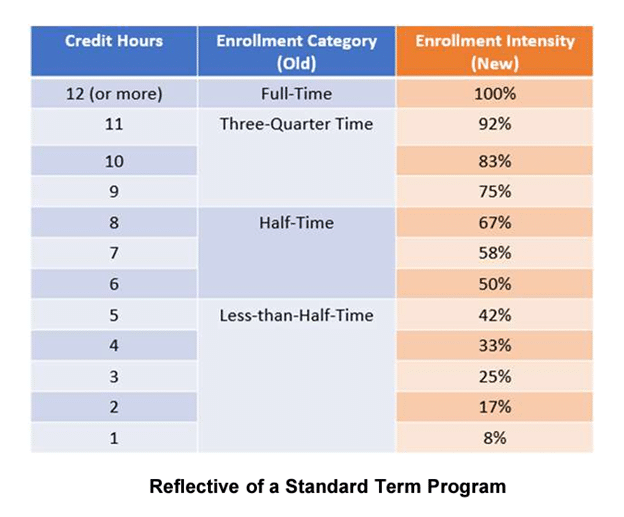
You can also use this Pell Grant Calculation Sheet to determine your Pell Grant Eligibility:
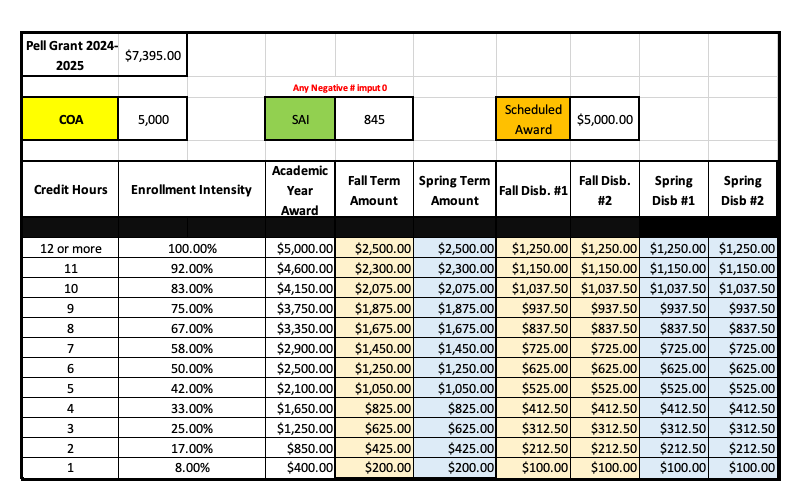
Download Pell Calculation Sheet (Excel)
More Information
- Financial Aid Census Date: The Financial Aid Census Date marks the end of the add/drop period for Financial Aid purposes. On these dates, the Financial Aid Office takes a "snapshot" of the student's active enrollment for the term. The number of actively attending units as of the Financial Aid Census Date will determine the amount of financial aid that is disbursed to you.
- A change in enrollment status during a semester may change or cancel your award. If you withdraw, your remaining financial aid award will be cancelled, and you may be responsible for paying back some of the funds you previously received.
- Withdrawing from school: Any student who receives financial aid and withdraws from ALL title IV eligible courses prior to completing 60% of the semester/program and/or courses may be required to repay a portion, or all financial aid received. CONTACT THE FINANCIAL AID OFFICE BEFORE WITHDRAWING FROM ANY COURSE.
- Satisfactory Academic Progress: By accepting financial aid, you have read and understood the Financial Aid Satisfactory Academic Progress policy, summarized as follows:
- Student is enrolled in an eligible program for the purpose of completing an AA/AS Degree or Certificate Program.
- Student will maintain a minimum cumulative grade point average (CGPA) of 2.0.
- Student will complete at least 67% of units attempted each semester, and 67% of their cumulative units attempted.
- Student must not have already completed 150% or more units of total college coursework required for the program the student is enrolled in. This unit total includes all repeated courses at Delta and all courses at other higher education institutions. NOTE: All courses will count towards a student’s financial aid eligibility. As soon as a course is passed with a grade “D” or better, students may only receive financial aid for one more repetition of the course.
- Overpayments: Students must repay any funds received in excess of the amount to which they are entitled; regardless of the reason they received those excess funds.
- Application of Financial Aid Disbursements: Financial Aid will be applied to student's tuition/enrollment fees first; any leftover funds will be disbursed to the student.
Financial Aid Withdrawal and Repayment Policy
Per federal/state regulations, schools must determine the amount of financial assistance a student earns if they withdraw from school. The Programs at San Joaquin Delta College covered by this law are:
- Federal Pell Grants
- Federal Supplemental Educational Opportunity Grants (FSEOGs)
- Direct Loans
- Cal Grants
Once a student withdraws from school, the student may owe money back or may be eligible for a post-withdrawal disbursement. Financial Aid will return any amount of unearned aid for both the Institutional Portion and Student Portion of the calculation.
*If you receive financial aid, contact the Financial Aid Office before withdrawing from any course.
Learn more:
Providing and delivering your financial aid is our top priority here at Delta College. Your choices in how you receive your money matters, so Delta College delivers your refund with BankMobile Disbursements, a technology solution, powered by BMTX, Inc. Visit this link for more information:
Additional Resources:
How to Receive Your Refund
San Joaquin Delta College delivers your refund with Bank Mobile Disbursements providing you with choices and offering great customer service.
The most common type of money we disburse to students are funds left over from financial aid awards, loans, or grants after tuition has been paid.
Students receiving these funds have usually requested this additional support to help them with books and living expenses.
If you don't receive financial aid, you still may receive money back from Delta in the future.
Going through this process now can ensure you'll receive any money owed to you by Delta in a timely manner.
Here's what you need to do to get started
- First, make sure your mailing address is up to date with your school.
- Look for an email from BankMobile containing your Personal Code to validate your identity. This code is needed to select how you will receive your refund money.
- The kit will include a Personal Code to validate your identity. This code is needed to select how you will receive your refund money.
- You will also receive a Personal Code by email which will be sent to the email address on record with your school.
- Next, go to refundselection.com and enter your Personal Code.
- Select how you would like to receive your money.
- After eight days, if you have not selected, look for a bright green envelope in the mail. This is your Refund Selection Kit. Please follow steps 3-6 once you receive this kit.
The choices you will see are
Deposit to an existing account: money is transferred to an existing account the same business day we receive the funds from your school. Typically, it takes 1 - 2 business days for the receiving bank to credit the money to your account.
Deposit to a Bank Mobile Vibe checking account: if you open a Bank Mobile Vibe checking account (upon identity verification), money is deposited the same business day we receive the funds from your school.
Disbursement Schedules
We make every effort to maintain the published disbursement schedule; however, it is subject to change.
Credit Balance Disbursements
Please be aware that schools have up to 14 days from the time your funding is applied to your student account to release your funds. Although we try to get these credit balances to students within 2-3 days after funds are applied to your account, we may experience some unforeseen circumstances that could hold up this process. Funding will ultimately be released by no later than the 14th day.
Degree Audit
All student courses are evaluated to determine if each course is applicable to the completion of a student’s program. Courses that are not part of a student’s program of choice, or any additional courses needed for transfer, are not courses that are covered with Federal financial aid. Other Financial Assistance may be used to cover these courses.
How to Check Your Financial Aid Status in MyDelta
When outstanding items have been added to your tasks, you will receive an email to your Delta College student email to log in and check.
After you submit the required documentation, the task status will change to "received" which means documentation was received and is being reviewed by Financial Aid specialists. Once they confirm they have everything they need for the task, it will change to "Completed" and be removed from your list.
If you need help with completing your tasks, please contact your financial aid specialist, stop by the Delta Connect Center, or reach out to Financial Aid and Scholarships.
California Residency
Education Code section 68075.6 grants an immediate nonresident tuition fee exemption to eligible Special Immigrant Visa (SIV) holders and refugee students who settled in California upon entering the United States. This exemption is granted for one year from the date the student settled in California upon entering the United States.
This exemption applies to the following:
Iraqi citizens or nationals (and their spouses and children) who were employed by or on behalf of the United States Government in Iraq (Pub.L. No. 110-181, § 1244)
Afghan and Iraq translators (and their spouses and children) who worked directly with the United States Armed Forces (Pub.L. No. 109-163, § 1059)
Afghanistan nationals who were employed by or on behalf of the U.S. government or in the International Security Assistance Force {ISAF} in Afghanistan (Pub.L. No. 111-8, § 602)
Refugee students admitted to the United States under Section 1157 of Title 8 of the United States Code.
These exemptions only apply to those who settled in California upon entering the United States. (Ed. Code, § 68075.6, subd. (b)(1).) Students who settled elsewhere in the United States, and then moved to California would not be eligible for this exemption and would be required to either establish residency or pay nonresident tuition. Under Education Code section 68122, T and U visa holders are also exempt from nonresident tuition by extension of Assembly Bill 343.
Assembly Bill 343 also states that the exemption for a student is only available for the maximum time it would take for the student to establish residency. (Ed. Code, § 68075.6, subd. (b)(1).) That time, and therefore any nonresident tuition exemption, will expire one year from the date the student settled in California upon entering the United States. (Ed. Code, § 68017.) Upon expiration of the nonresident tuition exemption, the student will either have established residency in California, or will have an intention to reside elsewhere, and be subject to nonresident tuition.
Students who believe they fit the above criteria may complete a Residency Reclassification Petition (Admissions & Records Forms site under "Admissions Forms") and submit copies of supporting documentation to the Admissions & Records Office to determine their eligibility for the above exemption waiver or California residency reclassification or non-resident classification.
Students under 19 years of age and unmarried derive California residency from their parents. The parents must meet the eligibility requirements and provide required documentation demonstrating physical presence in California and intent to make California their permanent residence. Students under 19 years of age who have been classified as a non-resident will need to complete a Residency Reclassification Petition (Admissions & Records Forms site under "Admissions Forms") and submit copies of supporting documentation to the Admissions & Records Office.
Students who have left California to attend an out of state College or University within the last 2 years will be required to show proof of retaining their California residency. Students who have been classified as a non-resident for attending an out of state College or University will be required to complete a Residency Reclassification Petition (Admissions & Records Forms site under "Admissions Forms") and submit all three of the following documents:
- Copy of your parent’s California Resident Tax Return (Form 540) indicating that you are being claimed as a dependent and, if applicable, your CA state income tax return for the prior tax year.
- Verification that you were or are attending college as a Non-Resident (For example: tuition bills or a letter from the Registrar stating what your categorization for tuition purposes is and what your permanent home of record is). Please note if the university/college is “private”, online, off-site campus located in California or correspondence/distance learning, you must provide a letter from the Admissions and Records Office verifying the permanent home of record you reported.
- Copy of your Valid California Driver’s License or Identification Card.
Active Duty Members (including spouse and dependent children) Stationed in California:
Students who are members of the armed forces of the United States domiciled or stationed in California on active duty are entitled to resident classification for purposes of determining the amount of tuition and fees for the duration of their attendance at a community college as long as they remain on active duty as of the residence determination date. (Service in the California National Guard does not constitute being a member of the armed forces of the United States for Education Code sections 68074 and 68075.)
Dependents of Active Duty Military Members EC 68074; T5 54041
A student who is a natural or adopted child, stepchild, or spouse and who is a dependent of a member of the armed forces of the United States domiciled or stationed in California on active duty is entitled to resident classification for the purposes of determining the amount of tuition and fees. There is no limitation on the length of the resident classification. If that member of the armed forces, whose dependent is in attendance at a community college, is thereafter transferred on military orders to a place outside this state where the member continues on active duty or is thereafter retired as an active member of the armed forces of the United States, the student dependent shall not lose his or her resident classification so long as he or she remains continuously enrolled at that community college.
Students who believe they fit the above criteria may complete a Residency Reclassification Petition (Admissions & Records Forms site under "Admissions Forms") and submit copies of supporting documentation to the Admissions & Records Office.
Requested supporting documentation consists of the following:
- Copy of Active Duty Stationing Orders
- Copy of Military ID and state ID or Driver’s License
Veterans or dependents of an eligible Veteran who meet the following requirements shall be exempt from paying nonresident tuition at San Joaquin Delta College. A “covered individual” for purposes of compliance with the VACA Act and Education Code Section 68075.7 is defined as:
A student who lives in California and uses education benefits under Chapter 30, 31, 33, or 35 is granted a waiver of non-resident tuition regardless of his/her formal State of residence. Under the provision of Isakson and Roe Veteran Health Care and Benefits Improvement Act of 2020, section 1005, the requirement for covered individuals to enroll in a course at a public institution of higher learning within three years of being discharged to receive in-state tuition is no longer required effective August 1, 2021.
- A covered individual is defined as:
- A veteran, or
- A spouse or dependent child using transferred benefits, or
- A spouse or dependent child of a person whose active-duty transferor dies, on or after September. 11, 2001, in the line of duty, or
- A spouse or dependent child using transferred benefits and the transferor is serving on active duty effective for courses, semesters, or terms beginning after July 1, 2017;
- Effective August 1, 2022, a spouse or dependent child using Chapter 35 Dependent Educational Assistance (DEA) will be eligible for in-state tuition rates.
Students who initially qualify under the applicable requirements above maintain "covered individual" status as long as they remain continuously enrolled.
Under this exemption, students are NOT eligible to receive a California College Promise Grant (Formerly BOG waiver). Students will still be classified as a non-resident but given an exemption from paying non-resident tuition.
How to apply for AB 13 (VACA) exemption
To apply for AB13 (VACA) California Nonresident Tuition Exemption for Eligible Veterans & Dependents you must:
- Complete and sign the AB13 (VACA) Affidavit form
- Attach all applicable documentation:Copy of DD214 Certificate of Release or Discharge from Active Duty.
- Certificate of Eligibility (COE) from VA confirming the approval of education benefits for student.
- Please submit to the Admissions and Records Service Window, DeRicco Building 1st floor in the Delta Connect Center or mail to:
San Joaquin Delta College
Admissions & Records Office - Residency
5151 Pacific Avenue, Box 102
Stockton, CA 95207
California Nonresident Tuition Exemption Form for Eligible Veterans & Dependents
California Education Code 68075.5 entitles a student who was a member of the Armed Forces of the United States stationed in California on active duty for more than one year prior to being discharged shall be exempt from paying nonresident tuition for the length of time he or she lives in this state after being discharged up to the minimum time necessary to become a resident. The one-year exemption shall be used while the student lives in this state and within two years of being discharged.
How to apply for this exemption:
- Please complete the Military Exemption Affidavit form, sign and attach a copy of your DD214 Certificate of Release.
- Please submit to the Admissions and Records Service Window, DeRicco Building 1st floor in the Delta Connect Center or mail to:
San Joaquin Delta College
Admissions & Records-Residency
5151 Pacific Avenue, Box 102
Stockton, CA 95207
Financial Aid Workshops
Join us at our workshop to make sure you are all set to receive your financial aid. We will cover how to set up your disbursement preference with BankMobile Disbursements, a technology solution, powered by BMTX, Inc., how to complete your verification documents, and how to check your financial aid status on your new MyDelta portal. See you there!
Do you have financial aid questions? Are you receiving your financial aid for the current semester? Do you wish you had access to a Financial Aid expert to answer all your financial aid questions? Are you stressed out with your financial aid file and need help? Visit us in the DeRicco Building to meet with a Financial Aid specialist and get all your financial aid needs met!
We will be in the quad outside of Danner Hall to answer all your financial literacy questions. Learn about topics like budgeting, debt, how to use your financial aid refund wisely, and more!
Do you wish you had more money every month? Do you know everything you need to know about banking? Join us to learn how to save money every month by budgeting effectively, and everything you need to know about banking!
Are you a Dream Act student? Do you have questions about how to apply or what type of financial aid is available to you? Join us to learn about the California Dream Act Application and how financial aid can help you afford college.
Don't miss out on free money for college! Join us and learn why it's so important to complete the FAFSA every year. You could be missing out on free money and not know it!
Delta College students must meet Financial Aid's Satisfactory Academic Progress (SAP) Policy to be eligible to receive their financial aid every semester. Join us to learn everything you need to know about SAP to maintain your financial aid eligibility!
Cash for College Workshops give students and their families an opportunity to receive assistance in completing the Free Application for Federal Student Aid (FAFSA), OR California Dream Act Application. During the event, staff is on site to provide one-on-one assistance and answer questions. The workshop is open to the public, current delta college students, high school seniors and parents. Walk-ins welcome!
What to Bring to the Cash For College Workshop
If you don’t have all of these documents, it’s OK! Please come to the workshop with whichever of the following documents you do have:
- Driver's license
- Social Security Card or Number (if applicable)
- Alien registration number, if you are not a U.S. citizen
- Student income information from the tax year
- Parent income information from the tax year (if dependent)
- Student taxes and parents' tax information; previous year taxes are OK
- Any records of untaxed income such as welfare benefits, social security benefits, or child support payment
Meet with a Financial Aid expert, so we can look into your file and explain what you need to complete your financial aid file and receive your disbursement. If you haven’t completed your FAFSA yet, learn how to apply for financial aid so you can receive any financial aid that you might be eligible for.
OWE Program
No, OWE does not assist students with finding jobs. You must already be employed, either paid or unpaid, in order to apply for OWE. However, you may want to check out Delta College’s Workforce Development Center for help in job postings, resume writing, and interview tutoring.
Most jobs qualify for OWE whether paid or unpaid/volunteer and you must be enrolled in a course related to your employment. This class can be taken concurrently or have been taken in the previous semester. Please refer to the OWE Program Areas to make sure we offer OWE in your field of employment.
Yes. Unpaid/volunteer work qualifies for OWE as long as you can substantiate the required work hours for the units you request.
No. You must have a work supervisor to participate in this program.
Yes. Once your application has been accepted, a Delta College instructor will be assigned to oversee your progress during the program. The instructor will contact you early in the program to review your Student Learning Objectives (SLOs) and assist you in modifying them as needed. Your OWE instructor will also contact your employer during the semester to check on your learning objectives progress.
Your work supervisor is required to do the following:
- Review, approve, and sign all of your OWE reports prior to submission.
- Meet (via phone or Zoom) with your OWE instructor to review your SLO progress.
Yes. You are required to submit five reports during the course of the semester as follows:
- Student Learning Objectives (SLOs)
- SLO Report #1
- SLO Report #2
- SLO Report #3
- Employer Evaluation
These reports are usually due one month apart by a specific date and time. In order to receive a PASS for this course, you must submit all reports on time, which also need to be signed by your work supervisor.
OWE can benefit students who want to enhance their job skills by setting goals (learning objectives) and reporting on those goals with measurable results. Developing job skills can lead to such things as promotion, salary increase, job satisfaction, and personal satisfaction just to name a few.
Yes. OWE units count toward full-time academic status.
You are allowed to apply for 1 to 4 OWE units per semester, with a maximum of 16 units for the program.
The OWE program is not limited by semester but by the number of units taken in a semester or by total number of units for the program.
No. Your related class can be taken concurrently or have been taken in the previous semester.
OWE units cost the same as all other Delta College units. Please refer to “Admissions, Tuition & Fees” for current unit cost.
No. Grading of OWE courses is generally Pass/No Pass. Since there are no points associated with the grading, it does not affect your GPA.
ONLY if Work Experience is a required course on the Degree or Certificate.
Units covered under internships related to certain OWE Program Areas are transferrable to the CSU system. Otherwise, you need to contact your school of interest to see if they accept Delta’s OWE units.
No. You may not reduce/increase the number of units originally requested since the OWE course code you are assigned is specifically linked to the number of units you request on your application.
You will receive a No Pass grade if your hours are not completed by the end of the semester. Please check with your employer before applying for this program to confirm that you will be able to work the hours required for the units you request.
You must notify the Workforce Development Center immediately.
No. If there is a hold in your MyDelta due to unpaid fees or registration issues, you must first clear these issues before you can apply for OWE.
Placement Guides
Updated: May 23, 2025
This chart illustrates how you may qualify for transfer-level and degree applicable English composition. Please consult with a counselor to determine the appropriate course for your educational goal.
| Enrollment Requirements | Delta College Course Work |
|---|---|
| Open to All Student (no requirements) |
|
| Cumulative high school GPA > 2.6 OR successfully completed ESL 59 |
|
Notes:
- All students have the right to enroll in transfer-level English composition (Title 5, Section 55522).
- If students previously had an Individualized Education Plan (IEP), they should see a Disability Support Programs and Services counselor to discuss their enrollment options.
Updated: May 23, 2025
ESL courses are designed for English Language Learners. Fluent English speakers with a U.S. high school GPA should directly take ENGL C1000 or ENGL C1000E. Fluent English speakers without a U.S. high school GPA should consult with a counselor.
This chart illustrates how ESL students may qualify for transfer-level and degree applicable English composition. ESL students should consult with a counselor, contact the Communication and Languages TrAC Resource Specialist(s), or refer to the chart below, to determine the appropriate course for their educational goal. If students feel that they need English language support, they should complete the ESL Guided Self-Placement.
| Enrollment Requirements | Delta College Course Work |
|---|---|
| English Language Learners needing English language Support | Complete ESL Guided Self-Placement to determine which ENG or ESL course you should take |
| No English language support needed |
|
Notes:
- All students have the right to enroll transfer-level English composition (Title 5, Section 55522).
- Students who are non-native English speakers may take ESL courses before completing ENG C1000.
- Students must provide U.S. cumulative high school GPA. Non-U.S. high school GPA may not be used for placement purposes.
ESL Course Sequence
ESL students and international students interested in taking ESL courses will take the ESL Guided Self-Placement to determine the appropriate course placement.
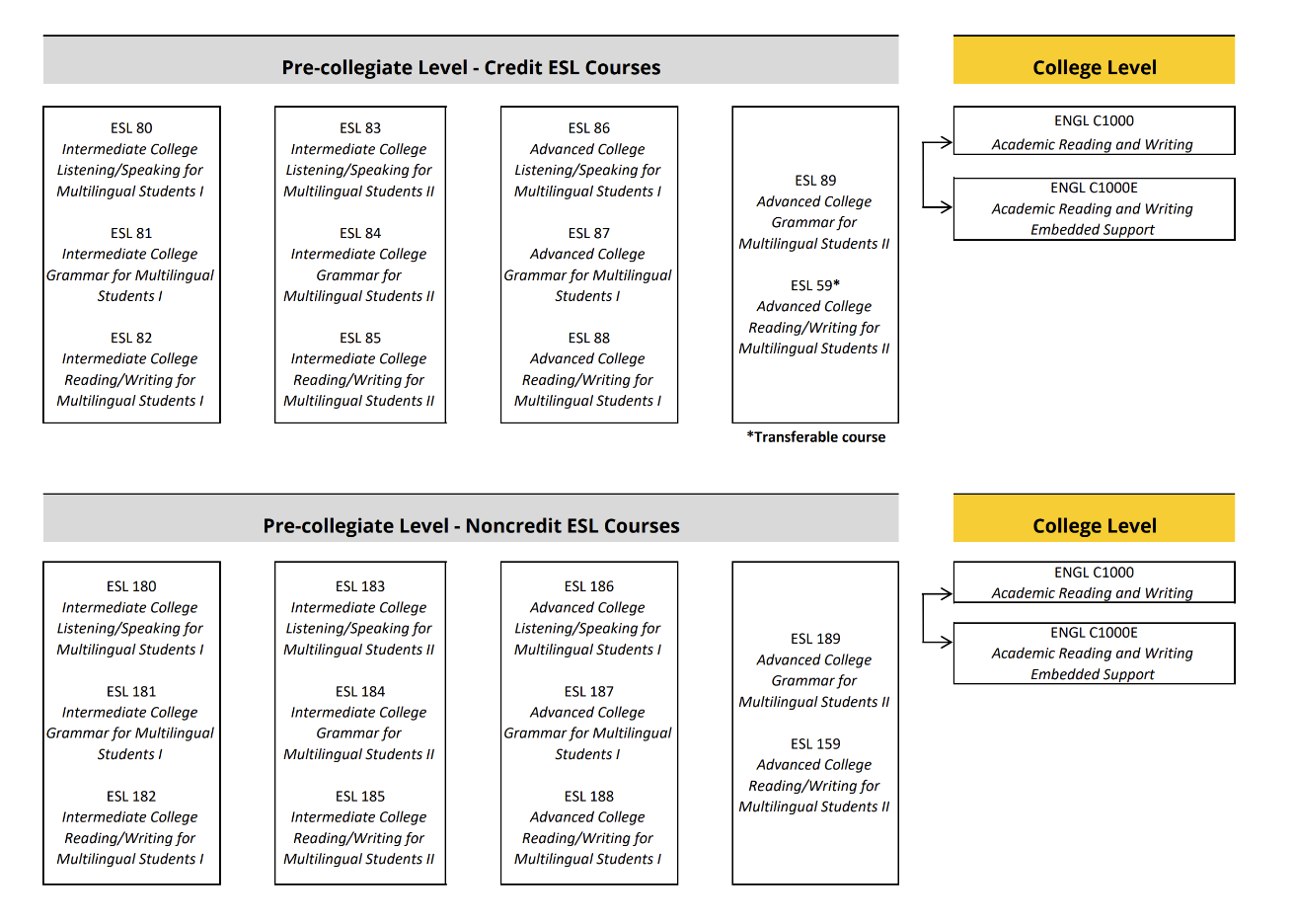
Updated: May 23, 2025
Math courses at Delta College are split into two broad categories, non-STEM courses and STEM courses. STEM stands for Science, Technology, Engineering, and Mathematics. If a student's educational and career goals fall into one of those areas, they probably need to take STEM math courses. If their educational and career goals fall into other areas, then they probably need to take at least one Non-STEM math course. The chart below gives examples of some Delta College majors that typically fall into each math pathway*.
All students should develop a personalized educational plan with a counselor to ensure they are taking the best courses to meet their goals.
| Non-STEM Majors | STEM Majors |
|---|---|
|
|
*Business and Health Science majors may need either the STEM or non-STEM track depending on their emphasis and degree goals. Students in these areas should meet with a counselor before enrolling in a math course.
Based on students’ educational goal, they should select one of the mathematics placement charts below to determine how they may qualify for transfer-level and/or associate degree applicable mathematics courses.
Notes about Your Placement:
All students have the right to enroll in transfer-level math (Title 5, Section 55522).
No students are required to repeat coursework that they have successfully completed in high school or college or take coursework that repeats competencies that the student has demonstrated through other methods of credit for prior learning. However, students should consult with a counselor if pursuing a degree that requires college units for Math 1.
Students are required to have successfully completed high school intermediate Algebra/Algebra II, Integrated Math III, or college-level Intermediate Algebra before enrolling in any transfer-level business/STEM math courses with the exception of MATH 37, MATH 37EX, or MATH 38A with MATH 71. Students who have not completed high school Intermediate Algebra/Algebra II, Integrated Math III, or college-level Intermediate Algebra may submit a Matriculation Petition to the Admissions and Records Office.
If students previously had an Individualized Education Plan (IEP), they should see a Disability Support Programs and Services counselor to discuss their enrollment options.
Updated: Sept. 22, 2025
This chart illustrates how you may qualify for transfer-level and/or associate degree applicable statistics and liberal arts math. Please consult with a counselor or see the Mathematics Entry Chart above to determine the appropriate course for your educational goal.
| Enrollment Requirements | Courses with Corequisite Support* | Courses without Corequisite Support |
|---|---|---|
| Open to All Student (no requirements) |
|
|
| Open to students who have a cumulative high school GPA > 3.0 |
|
|
*Courses with Corequisite Support include additional time to review prerequisite skills necessary for success and to provide extra instruction and practice with course concepts.
**BUS 67, MATH 14, and MATH 17A will only satisfy Associate Degree General Education Area 2, Mathetical Concepts and Quantitative Reasoning. These courses will not satisfy Cal-GETC Area 2, Mathematical Concepts and Quantitative Reasoning
Updated: May 23, 2025
This chart illustrates how you may qualify for transfer-level and/or associate degree applicable business/STEM math. Please consult with a counselor or see the Mathematics Entry Chart above to determine the appropriate course for your educational goal.
| Enrollment Requirements | Courses WITH Corequisite Support* | Courses WITHOUT Corequisite Support |
|---|---|---|
| Open to All Student (no requirements) |
|
|
| Open to students who have successfully completed high school intermediate algebra (or equivalent) |
| |
Open to students who have successfully completed high school Precalculus (or equivalent) MATH 15EX, MATH 39, OR any combination of MATH 38A/MATH 38AEX and MATH 38B/MATH 38BEX
|
|
|
| Open to students who have successfully completed high school Calculus (or equivalent) OR MATH 1 |
|
|
Courses with Corequisite Support include additional time to review prerequisite skills necessary for success and to provide extra instruction and practice with course concepts.
Financial Aid Specialists
You don't have to be a full-time student to receive financial aid:
- Full-Time: 12 or more units - You will receive 100% of your financial aid.
- Three-Quarter-Time: 9 to 11.5 units - You will receive 75% of your financial aid.
- Half-Time: 6 - 8.5 units - You will receive 50% of your financial aid.
- Less-Than-Half Time: 0.5 - 5.5 units - You will receive 25% of your financial aid if eligible.
Please Note: Your enrollment (the number of units you are enrolled in) is checked by our automated system each time a disbursement is made. Your disbursement will be adjusted as you drop or add units.
The Free Application for Federal Student Aid (FAFSA) is a federal application and the primary means of applying for financial aid at colleges and universities in the United States. It is completed by students each year they want to be considered for financial aid. Applications are available every October for the upcoming academic year.
Many colleges use the FAFSA to award federal aid like:
- Pell Grants
- Federal Work-Study
- Federal SEOG
- Direct Student Loans, etc.
California also uses information found on the FAFSA to award state grants like Cal Grant.
To begin the application process for grants, loans and work-study, your first step is to complete a Free Application for Federal Student Aid (FAFSA).
The easiest (and most secure) way to update your FAFSA is to do it online.
- Go to Free Application for Federal Student Aid (FAFSA)
- Enter your login information using your FSA ID.
- Select "Make FAFSA Corrections" and navigate to the section where you've listed your colleges.
- Add Delta College as one of your schools - school code 001280.
If you feel you need additional assistance, come to Delta College and receive help in our DeRicco Student Services center. We'd be more than happy to help you complete your FAFSA and answer any questions.
You can also call the Federal Student Aid at 1-800-433-3243 for more help. Please keep in mind you may need to have your Student Aid Report (SAR) on hand if you do.
If you listed Delta College on your FAFSA, we will receive your information electronically about 2 weeks from the date you completed your online application. (Note: Paper FAFSA submissions to the FSA will take longer.)
Once your FAFSA is received, an e-mail will be sent to your Delta College email account, to login to your MyDelta student portal and check your Financial Aid tile. From here, you will be able to check your financial aid status and find your Financial Aid Specialist, who will serve as one your main point of contact.
If you find you do not see any Financial Aid information in your MyDelta Portal, it's likely that the College hasn't received your FAFSA yet. Feel free to call (209) 954-5115 to check.
You can find your Specialist's contact information in your MyDelta Portal under tasks.
- Login to MyDelta
- From your homepage, click on Tasks.
- From the To-Do list, click on Your Financial Aid Specialist.
- A modal will open with the name and contact information for your Financial Aid Specialist at Delta College.
You don't have to come from a low-income family to qualify for financial aid. Showing sufficient evidence that you'll need help with the costs of attending college is sometimes enough to qualify for some type of aid. Assume you are eligible and complete a FAFSA today!
Most financial aid offered at Delta College (or any other public college) is money that doesn't have to be repaid. Grants, part-time employment and scholarships make up 90% of the approximately $30 million annual aid received by Delta students. Only a small percentage of students take out student loans. If you apply early, chances are that all or most of your financial need can be met with aid that doesn't need to be repaid.
We understand that filling out your FAFSA can be a daunting process. As a result, we have a number of options to help students complete their FAFSAs.
- Visit us at our DeRicco E-Services Lab
- Email us at financialaid@deltacollege.edu with your questions
- Call us at (209) 954-5115
- Attend one of our available workshops. For dates, click financial aid workshops.
You can get your transcripts immediately online! Go to IRS.gov and use the Get Transcript Tool.
Other options to get request your tax transcripts include:
- Order by Phone: 800-908-9946
- Order by Mail or Fax: Complete Form 4506T-EZ, Short Form Request for Individual Tax Return Transcript
- For more information, visit the IRS Get Transcript FAQ.
For general questions, you can reach us at financialaid@deltacollege.edu. Or, if you already know who your Financial Aid Specialist is, you can to our go Contact Us page to contact them.
It's true, many students do apply for financial aid during the course of a school year. To make sure you receive the best possible consideration, we encourage our students to apply as early as the FAFSA application becomes available on October 1st. Not only will this give you the best opportunity to receive financial aid, it will also allow you more time to have your financial aid file fully completed before you begin attending classes.
For Cal Grants, we urge our students to complete their application by March 2nd for the best possible chance to receive Cal Grant consideration. (Tip: You'll be considered for Cal Grants as soon as you submit your FAFSA.)
For other Delta College aid like Federal SEOG or Federal Work Study, funds for these awards are extremely limited so completion of your entire financial aid file is highly encouraged. We generally recommend that your financial aid file is completed by early Spring to guarantee the best possible funding for the following academic year.
A completed financial aid file means:
- A valid FAFSA which has been submitted to Delta College by the FSA (Federal Student Aid)/Department of Education
- All required supporting documents requested via the Delta College online Financial Aid system
Students with a G.E.D. or other high school proficiency certificate should still apply for financial aid.
Students without a high school diploma, GED, or equivalent, can still qualify for financial aid in the form of a California College Promise Grant.
High School Graduates: If the potential student has graduated from high school, they must provide one of the following documents indicating their high school completion
- The student's original high school diploma
- The student's final, official high school transcript that clearly shows the date when the diploma was awarded
- The student's original General Educational Development (GED) certificate or GED transcript
- The student's original academic transcript that indicates the student successfully completed at least a two-year program that is acceptable for full credit toward a bachelor's degree
- California state law does not require a homeschooled student to obtain a secondary school completion credential for homeschool (other than a high school diploma or its recognized equivalent). An original transcript or the equivalent - signed by the student's parent or guardian - shall be submitted. The transcript will list the secondary school courses the student completed and will document the successful completion of a secondary school education in a homeschool setting. Validity of the transcript will be determined by the Financial Aid office.
You're not alone. Help is available!
- In-Person: Delta Connect Center
- Phone: (209)954-5115
- Email: finaid@deltacollege.edu
Financial Aid processing could easily take up to 4 weeks from the time your financial aid file is fully completed to actual disbursement of your funds.
As a result, Delta College is committed to giving you as many possible solutions as we can to help you succeed as one of our students:
- Book Advance Voucher: If you've been informed that you'll be receiving financial aid, you may qualify for the Book Advance program. For more information, go for a full overview or check with your Financial Aid Specialist today!
- Textbook Rental: You may be able to rent textbooks, which may cost significantly less than actually buying your textbooks for your classes.
- Library Reference Desk: Check with your instructor to find out if a class textbook is located at the Library Reference Desk. If yes, you may even be able to use the textbook there.
Satisfactory Academic Progress (or 'SAP' for short) is a set of academic guidelines which every student receiving (or wants to receive) financial aid must adhere to. Three primary guidelines make up the groundwork of an SAP policy:
- GPA
- Progression Rate
- Maximum Time Frame
These guidelines are set in place by both the Department of Education and Delta College in order to ensure that:
- Our students actively monitor their academic progress while they're enrolled so they may achieve their educational goals on time, and
- All federal financial aid monies are disbursed responsibly
Every post-secondary school that participates in disbursing federal financial aid (Title IV aid) has an SAP policy.
You can find your Financial Aid Academic History under the registration portal.
If you find yourself disqualified from receiving financial aid because you did not meet Satisfactory Academic Progress (SAP), and believe you have extenuating circumstances which prevented you from meeting Progress, you may file a Financial Aid appeal.
Note that submitting an appeal does not guarantee financial aid eligibility.
Grants - Federal
A Federal Pell Grant is provided by the U.S. Department of Education to undergraduate students who have not earned a bachelor's or professional degree yet. (In rare cases, students enrolled in a post-baccalaureate teacher certificate program may also qualify for a Pell Grant.)
Unlike loans, a Pell Grant does not have to be repaid except under certain circumstances. Your eligibility and the amount you'll receive is based on: Your financial need The calculated cost of attendance Your current course load (whether you're going to school full-time or part-time)
The amount of the award varies every academic year and you cannot receive a Federal Pell Grant award from more than one school at a time.
A student can receive Federal Pell Grant for no more than six award years (also known as 600%).
Federal Supplemental Educational Opportunity Grants (FSEOG) are awarded to undergraduate students in exceptional need of financial aid. Funds for the grant are extremely limited and will only be awarded on a first-come-first-served basis. Pell Grant recipients also take priority.
Grants - Student Success Completion Grant
Senate Bill 840, the 2018 Budget Act education trailer bill, was signed by the Governor on June 15, 2018, and included language initiating a new grant program for Community College students, the Student Success Completion Grant (SSCG). The program consolidated the Full Time Student Success Grant (FTSSG) and the Community College Completion Grant (CCCG). The new SSCG program came with $131 million to augment students receiving a Cal Grant B or C who are enrolled in at least 12 units per term.
The Legislature and Governor sought to simplify and streamline the administration of the program to better serve the needs and interests of full-time students completing their education goals. When implementing the amended provisions, colleges are reminded to honor the intent of this legislation. Amendments include:
- No requirement to monitor a complicated multi-year student education plan
- No specific rules for additional required coursework
- Allows for change of majors and prerequisites
- Simplifies progress made by aligning new program with federal SAP
The intent of the Student Success Completion Grant program (SSCG) is to support student persistence, retention and success by providing full-time and greater than full-time students additional assistance to help them complete their programs timely and to offset the total cost of attending community college.
To be eligible to receive SSCG, students must:
- Be enrolled at least full-time
- Receive a Cal Grant B or C award
- Be in compliance with the federal SAP policy
- Be a California resident or exempt from paying nonresident tuition
- First we pay all eligible Fall and Spring term students that are actively attending courses in alignment with the same enrollment status determined for Cal Grant eligibility. This means the amount disbursed to a student is based on courses actively attending at the time of institutional census.
- If a student is attending 12-plus units per semester term, they receive half the award year-based amount of the SSCG or the quarter equivalent (see tables above).
- After awarding all eligible students during Fall and Spring, a community college may grant additional summer awards to students who take a sufficient number of units during the summer term to bring their total number of academic units to 24 units or more for the academic year.
- After awarding all eligible students for the Summer term, a community college may grant additional awards to students who take a sufficient number of units of 30 units or more for the academic year
Grants - California College Promise Grant
The California College Promise Grant (CCPG), formerly known as the Board of Governors Enrollment Fee Waiver (BOGW), waives enrollment fees for qualified students for the entire school year. Students may receive a waiver for any number of units, with no minimum. You may qualify if you have some financial need, receive Temporary Assistance to Needy Families (AFDC/TANF), Supplemental Security Income/SSP or General Assistance and those who meet certain income standards.
The CCPG ONLY waives ENROLLMENT FEES ($46 per unit). You are responsible to pay any fees not covered by your award at the time of registration to avoid being dropped for non-payment.
The CCPG is awarded through Financial Aid.
Academic - Sustain a GPA of 2.0 or higher
If your cumulative GPA falls below 2.0 for two consecutive primary terms (fall/spring semesters, or fall/winter/spring quarters), you may lose your eligibility.
Progress - Complete more than 50% of your coursework
If the cumulative number of units you complete is not more than 50% in two consecutive primary terms (fall/spring semesters, or fall/winter/spring quarters), you may lose your eligibility.
Combination of Academic and Progress Standards
Any combination of two consecutive terms of cumulative GPA below 2.0, and/or cumulative unit completion of not more than 50% may result in loss of California College Promise Grant eligibility.
How will I know?
You'll be notified within 30 days of the end of each term if you are being placed on either Academic (GPA) and/or Progress (Course Completion) probation. Your notification will include the information that a second term of probation will result in loss of fee waiver eligibility. After the second consecutive term of probation, you may lose eligibility for the fee waiver at your next registration opportunity.
How to regain eligibility?
If you lose eligibility for the California College Promise Grant, there are a few ways that you can have it reinstated:
- Improve your GPA or course completion measures to meet the academic and progress standards
- Successful appeal regarding extenuating circumstances
- Not attending your school district for two consecutive primary terms (fall/spring semesters, or fall/winter/spring quarters)
The appeals process for extenuating circumstances includes:
- Verified accidents, illness or other circumstances beyond your control
- Changes in economic situation
- Evidence of inability to obtain essential support services
- Special consideration factors for CalWORKs, EOPS, AAC and veteran students
- Disability accommodations not received in a timely manner
Download the Loss of Enrollment Priority and/or California College Promise Grant (BOGW Fee Waiver) Appeal
Please note that foster youth and former foster youth (age 24 years and younger) are not subject to loss of the California College Promise Grant (BOG Fee Waiver) under these regulations. If you have questions or need assistance, please contact the financial aid office or the admissions and records office.
- Be a California resident, or have an AB540 status as determined by the Admissions Office and
- Meet the annual qualifying income standards for one of the methods below.
How do I Apply?
Complete the application and submit it to the Financial Aid Office.
Application | Application Valid for Terms | Application Deadline |
|---|---|---|
| 2024-2025 California College Promise Grant (ONLINE Application) | Fall 2024, Winter 2025, Spring 2025, Summer 2025 | Last day of Summer 2025 |
| 2024-2025 California College Promise Grant (PAPER APPLICATION - ENGLISH) coming soon! | Fall 2024, Winter 2025, Spring 2025, Summer 2025 | Last day of Summer 2025 |
We will let you know if you qualify for an automatic California College Promise Grant on your Award Notification. Even if you do NOT qualify using the simple method, you should file a FAFSA. Many students do not qualify for a Method A or Method B or Method D, but will qualify for a Method C California College Promise Grant (BOGW) and additional financial aid funds by completing the FAFSA. If you are an undocumented student, you can complete the California Dream Act Application instead of the FAFSA. The Dream Application will gather information about your family's income and assets and will issue you and your college information that will help determine eligibility for the California College Promise Grant.
Method A
You, or your parents if applicable, must be currently receiving benefits from CalWORKs, TANF, Supplemental Security Income (SSI)/SSP, or General Relief. Bring verification of your benefits, dated within the last 60 days, to the Financial Aid Office.
Method B
You, or your parents if applicable, must meet the following income standards for the school year. Your income must be equal to or less than the amount indicated based upon your family household size, as indicated in the table below. In addition, students with a Student Aid Index (SAI) less than or equal to zero meet the financial eligibility for Method "B".
Method C
You must have already applied for and been determined to have at least $1104 of financial need by filing a FAFSA or the California Dream Application. No California College Promise (BOGW) application is required for a Method "C".
Method D
At the time of enrollment, you must be a homeless youth as defined in the federal McKinney-Vento Homeless Assistance Act and you must be under 25 years of age.
Enrollment Fees
The California College Promise Grant ONLY waives ENROLLMENT FEES ($46 per unit). You are responsible to pay any fees not covered by your award at the time of registration to avoid being dropped for non-payment.
Parking
The California College Promise Grant reduces the cost of the PARKING PERMIT down to a maximum of $30.00 per term for Method B or Method C or Method D eligible students. The cost of the PARKING PERMIT is waived for Method A students.
The following table is a sample of student fees for the 2024-2025 award year that a California College Promise Grant Method B or Method C or Method D fee waiver recipient enrolled Full-Time (12.0 units) may have for a fall or spring term.
View the current annual cost of attendance.
| Fee Type for Method B/C/D | Fee Amount | Total | Amount Due |
|---|---|---|---|
| Enrollment Fee | $46 per unit | $552 | Waived |
| Student Health Fee | $26 per term | $26 | You Must Pay |
| Student Representative Fee | $2 per term | $2 | You Must Pay |
| Student Activity Fee | $10 per term | $10 | You Must Pay |
| Parking Permit | $30 per term | $30 | Must Pay to Park |
| Balance Due | $68 |
*Students receiving a Method A Fee Waiver will have the Student Health, Student Center, Student Representative and Parking Permit fees waived. Method A students must pay a $15 Student Support Fee at the time of registration.
2026-2027 California College Promise Grant Income Standards
| Number in Family Household | Base Year Family Income |
|---|---|
| 1 Family Member | $23,475 |
| 2 Family Members | $31,725 |
| 3 Family Members | $39,975 |
| 4 Family Members | $48,225 |
| 5 Family Members | $56,475 |
| 6 Family Members | $64,725 |
| 7 Family Members | $72,975 |
| 8 Family Members | $81,225 |
| Each Additional Family Member | $8,250 |
Loans - Direct Loans Information
The interest rate for a federal student loan varies depending on
- The loan type and
- The first disbursement date of the loan (for most types of federal student loans).
The table below provides interest rates for Direct Subsidized Loans, Direct Unsubsidized Loans, and Direct PLUS Loans first disbursed on or after July 1, 2026, and before July 1, 2027.
Perkins Loans (regardless of the first disbursement date) have a fixed interest rate of 5%.
| Loan Type | Borrower Type | Fixed Interest Rate |
|---|---|---|
| Direct Subsidized Loans and Direct Unsubsidized Loans | Undergraduate | 6.52% |
| Direct Unsubsidized Loans | Graduate or Professional | 8.07% |
| Direct PLUS Loans | Parents and Graduate or Professional Students | 8.94% |
All interest rates shown in the chart above are fixed rates. A fixed rate will not change for the life of the loan.
If your loan was disbursed before July 1, 2026, you likely have a different interest rate.
Interest is additional money that you pay to a lender as a cost of borrowing money. Interest is calculated as a percentage of the unpaid principal amount that you borrowed.
Direct Loans are “daily interest” loans. On daily interest loans, interest accrues (adds up) every day.
If your loans are subsidized, you are not responsible for paying the interest that accrues while you’re in school. If your loans are unsubsidized, you’re responsible for all the interest that accrues, even while you’re in school. Learn about the differences between subsidized and unsubsidized loans.
A daily interest formula determines the amount of interest that accrues (adds up) on your loan each day. This formula consists of multiplying your loan balance by the number of days since you made your last payment and multiplying that result by the interest rate factor.
Simple daily interest formula:
Interest Amount = (Outstanding Principal Balance x Interest Rate Factor) x Number of Days Since Last Payment
What is the interest rate factor?
The interest rate factor is used to calculate the amount of interest that accrues on your loan. You can find your interest rate factor by dividing your loan's interest rate by the number of days in the year.
It’s your responsibility to pay any interest that accrues (adds up) on your loan(s). And, in some cases, unpaid interest can capitalize (be added to your principal balance).
On a traditional repayment plan (Standard, Graduated, or Extended), your monthly loan payment covers all the interest that accrues between monthly payments. So no additional unpaid interest will accrue while you're making payments on one of these plans.
But unpaid interest can add up in some situations, such as if you’re on an income-driven repayment (IDR) plan or if you’re not making payments.
When does unpaid interest accrue (add up)?
On Income-Driven Repayment (IDR) Plans
Unpaid interest may accrue if you’re repaying your loans under an IDR plan. Under an IDR plan, your monthly loan payment can sometimes be less than the amount of interest that accrues between your payments. In this case, your payment won’t cover all of your interest, so an amount of unpaid interest will add up each month. This unpaid interest will still be your responsibility to pay until your loan is forgiven (or paid in full).
During Forbearance
You don’t have to make monthly payments during periods of forbearance. But interest continues to accrue during periods of forbearance.
During Deferment for Unsubsidized Loans
You don’t have to make monthly payments during periods of deferment. But if you have an unsubsidized loan, interest continues to accrue during periods of deferment.
During School and Grace Periods for Unsubsidized Loans
You’re not required to make monthly payments while you’re in school at least half-time or during your grace period. But if you have an unsubsidized loan, interest continues to accrue while you're in school and during the grace period.
What happens when interest capitalizes?
When your unpaid interest capitalizes, it increases the outstanding principal amount due on your loan. Then your interest is recalculated based on that higher principal balance, increasing the overall cost of your loan. And depending on your repayment plan, capitalization may also cause your monthly payment amount to increase.
When does unpaid interest capitalize?
Unpaid interest on Direct Loans and Federal Family Education Loan (FFEL) Program loans managed by the U.S. Department of Education (ED) capitalizes
- After a deferment on an unsubsidized loan; or
- If you are repaying your loans under the income-based repayment (IBR) plan and no longer qualify to make payments based on income or leave the IBR plan.
Unpaid interest on FFEL Program loans not managed by ED may capitalize
- After a deferment on an unsubsidized loan;
- After a forbearance on any type of loan;
- After the grace period on an unsubsidized loan; or
- If you are repaying your loans under the income-based repayment (IBR) plan and no longer qualify to make payments based on income or leave the IBR plan.
Example of What Happens When Interest Capitalizes
Say you have a $10,000 Direct Unsubsidized Loan with a 6.8% interest rate. On this loan, the amount of interest that accrues (adds up) each day is $1.86 (find out how interest is calculated).
In this example, you’re in a deferment for six months. During the deferment, you do not pay off the interest as it accrues. In this case, the loan will accrue $340 of unpaid interest. At the end of the deferment, the accrued interest of $340 will capitalize (be added to your principal balance).
You’ll then be charged interest on the higher principal balance of $10,340. Based on this increased principal balance, the amount of interest that accrues each day will also increase (to $1.93 per day). This will result in you paying more over the course of repaying your loan balance.
Interest rates on federal student loans are set by federal law, not the U.S. Department of Education.
No payment you make will go toward any of your loan principal until you’ve paid all your unpaid interest.
Follow these steps to see how much of your payment will go toward your principal balance.
- Use the interest calculation formula explained above to determine how much interest has accrued (added up) since your last payment.
- Subtract the amount of accrued interest from your monthly payment and any other outstanding interest.
- See the number that’s left. This number is how much of your payment will be applied to your outstanding principal balance. This amount may continue to be $0 until all outstanding interest has been paid.
Example of Paying Interest and Principal
Say you have a $10,000 Direct Unsubsidized Loan with a 6.8% interest rate. The amount of interest that accrues (adds up) per day is $1.86.
Let’s assume you’re repaying your loan under the Standard Repayment Plan. In this repayment plan, your monthly payment would be $115.
It has been 30 days since your last payment, and there was no other interest outstanding when you made your last payment. In this case, $55.80 in interest will have accrued.
Subtracting this amount from $115 results in a total of $59.20. So $59.20 would be applied to your outstanding principal balance of $10,000.
Under any income-driven repayment plan, your monthly payment amount may sometimes be less than the amount of interest that accrues on your loans. This is called negative amortization.
Learn what happens to your unpaid interest.
Contact your loan servicer if you have more questions about how your payment is applied to your principal balance.
Most federal student loans have loan fees. These fees are a percentage of the total loan amount.
A loan fee comes out of the amount of money that is disbursed (paid out) to you while you’re in school. This means the money you receive will be less than the amount you actually borrow.
You’re responsible for repaying the entire amount you borrowed and not just the amount you received.
The chart below shows the loan fees for Direct Subsidized Loans, Direct Unsubsidized Loans, and Direct PLUS Loans first disbursed on or after Oct. 1, 2019.
Loan Fees for Direct Subsidized Loans and Direct Unsubsidized Loans
| First Disbursement Date | Loan Fee |
|---|---|
| On or after 10/1/2020 and before 10/1/2027 | 1.057% |
| On or after 10/1/2019 and before 10/1/2027 | 1.059% |
Loan Fees for Direct PLUS Loans
| First Disbursement Date | Loan Fee |
|---|---|
| On or after 10/1/2020 and before 10/1/2027 | 4.228% |
| On or after 10/1/2019 and before 10/1/2027 | 4.236% |
Note: Loans first disbursed prior to Oct. 1, 2019, have different loan fees.
Previous Years’ Interest Rates
For most loans, the interest rate depends on the year it was first disbursed.
Perkins Loans (regardless of the first disbursement date) have a fixed interest rate of 5%.
Interest Rates for Loans Disbursed July 1, 2006–July 1, 2023
The following table provides interest rates for Direct Loans and Federal Family Education Loan (FFEL) Program loans* first disbursed on or after July 1, 2006, and before July 1, 2023.
Fixed Interest Rates for Direct Subsidized Loans and Subsidized Federal Stafford Loans* - Undergraduate Borrowers
| First Disbursement Date | Fixed Interest Rate |
|---|---|
| 7/1/2025-6/30/2026 | 6.39% |
| 7/1/2024–6/30/2025 | 6.53% |
| 7/1/2023–6/30/2024 | 5.50% |
| 7/1/2022–6/30/2023 | 4.99% |
| 7/1/2021–6/30/2022 | 3.73% |
| 7/1/2020–6/30/2021 | 2.75% |
| 7/1/2019–6/30/2020 | 4.53% |
| 7/1/2018–6/30/2019 | 5.05% |
| 7/1/2017–6/30/2018 | 4.45% |
| 7/1/2016–6/30/2017 | 3.76% |
| 7/1/2015–6/30/2016 | 4.29% |
| 7/1/2014–6/30/2015 | 4.66% |
| 7/1/2013–6/30/2014 | 3.86% |
| 7/1/2011–6/30/2013 | 3.4% |
| 7/1/2010–6/30/2011 | 4.5% |
| 7/1/2009–6/30/2010 | 5.6% |
| 7/1/2008–6/30/2009 | 6.0% |
| 7/1/2006–6/30/2008 | 6.8% |
Fixed Interest Rates for Direct Subsidized Loans and Subsidized Federal Stafford Loans* - Graduate or Professional Borrowers**
| First Disbursement Date | Fixed Interest Rate |
|---|---|
| 7/1/2025-6/30/2026 | 7.94% |
| 7/1/2006–6/30/2012 | 6.8% |
Fixed Interest Rates for Direct Unsubsidized Loans and Unsubsidized Federal Stafford Loans* - Undergraduate Borrowers
| First Disbursement Date | Fixed Interest Rate |
|---|---|
| 7/1/2025-6/30/2026 | 6.39% |
| 7/1/2024–6/30/2025 | 6.53% |
| 7/1/2023–6/30/2024 | 5.50% |
| 7/1/2022–6/30/2023 | 4.99% |
| 7/1/2021–6/30/2022 | 3.73% |
| 7/1/2020–6/30/2021 | 2.75% |
| 7/1/2019–6/30/2020 | 4.53% |
| 7/1/2018–6/30/2019 | 5.05% |
| 7/1/2017–6/30/2018 | 4.45% |
| 7/1/2016–6/30/2017 | 3.76% |
| 7/1/2015–6/30/2016 | 4.29% |
| 7/1/2014–6/30/2015 | 4.66% |
| 7/1/2013–6/30/2014 | 3.86% |
| 7/1/2006–6/30/2013 | 6.8% |
Fixed Interest Rates for Direct Unsubsidized Loans and Unsubsidized Federal Stafford Loans* - Graduate or Professional Borrowers
| First Disbursement Date | Fixed Interest Rate |
|---|---|
| 7/1/24–6/30/25 | 8.08% |
| 7/1/23–6/30/24 | 7.05% |
| 7/1/22–6/30/23 | 6.54% |
| 7/1/21–6/30/22 | 5.28% |
| 7/1/20–6/30/21 | 4.30% |
| 7/1/19–6/30/20 | 6.08% |
| 7/1/18–6/30/19 | 6.6% |
| 7/1/17–6/30/18 | 6% |
| 7/1/16–6/30/17 | 5.31% |
| 7/1/15–6/30/16 | 5.84% |
| 7/1/14–6/30/15 | 6.21% |
| 7/1/13–6/30/14 | 5.41% |
| 7/1/06–6/30/13 | 6.8% |
Fixed Interest Rates for Direct PLUS Loans - Parents and Graduate or Professional Borrowers
| First Disbursement Date | Fixed Interest Rate |
|---|---|
| 7/1/2025-6/30/2026 | 8.94% |
| 7/1/2024–6/30/2025 | 9.08% |
| 7/1/2023–6/30/2024 | 8.05% |
| 7/1/2022–6/30/2023 | 7.54% |
| 7/1/2021–6/30/2022 | 6.28% |
| 7/1/2020–6/30/2021 | 5.30% |
| 7/1/2019–6/30/2020 | 7.08% |
| 7/1/2018–6/30/2019 | 7.6% |
| 7/1/2017–6/30/2018 | 7% |
| 7/1/2016–6/30/2017 | 6.31% |
| 7/1/2015–6/30/2016 | 6.84% |
| 7/1/2014–6/30/2015 | 7.21% |
| 7/1/2013–6/30/2014 | 6.41% |
| 7/1/2006–6/30/2013 | 7.9% |
Fixed Interest Rates for Federal PLUS Loans* - Parents and Graduate or Professional Borrowers
| First Disbursement Date | Fixed Interest Rate |
| 7/1/06–6/30/10 | 8.5% |
*These loans were made under the Federal Family Education Loan (FFEL) Program. No new FFEL Program loans have been made since July 1, 2010.
**As of July 1, 2012, graduate or professional students are no longer eligible to receive subsidized loans.
Loans - Federal Direct Loans Procedures and Requirements
- Complete a Free Application for Federal Student Aid (FAFSA).
- If requested, submit all required documents to complete your financial aid verification file. Check Tasks tile on the MyDelta Student Portal or the CampusLogic tile on the MyDelta Dashboard for additional documentation you may need to submit.
- Receive your Financial Aid eligibility notice in your student email account.
- Send an email to studentloans@deltacollege.edu indicating that you would like to request a student loan.
Please note the program specific annual loan limits beginning July 1, 2026:
Nursing, Radiologic Technology, Psychiatric Technology, and Peace Officer Standards and Training (POST) programs:
- First-year student: $3,500
- Second-year student: $4,500
All other programs eligible for federal financial aid:
- First-year student: $2,000
Second-year student: $3,000
Award amounts may consist of subsidized and/or unsubsidized loans, depending on student eligibility.
- Students must complete a signed Master Promissory Note (MPN).
- Students must complete entrance loan counseling.
- Students must be enrolled in at least 6 units (half-time).
- Students must meet the Satisfactory Academic Progress standards.
- Students must complete verification (if selected for verification).
- Student must not have exceeded their annual loan amount and lifetime aggregate undergraduate loan limits.
- Students must formally accept, decline, or adjust the loans offered through the MyDelta online platform.
- Students must complete exit loan counseling.
Federal regulations require colleges to prorate Direct Loan eligibility for undergraduate students who are graduating and attending only one term of an academic year. As a result, the student may be eligible for less than the full annual loan amount normally available for their grade level. This mostly affects students that will graduate from their program of study at the end of a fall semester.
Loan Proration Formula
(Credit Hours Enrolled ÷ Credit Hours in the Academic Year) × Annual Direct Loan Limit = Prorated Loan Eligibility
The amount of Direct Loan eligibility for a graduating undergraduate student is reduced in proportion to the number of credits remaining in the student's final period of enrollment compared to the credits in the academic year.
Loan Request Deadlines – 2026/2027 Academic Year
| Term | Deadline Date |
|---|---|
| Fall 2026 | November 12,2026 |
| Spring 2027 | April 16 ,2027 |
Follow this link for disbursement dates: Financial Aid Important Dates/Disbursements - Delta College
Disbursement Information
According to our policy and regulations, loan funds will be disbursed as follows:
- Loans are disbursed in one payment per semester.
- If the student is awarded for a full academic year including the Fall and Spring semesters, the award total will be allocated 50% in the Fall and 50% in the Spring.
- All loans are subject to loan origination fees enacted by the Department of Education.
Federal Regulations for First-Time Student Loan Borrowers
If a student is enrolled in the first year of an undergraduate program of study and has not previously received a Direct Subsidized Loan, a Direct Unsubsidized Loan, a Subsidized or Unsubsidized Federal Stafford Loan, or a Federal Supplemental Loan for Students, a school may not disburse the proceeds of a Direct Subsidized or Direct Unsubsidized Loan until 30 days after the first day of the student’s program of study. [34 CFR 685.303(b)(5)]
First-time student loan borrowers will receive their first loan disbursement on the next scheduled disbursement date following the 30-day waiting period.
Students Rights
You have the right to ask a school:
- What it costs to attend and about the refund policies for students who drop out.
- How the school determines whether students are maintaining satisfactory academic progress and what happens if they are not.
- What financial assistance is available, including all federal, state and school financial aid programs.
- What the deadline is for submitting each aid application and about the criteria used to select recipients.
- How each student's financial need is determined, including how costs for tuition and fees, room and board, transportation, books and supplies, and personal and miscellaneous expenses are considered in your budget.
- What resources -- such as parental contribution, other financial aid, personal assets, etc. -- are included in the need calculation, and how much of your financial need, determined by the school, has been met.
- To explain the various programs in your student aid package. If you believe you have been treated unfairly, you may request reconsideration.
- What portion of the financial aid must be repaid and what portion is grant aid.
- What is the interest rate, the total amount to be repaid, repayment procedures, the length of time to repay the loan, and the date when repayment begins.
- How to apply for additional aid if your financial circumstances change.
- Within certain timeframes, you may cancel a loan or request a lower amount through your MyDelta portal before accepting your loan(s). Once your loan(s) have been accepted, you will need to work with your lender/servicer to return funds.
Students' Responsibilities
It is your responsibility to:
- Review all information about a school's program before enrolling.
- Pay special attention to your application for student financial aid, complete it accurately, and submit it on time to the right place. Errors can delay financial aid. Intentional misreporting of information on application forms for financial aid is a criminal offense subject to penalties. Aid awarded due to inaccurate information will have to be repaid.
- Submit all paperwork by the deadline.
- Submit all paperwork to the right place.
- Respond promptly and return all additional documentation, verification, corrections, and/or new information requested by the financial aid office or the agency to which you submitted applications.
- Read, understand, and keep copies of all forms that you sign.
- Notify the lender within 10 days of changes in your name, permanent mailing address, and school status.
- Repay the loan according to the repayment schedule. Payment is required even if you do not get a bill.
- Do not wait for the lender to contact you; write and request a repayment schedule.
- If you cannot make a payment or think no payment is due, contact your lender and request a deferment of repayment, forbearance, hardship extension, or in-school extension.
- Understand the school's refund procedures.
Defaulting on student loans is a serious matter and should be addressed as soon as possible. DO NOT be afraid to contact your lender or collection company; they are there to assist you in finding the best way to pay off your student loan, regain your financial aid eligibility and straighten out your credit record. In order to regain eligibility for financial aid and get back on track with credit bureaus, some important options are available:
- Pay the defaulted loan in full.
- Borrowers can meet satisfactory repayment criteria, like making six consecutive satisfactory payments.
- Some loan servicer(s) allow consolidation of defaulted loans, though some consolidation lenders will require students to make satisfactory repayments on their loans for a specific period of time before consolidation can be considered.
- Rehabilitation of the defaulted loan, meaning students can agree with their loan servicers on an affordable repayment plan, which would allow repayments to occur for 12 consecutive months. Once the 12 payments are made, default information will be removed from the student's credit records.
For more help with student loan defaults as well as a listing of loan servicers and possible repayment options, students can utilize with their lenders, visit Delta's Default Management page. Also visit the Federal Student Aid website for more information on what it means to be delinquent on student loans, what the consequences are for going into default, and tips on how to get out of it.
San Joaquin Delta College’s Cohort Default Rate (CDR) is 0% and the National Default Rate is 2.3%. Approximately 3% of our student population borrow student loans.
Financial Aid Work-Study How to Apply
To complete and submit the FAFSA application, visit and follow the steps on the FAFSA Application website.
Check your tasks in MyDelta by logging into you MyDelta Dashboard
Review offer letter under student employment to determine if you're eligible for Federal Work Study. Do not forget to accept your OFFERED award(s) through your MyDelta Portal.
Review the list of Federal Work-Study job openings and contact the supervisor of the position you are interested in either by phone or via email.
Bring the following to your interview:
- Your Delta College Financial Aid Award Notice (must include Federal Work Study award)
- Your course eligibility to confirm enrollment in 6 Financial Aid eligible units
- Any other documents requested by the department such as a resume
Financial Aid Work-Study Policies
Each eligible student will receive an initial award of $6,000 for the academic year if they demonstrate sufficient financial need and are informed about the wage rate. Additionally, all Federal Work-Study (FWS) students will be provided with a FWS Tracker spreadsheet. It is the responsibility of both the student and their supervisor to keep track of the remaining FWS budget, to ensure that the allotted funds are not exceeded. The budget allocation may be adjusted, either increased or decreased, depending upon the availability of FWS funds, any changes in the student's remaining need, and other relevant factors.
Employers have the option to pay students who have utilized their entire Federal Work-Study (FWS) amount using their own funding. However, if a student continues to earn money beyond their FWS allotment, the employer must reimburse the FWS account for any over-earned amount.
Community service is a set of services designed to improve the quality of life for community residents, especially those who are low-income, or to solve specific problems related to their needs. These services may include childcare services and support services offered by the school to its students with disabilities.
According to federal regulations, a school must spend at least 7% of its FWS (Federal Work-Study) allocation on compensating students employed in community service positions. This includes at least one FWS student working as a reading tutor for preschool-age or elementary school children, or in a family literacy project performing family literacy activities. Delta College communicates with the local community to develop partnerships and create regular and community service positions for the school's students. This outreach helps fulfill the 7% requirement for community service positions. The remaining 93% of the FWS allocation is available for general FWS use.
As a reminder, there are certain guidelines that Federal Work-Study (FWS) students/supervisors must follow. These guidelines are as follows:
- FWS students are not allowed to provide voluntary services to their employers.
- FWS students are prohibited from receiving payment for work that is required for their coursework, such as laboratory hours or experiments in the classroom.
- FWS funds cannot be used to subsidize an employee's share of fringe benefits such as paid sick leave, vacation, and holiday pay, contributions to welfare, or insurance programs such as Social Security, Worker's compensation, or retirement.
- FWS students are required to record their hours worked on Munis Web time Entry. It is the student's responsibility to record the hours worked each day on the Web-time entry account through their MyDelta Dashboard by 11:59 a.m. on the last working day of the month or the last business date of each month. Paydays are on the 10th of the month. FWS hiring supervisors are responsible for reviewing the electronic timesheets submitted through Web-Time Entry each day to ensure accuracy. Department supervisors approve the FWS students' Web Time Entry electronic document.
- To ensure that FWS students stay within their allotted hours for their Federal Work-Study allocation amount, both the student and supervisor are encouraged to complete the Working Hours Tracker (PDF) on a weekly basis.
- FWS funds are intended to help students cover their educational expenses. Therefore, employers may not require students to work during class time or exam periods.
Federal Work-Study funds are not automatically applied to your tuition bill.
You are paid directly for the hours you work.
You can choose to apply your paychecks to your tuition bill or use your work-study funds for living expenses.
You are responsible for making arrangements with your school to apply your Work-Study earnings toward your tuition.
As a Federal Work-Study student, it is highly unlikely that you will work overtime.
However, if you do, you will be paid in accordance to the time worked, including overtime pay.
You will not be paid for holidays unless you are working on a holiday, in which case you will be paid your regular wage.
If your state has any laws regarding holiday pay, those must be paid in addition to your regular pay by the institution or company providing your employment.
When completing a job application, it is essential to carefully and thoroughly read all the questions. Avoid leaving any blank fields unless instructed, and if a question does not apply to you, write "N/A" or "not applicable." Accuracy is crucial, so ensure that you provide precise answers. For instance, if asked about your work history and you know only the month and year, enter those rather than the full date. If you are handwriting the application, make sure your handwriting is clear and legible.
Always proofread your application before submitting it. Imagine yourself in the employer's shoes—would you want to read the application you've prepared? If yes, then you've likely done a great job. If not, an employer may feel the same way, and it's worth revisiting to ensure professionalism. Remember, you are likely competing with other applicants, so the more polished your application, the better your chances of standing out.
Often, your first contact with an employer will be through email, so take care to craft a professional, formal message. Begin with a polite introduction such as "Dear Ms. Smith," mention where you found the job listing, and express your interest in the position. Attach your completed application, resume, or both to the email. A professional tone will help set you apart from other candidates who may take a more casual approach.
There are a few things to keep in mind when you are going to an interview.
- Dress professionally.
- It is better to be overdressed for an interview, than underdressed.
- Always wear clean, professional attire no matter what you'll wear to work once you're hired.
- Do not wear casual clothes such as jeans, flip-flops, tank tops, or shorts to your interview.
- You want to present yourself at your best and send the message that you want the job and that you take it very seriously.
- Be on time.
- It is very important that you give yourself enough travel time when going to an interview.
- Leave in plenty of time to get to your interview and account for bad traffic, or in case you have difficulty finding the location.
- It is always a good idea to find the location of the business ahead of your interview and drive or take public transportation to it, to ensure you know where you are going.
- This will help gauge how much time you need to get there.
- You should also plan to arrive 5 -10 minutes early just to be safe, and be prepared to wait patiently for the interview to begin.
- Bring your cover letter, resume, and references with you.
- Even if you have already submitted these items to the potential employer, it is a good idea to bring them with you.
- Sometimes there are other individuals who may be interviewing you, and they may not have all of your information.
- Be prepared. Do research on the company you're interviewing with to give you an idea of what they do and how you might fit in.
This way if they ask you if you know anything about the company, you will be able to answer positively and mention why you are a great fit for the job. - Be prepared to ask the interviewer questions. This does not mean you want to know how much vacation or when you get paid.
- Ask your interviewer questions about the company overall, your potential coworkers, or specifics about the position you are applying for.
This shows you have given this some thought and that you care about getting the job. - Finally, be as relaxed as possible. Job interviews can seem stressful, but they don't need to be. If you have done your research and are confident that your skillset is a good match for the position, then you can treat the interview as a sharing of information between you and the interviewer to determine if you are a good fit for the position and if the department is a good fit for you.
Federal Work-Study jobs are available to students who have been awarded work-study as part of their financial aid package.
This program is available to students who demonstrate financial need based on the results of the Free Application for Federal Student Aid (FAFSA). Unlike other forms of student employment, Federal Work-Study wages are paid largely by the Department of Education.
Under the Federal Work-Study program, there are limits on the number of hours a student can work per week, and students cannot exceed the amount awarded in their financial aid package.
The Federal Work-Study job must also benefit the student in terms of being related to their degree program.
These positions are primarily on-campus working for the school, but they may also be off-campus at selected community service organizations such as healthcare agencies, literacy training, tutoring services, and more.
Supplier Handbook
Responsibilities and Objectives The sole purpose of the San Joaquin Delta College Purchasing Department is to ensure appropriate purchasing regulations and procedures are established and to maintain the sacred trust of conducting business in a business-like manner to achieve the highest standards of fairness, honesty, and integrity. To that end, the Purchasing Department has developed specific objectives: Coordinate the procurement of goods and services for all Academic and Administrative Departments of the District;
Develop and maintain a good working relationship with campus departments through an understanding of their purpose and objectives
Give all qualified suppliers an equal opportunity
Develop and maintain sources of supply such as commodity mailing lists and catalog library
Maintain up-to-date knowledge of manufacturing technology, supplier competence, and competitive marketing conditions as they relate to the material, equipment, supply and service requirements of the District
Test and evaluate various commodities to ensure proper balance of quality and monetary expenditures;
Refer information regarding new or improved products and exceptional buys to departments using those products
Expedite delivery of urgently needed good and/or services; and,
Secure competitive bids whenever possible to obtain maximum value from the expenditure of District funds.
On the other hand, the suppliers doing business with San Joaquin Delta College must: Conduct business with us with a deep concern for honesty, fairness, and integrity.
Assist us in our buying problems remembering that they are our best source of information.
Comply with local Board of Trustees rules, regulations and legal code provisions applying to public school purchasing; Federal, State, county and local.
It is the policy of the District to neither solicit nor accept gratuities, favors, or anything of monetary value from any current or potential supplier of goods or services per Govenment Code 81000-91014 and District Policy 1300. Vendors must refrain from offering such gifts or gratuities to any college personnel. All purchases will be made on the basis of quality, price and delivery terms offered for required materials and/or services.
Bond Information
Thanks to the voters of the San Joaquin Delta Community College District, Measure L, a $250 million bond measure, successfully passed on March 2, 2004. This measure will provide the necessary funds to improve and expand the districts educational centers. New classrooms, computer labs, and science labs will accommodate expanded job training and academic programs. As a result, San Joaquin Delta College will help to provide a better-educated workforce, which will benefit local business and stimulate our economy.
Below are some of the ways the Purchasing Department may use the Supplier’s Representative as one of the most efficient tools – they are specialists in their product line and are able to provide us with the following information:
Product knowledge
Prevailing market conditions
Current business trends
Assist in expediting orders
Assist in follow-up
Recommend other sources
Help in emergency situations
Help in specification writing
Provide product demonstrations
The following information is being provided to current and prospective suppliers to remind them of certain requirements that must be met when providing material or services to the college.
- Service Providers: If you are a service provider, please be aware that prior to the award of the project, you will be expected to submit your Worker's Compensation and Liability Insurance Certificate for a minimum of $1,000,000 showing San Joaquin Delta College as the "Additional Insured" and not as a "Certificate Holder." The Contract and Purchase Order will not be issued until the above requirements are met.
- Prevailing Wage: The Contractor shall observe and comply with all requirements set forth in the Labor Code, Sections 1770 et Set., Governing Prevailing Wage Rates and Employment of Apprentices, Labor code, Section 1777.5 and Section 1811-1815 Governing Hours of Work.
- Video Tape Suppliers: In order to comply with the Office of Civil Rights, we are now requesting closed-captioned versions of all video recordings we order, if available. In the case where the closed-captioned version is not available, the regular version videotape will be acceptable.
- Electronic/Computer related orders: supplier must warrant that the products or services to be provided for the College comply with the accessibility requirements of Section 508 of the Rehabilitation Act of 1973, as amended (29 U.S.C.794d), and its implementing regulations set forth by Title 36, Code of Federal Regulations, part 1194. The definition for Section 508 can be found at http://www.access-board.gov/508.htm. supplier agrees to promptly respond to and resolve any complaint regarding accessibility of its products or services, which is brought to their attention. supplier further agrees to indemnify and hold harmless San Joaquin Delta College District, the Chancellor's Office of the California Community Colleges, and any California Community College using the supplier's products or services from any claim arising out of its failure to comply with the aforesaid requirements. Failure to comply with these requirements shall constitute a breach and be grounds for termination of the agreement, or purchase order.
- Chemical Providers: The seller must provide to San Joaquin Delta College, 5151 Pacific Avenue, Stockton, CA 95207-6370, and the Material Safety Data Sheet (MSDS) for each product, which contains any substance on "The List of 800 Hazardous Substances," published by the State Director of Industrial Relations. (See Hazardous Substances Information and Training Act California State Labor Code, Section 6360 thru 6399.7). The MSDS must be submitted with every shipment or within 10 days of invoice.
- Where applicable, items must conform to CAL-OSHA/Hazmat requirements.
Appointments are necessary because the purchasing personnel can not put their time absolutely and indiscriminately at the disposal of all sales representatives; however, they still have an obligation of courtesy and should give manufacturers, suppliers, or distributor's reasonable consideration.
Making an appointment guarantees:
- An audience with the appropriate purchasing personnel
- Maximum utilization of buyer's and seller's time
- An opportunity to set up the meeting to include other personnel
- Adequate time for preparation or compilation of topics to be discussed with the sales representative
- The opportunity to enhance public relations
In each school district the Governing Board of Trustees shall designate District Officials who shall be authorized to sign purchase orders and other purchase or contractual obligations of the District. San Joaquin Delta College Board of Trustees has designated the Vice President of Business Services to sign purchase orders. The Superintendent is the designated official to sign contractual obligations of the district. San Joaquin Delta College is not responsible for purchases made other than through the Purchasing Department The departments or individuals making such purchases may be held liable for payment to the supplier. As a supplier, you would be protecting yourself and your company if you made the following inquiries:
- What signature or signatures are valid when doing business with San Joaquin Delta College?
- Does San Joaquin Delta College issue a verbal Purchase Order number?
- Is it necessary to verify the Purchase Order number given verbally?
- When an individual is picking up materials on a verbal purchase order number it is a good idea to ask for identification, proof of employment with the district, etc.
- Open or Yearly Purchase Orders must specify the name of the individuals authorized to pick up the order.
- Unsolicited phone calls or sales calls directly to department(s) are not permitted. suppliers are required to contact the Purchasing Department, who is the college authorized purchasing agent for any purchasing related questions.
Occasionally a sales representative will bypass the Purchasing Department and make a sale directly to a person or department. There are definite RISKS in doing business with San Joaquin Delta College in this matter - below are a few examples:
- San Joaquin Delta College may not be liable for goods furnished without an authorized purchase order and the requestor placing the order may be personally liable for the purchase.
- Payment MAY NOT be made if the proper procedure has not been followed.
- Requisition processed so department can be charged
- Purchase Order issued so funds can be encumbered
- Funds set aside so payment can be guaranteed
- Proof of delivery so invoice can be approved for payment
- supplier will be faced with these two possibilities:
- At best - payment will be delayed
- Worst yet - supplier may not be able to get paid, since purchase was not authorized
- suppliers should work directly with the Purchasing Department to ensure payment
A Purchase Order is a legal contract between San Joaquin Delta College and supplier. It should contain a clear description of each item listed and/or a statement to the effect that materials and services furnished shall be in accordance with certain specifications and conditions. Purchase Order modifications are to be made by the Purchasing Department. A purchase order should also include the following:
- Title of form "Purchase Order"
- Purchase Order number
- Name of San Joaquin Delta College, billing address, shipping address and phone number
suppliers name and address - Quantity, unit, description, unit price, extensions, and item availability
- Authorized Signature
- Date, terms and conditions
No contract or purchase order for procurement or Public Construction Works Projects that exceeds the Public Contract Code (PCC 20651) bid limits will be issued without required competitive bids and notifications unless it's an emergency as defined in the Public Construction Code 20654. The procurement formal bid threshold is established on a yearly basis, by the Chancellor's Office and approved by the Board of Governors.
The formal bid threshold for Public Construction Works Projects is $15,000. It is an unlawful to split or separate a project into smaller work orders or projects any work, project, service, or purchase for the purpose of evading the competitive bidding process. (PCC 20657).
If a supplier wants to be an active bidder for the college, the supplier should:
- Fill out a supplier Information Form to be placed on the bidder's list
- List all commodities they are interested in bidding
- Supply samples when applicable, or as requested
- Follow the Bid Instructions and Conditions for the bidding process
- Have the signed bid delivered by the designated time
- Enclose the 10% bid bond with the bid, when applicable
For the purpose of securing informal bids, the District requires at least three (3) Requests for Quotes, (RFQ) for any materials or services up to the formal bid amount established on a yearly basis, by the Chancellor's Office and approved by the Board of Governors.
For the purpose of securing formal bids, the Purchasing Department shall publish at least once a week for two weeks in a newspaper of general circulation published in the district, circulated in the county, a notice calling for bids stating the material or supplies to be furnished or work to be done, and the time and place the bid will be opened.
To obtain project information about San Joaquin Delta College current projects and specifications click on ebidboard.com
The Purchasing Department shall open and summarize the bids. The bids and results of the summary are available for public review. (See procedure for reviewing bid results).
When a bidder(s) determines the summary or recommendation of award by the Purchasing Officer is not to their satisfaction, the next step is to follow the bid protest procedure.
Bid results are public information and bidders are encouraged to attend the formal bid openings, when applicable. However, if the bidder cannot attend the openings he will be allowed, by appointment, to review the bid results at a time convenient for the Purchasing Department. The bids shall NOT be removed from the Purchasing Department. This also applies to the informal bid process. The obvious advantages of reviewing the bid results are:
- Knowing what your competition is doing
- Being better prepared for the next bid
- Gain product knowledge
- Another chance to enhance public relations
Any respondent may file a protest against the awarding of the contract. The protesting respondent shall file with San Joaquin Delta College a full and complete written statement specifying the grounds for the protest. Protests shall be made in writing and delivered to: San Joaquin Delta College, Vice President of Business Services 5151 Pacific Avenue, Stockton CA 95207-6370 or faxed to the Purchasing Department at 209-954-5601.
Following the receipt of a protest, San Joaquin Delta College will determine whether the protest is to be resolved by written submission of material or decided by a "Protest Review Committee." The decision of San Joaquin Delta College shall be final. All parties will be notified of the decision within 30 days following the receipt of the complete written statement specifying the grounds for protest.
All purchase orders will have a "Ship to" address indicated. All supplies and equipment must be delivered as directed. San Joaquin Delta College has a Central Receiving, where goods are received and signed for. Problems are numerous when delivery instructions are not followed unless otherwise specified on purchase order. Such as:
- Receipt of merchandise may not be reported
- Packing slips are misplaced/lost or destroyed
- Problems resulting from damages or discrepancies create serious delays in processing payment.
- Bill of Lading will not have an authorized signature
- Help for off loading supplies or equipment may not be available
- Staff are not authorized to pick up merchandise unless authorized by Purchasing Department
Processing payment to the supplier after the contract has been fulfilled whether it is for services or materials should be a very simple process, however, this is not always the case. The information below should help both the buyer and seller develop a more concise picture of what must happen before payment can be issued.
- The supplier should inquire about the payment process before they accept the purchase order.
- Delivery must be made as directed on the purchase order.
- An authorized signature certifying that the articles have been received, that the quantities are correct and that the services reported were performed.
- A clear concise invoice that includes the following:
- supplier's name and address
- Purchaser's name and address
- Purchase Order number
- Invoice date
- Quantity (units)
- Description of Materials/Services
- Unit Cost/Extended cost
- Amount due, including sales tax and other applicable charges
- Terms
- Separate invoices must be submitted for each Purchase Order.
- San Joaquin Delta College Purchase Orders do not include sales tax. The current sales tax will be applied at the time of payment.
- If items are back ordered and the supplier wants partial payment - they must invoice accordingly.
- To ensure prompt payment, San Joaquin Delta College processes weekly payment registers.
Purchasing Department welcome suppliers and suppliers to visit and become familiar with Districts purchasing policies and procedures. We look forward to your visit which we hope will be mutually informative and beneficial for you as well as for the District.
Purchasing - Purchase Orders & Disbursement Reports
| For the Period | Contract |
| January 1, 2025 - February 1, 2025 | Contract Report |
| March 1, 2025 - April 30, 2025 | Contract Report |
| May 1, 2025 - June 30, 2025 | Contract Report |
| July 01, 2025 - August 31, 2025 | Contract Report |
| September 01, 2025 - October 31, 2025 | Contract Report |
| November 1, 2025 - December 31, 2025 | Contract Report |
| For the Period | Contracts |
| January 1, 2024 - February 28, 2024 | Contract Report |
| March 1, 2024 - April 30, 2024 | Contract Report |
| May 1, 2024 - June 30, 2024 | Contract Report |
| July 1, 2024 - August 31, 2024 | Contract Report |
| September 1, 2024 - October 31, 2024 | Contract Report |
| November 1, 2024 - December 31, 2024 | Contract Report |
| For the Period | Contracts |
| January 1, 2023 - February 28, 2023 | Contract Report |
| March 1, 2023 - April 30, 2023 | Contract Report |
| May 1, 2023 - June 30, 2023 | Contract Report |
| July 1, 2023 - August 31, 2023 | Contract Report |
| September 1, 2023 - October 31, 2023 | Contract Report |
| November 1, 2023 - December 1, 2023 | Contract Report |
| For the Period | Contracts |
| January 1, 2022 - February 28, 2022 | Contract Report |
| March 1, 2022 - April 30, 2022 | Contract Report |
| May 1, 2022 - June 30, 2022 | Contract Report |
| July 1, 2022 - August 31, 2022 | Contract Report |
| September 1, 2022 - October 31, 2022 | Contract Report |
| November 1, 2022 to December 31, 2022 | Contract Report |
| For the Period | Expenditures Summary | Expenditure Detail | Contracts |
| January 1, 2021 - February 28, 2021 | PO & DV Voucher Expenditures Summary | PO & DV Expenditure Detail | Contract Report |
| March 1, 2021 - April 30, 2021 | PO & DV Voucher Expenditures Summary | PO & DV Expenditure Detail | Contract Report |
| May 1, 2021 - June 30, 2021 | PO & DV Voucher Expenditures Summary | PO & DV Expenditure Detail | Contract Report |
| July 1, 2021 - August 31, 2021 | Contact SJDC's Fiscal Services For This Information | Contact SJDC's Fiscal Services For This Information | Contract Report |
| September 1, 2021 - October 31, 2021 | Contact SJDC's Fiscal Services For This Information | Contact SJDC's Fiscal Services For This Information | Contract Report |
| November 1, 2021 - December 31, 2021 | Contact SJDC's Fiscal Services For This Information | Contact SJDC's Fiscal Services For This Information | Contract Report |
| For the Period | Expenditures Summary | Expenditure Detail | Contracts |
| January 1, 2020 - February 15, 2020 | PO & DV Voucher Expenditures Summary | PO & DV Expenditure Detail | Contract Report |
| February 16, 2020 - March 31, 2020 | PO & DV Voucher Expenditures Summary | PO & DV Expenditure Detail | Contract Report |
| April 1, 2020 - May 31, 2020 | PO & DV Voucher Expenditures Summary | PO & DV Expenditure Detail | Contract Report |
| June 1, 2020 - June 30, 2020 | PO & DV Voucher Expenditures Summary | PO & DV Expenditure Detail | Contract Report |
| July 1, 2020 - August 31, 2020 | PO & DV Voucher Expenditures Summary | PO & DV Expenditure Detail | Contract Report |
| September 1, 2020 - October 31, 2020 | PO & DV Voucher Expenditures Summary | PO & DV Expenditure Detail | Contract Report |
| For the Period | Contract |
| January 1, 2026 - February 1, 2026 | Contract Report |
| March 1, 2026 - April 30, 2026 | Contract Report |
| May 1, 2026 - June 30, 2026 | Contract Report |
Admission Steps
Complete the Online Application for Admission.
Apply early to begin the process and improve the date you are able to register for classes!
The basic steps to complete and submit an application are:
- Create an OpenCCC Account If you don't already have one.
- Sign-in to your OpenCCC Account and start an application.
- Submit the San Joaquin Delta College Application Login-in and be sure your application is submitted.
Follow the link below to complete our online application for admission.
If you have questions or need more information, please contact the Admissions & Records Office via email at: admissions-followup@deltacollege.edu or via LiveChat
Applications are processed daily. It may take a week to process your application and get your Student ID and email..
You will receive several emails during the processing of your application.
- If you created a new Account on OpenCCC Apply, you will receive a "New Open CCC Account Creation" email with your CCC login information. You still will need to complete the application process by logging back into CCC and Start a New Application using the same Apply to Delta College link above.
- After completing AND submitting your Application for Admission, you will receive a "Welcome to Delta" email from admissions@cccapply.org to the email you used on the application. Please keep this for your records.
- When your application is processed by Delta College, you will receive a "Welcome to San Joaquin Delta College!!!" email from "ADMISSIONS@deltacollege.edu" with your student ID and your Delta College email address information. This is when you can now log into the MyDelta Portal.. If you do not receive this email in one week, please contact admissions and records through live chat.
If one of the emails you receive states that you are considered an out of state student, please continue with the following. If you did not receive an email about being out of state, you do not need to complete this step.
If you are eligible for the Nonresident Tuition Exemption /AB 540, please the submit the AB 540 California Nonresident Tuition Exemption Form to admissions and records at residency@deltacollege.edu
Learn More About California Nonresident Tuition Exemption
Have any questions about applying?
Please contact dreamers@deltacollege.edu
NOTE: You can only complete this step if you have received the "Welcome to Delta College - Important information for New Students" email from "ADMISSIONS@deltacollege.edu". If you have not received this email please check your email spam/junk box on the personal email account that you used to fill out your admission application. This email will take anywhere from a few hours to up to one (1) week to arrive. If it has been over a week since you submitted your application, please contact Admissions & Records via email at ar-applicationissue@deltacollege.edu or via LiveChat.
Activate your MyDelta Dashboard login
In order to access class registration, your Delta email, and other features, you will need to activate our single sign-on service called MyDelta Dashboard.
To log into MyDelta Dashboard for the first time, visit MyDelta Dashboard Password Reset link.
MyDelta Dashboard Password Reset
Enter your Delta student email address (@mustangs.deltacollege.edu) and choose “Reset via Email." A link will be sent to the personal email address you used in your application for admission. Click on the link and follow the steps for creating your account (including picking a strong password, adding a recovery phone number and selecting a security image).
After you have set up your password, you can now log into your MyDelta Dashboard. You'll see several squares or "tiles" on your dashboard. To access class registration, transcripts, financial aid and much more, click on the "MyDelta" tile. You can also access your Delta email by clicking on the "Microsoft Office 365 Mail" tile. We encourage you to explore the dashboard and become familiar with the many things that you can do here.
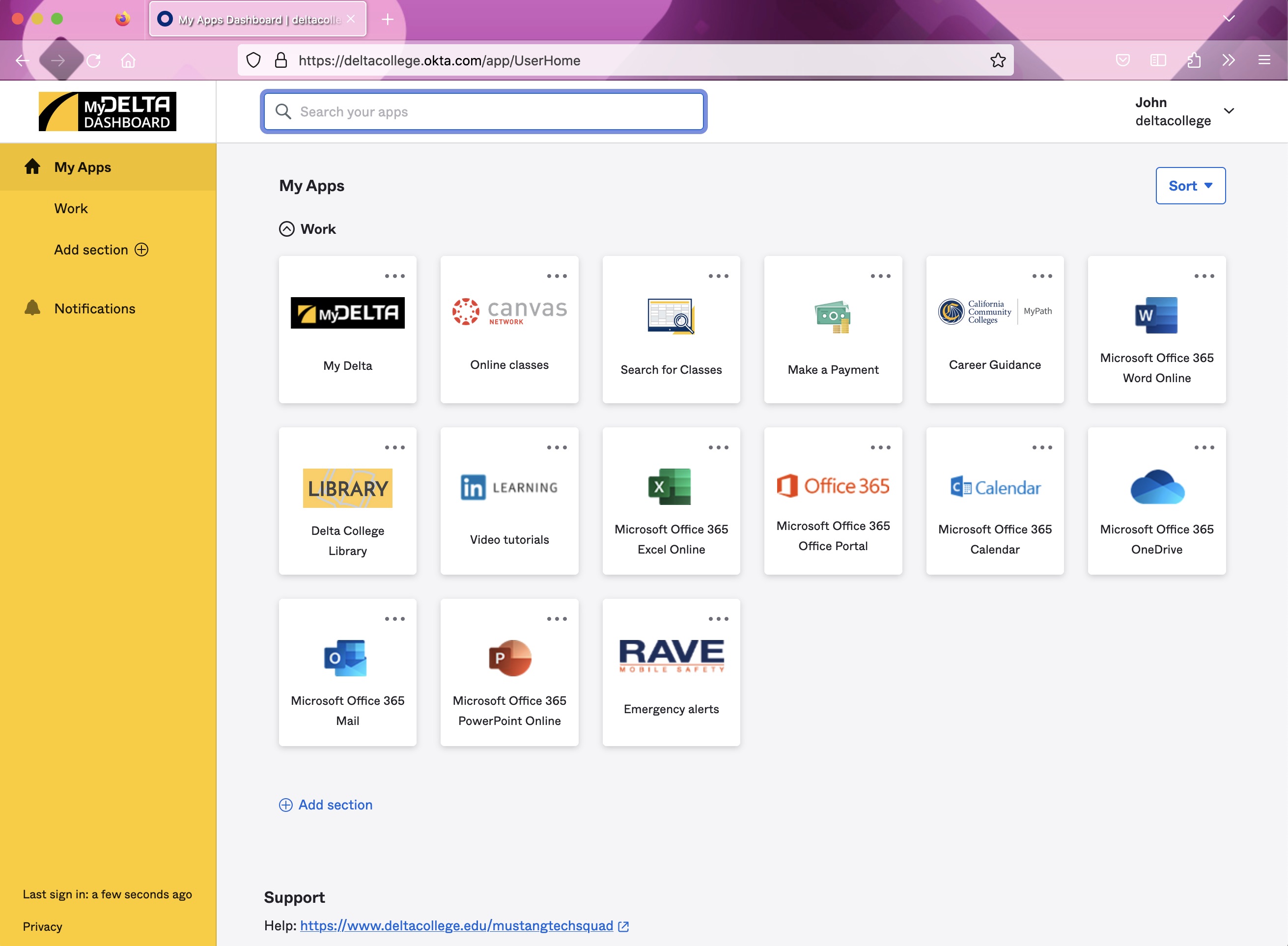
As a new student, we use your high school information, listed below, to determine your English and Math placement.
- Your high school status
- Cumulative GPA
- Math courses and grades
For more information on placement, please visit the Placement page for details on how placement is determined and what course you can take.
You need to complete an Orientation, also known as a New Student Group Advising (NSGA) Session and an Abbreviated Student Education Plan (ASEP). The best part is that you'll get to connect with our counselors and start feeling like a Delta College student! You will also come away with a first-semester course plan.
There are two options available:
- In-person NSGA Session or
- Online NSGA Session + an In-person ASEP meeting with a Counselor
(this completes one of the requirements for receiving priority registration)
If you have questions or need more information, visit the Counseling and Retention.
Couple of things to note before trying to register for classes
- Registration is conducted online only. From what you learned from Orientation, you can register for classes using the Class Scheduler or directly in MyDelta.
- You may register for classes on or after your scheduled registration date and time, but not before.
- Past fees and/or Administrative and Academic Holds must be cleared prior to registration.
- If you need assistance while registering for classes, please click on the Live Help support icon within Online Registration portion of MyDelta. For in-person assistance please visit the Delta Connect Center in the DeRicco Student Services Building.
For additional information regarding registration, check the Registration and Key Date Page
Admission App - Domestic First Year
Complete the Online Application for Admission.
Apply early to begin the process and improve the date you are able to register for classes!
The basic steps to complete and submit an application are:
- Create an OpenCCC Account If you don't already have one.
- Sign-in to your OpenCCC Account and start an application.
- Submit the San Joaquin Delta College Application Login-in and be sure your application is submitted.
Follow the link below to complete our online application for admission.
If you have questions or need more information, please contact the Admissions & Records Office via email at: admissions-followup@deltacollege.edu or via LiveChat
Applications are processed daily. It may take a week to process your application and get your Student ID and email..
You will receive several emails during the processing of your application.
- If you created a new Account on OpenCCC Apply, you will receive a "New Open CCC Account Creation" email with your CCC login information. You still will need to complete the application process by logging back into CCC and Start a New Application using the same Apply to Delta College link above.
- After completing AND submitting your Application for Admission, you will receive a "Welcome to Delta" email from admissions@cccapply.org to the email you used on the application. Please keep this for your records.
- When your application is processed by Delta College, you will receive a "Welcome to San Joaquin Delta College!!!" email from "ADMISSIONS@deltacollege.edu" with your student ID and your Delta College email address information. This is when you can now log into the MyDelta Portal.. If you do not receive this email in one week, please contact admissions and records through live chat.
NOTE: You can only complete this step if you have received the "Welcome to Delta College - Important information for New Students" email from "ADMISSIONS@deltacollege.edu". If you have not received this email please check your email spam/junk box on the personal email account that you used to fill out your admission application. This email will take anywhere from a few hours to up to one (1) week to arrive. If it has been over a week since you submitted your application, please contact Admissions & Records via email at ar-applicationissue@deltacollege.edu or via LiveChat.
Activate your MyDelta Dashboard login
In order to access class registration, your Delta email, and other features, you will need to activate our single sign-on service called MyDelta Dashboard.
To log into MyDelta Dashboard for the first time, visit MyDelta Dashboard Password Reset link.
MyDelta Dashboard Password Reset
Enter your Delta student email address (@mustangs.deltacollege.edu) and choose “Reset via Email." A link will be sent to the personal email address you used in your application for admission. Click on the link and follow the steps for creating your account (including picking a strong password, adding a recovery phone number and selecting a security image).
After you have set up your password, you can now log into your MyDelta Dashboard. You'll see several squares or "tiles" on your dashboard. To access class registration, transcripts, financial aid and much more, click on the "MyDelta" tile. You can also access your Delta email by clicking on the "Microsoft Office 365 Mail" tile. We encourage you to explore the dashboard and become familiar with the many things that you can do here.
As a new student, we use your high school information, listed below, to determine your English and Math placement.
- Your high school status
- Cumulative GPA
- Math courses and grades
For more information on placement, please visit the Placement page for details on how placement is determined and what course you can take.
You need to complete an Orientation, also known as a New Student Group Advising (NSGA) Session and an Abbreviated Student Education Plan (ASEP). The best part is that you'll get to connect with our counselors and start feeling like a Delta College student! You will also come away with a first-semester course plan.
There are two options available:
- In-person NSGA Session or
- Online NSGA Session + an In-person ASEP meeting with a Counselor
(this completes one of the requirements for receiving priority registration)
If you have questions or need more information, visit the Counseling and Retention.
Couple of things to note before trying to register for classes
- Registration is conducted online only. From what you learned from Orientation, you can register for classes using the Class Scheduler or directly in MyDelta.
- You may register for classes on or after your scheduled registration date and time, but not before.
- Past fees and/or Administrative and Academic Holds must be cleared prior to registration.
- If you need assistance while registering for classes, please click on the Live Help support icon within Online Registration portion of MyDelta. For in-person assistance please visit the Delta Connect Center in the DeRicco Student Services Building.
For additional information regarding registration, check the Registration and Key Date Page
First Semester Probation
- You have attempted at least 12 units since you began Delta College.
- Your cumulative GPA is less than 2.0 or "C" average.
Requirements for 1st Semester Academic Probation Students
You will need to complete an online workshop. If the workshop is not completed it can affect your registration. Check your Delta College email for your probation notification. The email will contain the link that will take you directly to the Online Probation Workshop.
- You have attempted at least 12 units since you began Delta College.
- You have received a Withdrawal (W), Incomplete (I), or a no credit (NC) in 50% or more of the courses you have attempted.
Requirements for First Semester Progress Probation Students
You will need to complete an online workshop. If the workshop is not completed it can affect your registration. Check your Delta College email for your probation notification. The email will contain the link that will take you directly to the Online Probation Workshop.
Second Semester Probation
- You have attempted at least 12 units since you began Delta College.
- Your Cumulative GPA is less than a 2.0 or "C" average for two consecutive semesters.
Requirements for 2nd Semester Academic Probation Students
If you are on 2nd semester Academic Probation you are REQUIRED to complete the Self Assessment Survey and Complete the Probation workshop.
In order to complete the workshop please complete:
- GRIT Scale at angeladuckworth.com/grit-scale/
- Have a copy of your Unofficial Transcripts
- Click on the link below to begin the workshop.
- You have attempted at least 12 units since you began Delta College.
- You Have received a Withdrawal (W), Incomplete (I), or a no credit (NC) in 50% or more of the courses you have attempted for two consecutive semesters.
Requirements for Second Semester Progress Probation Students
If you are on second-semester Progress Probation you are REQUIRED to complete the Self Assessment Survey and complete the Probation Workshop.
In order to complete the workshop please complete:
- GRIT Scale at angeladuckworth.com/grit-scale/.
- Have a copy of your Unofficial Transcripts
- Click on the link below to begin the workshop.
Dismissal
- You have attempted at least 12 units since you began Delta College.
- Your Cumulative GPA is less than a 2.0 or "C" average for three consecutive semesters
- If you are dismissed a notice will be sent to your Delta College email that explains your dismissal status, the appeal process, and the reinstatement after dismissal process. Please refer to this email first.
Reinstatement After Dismissal
A student who has served his/her period of dismissal may request permission to return to Delta College. The criteria for consideration of reinstatement includes:
- You were enrolled in a curriculum that was not adapted to your needs, interests, and abilities.
- Your failure to achieve was the result of a medical or emotional disability which has had sufficient correction to enable significant change in performance for the better.
- Your failure to perform satisfactorily was the result of family or financial stress.
- You had other extenuating circumstances that should be considered.
- If you are filing an appeal and/or have questions about your dismissal and would like to speak with a counselor, please make an appointment with a counselor. Make sure you request an appointment specifically for Academic Dismissal.
During your one-hour appointment with your counselor, you will jointly establish a personal plan of corrective action. During the appointment, the counselor completes a Student Educational Plan outlining your academic and/or career goal(s). Recommended strategies and resources for achieving those goals will be included on the student educational plan.
After your appointment, the counselor will contact the director of Admissions & Records with a recommendation regarding the removal of your Academic Probation hold.
- You have attempted at least 12 units since you began Delta College.
- You have received a Withdrawal (W), Incomplete (I), or a no credit (NC) in 50% or more of the courses you have attempted for 3 consecutive semesters.
- If you are dismissed a notice will be sent to your Delta College email that explains your dismissal status, the appeal process, and the reinstatement after dismissal process. Please refer to this email first.
If you are filing an appeal and/or have questions about your dismissal and would like to speak with a counselor, please make an appointment with a counselor. Make sure you request an appointment specifically for Probation Dismissal.
Reinstatement After Dismissal
A student who has served his/her period of dismissal may request permission to return to Delta College. The criteria for consideration of reinstatement includes:
- You were enrolled in a curriculum that was not adapted to your needs, interests, and abilities.
- Your failure to achieve was the result of a medical or emotional disability which has had sufficient correction to enable significant change in performance for the better.
- Your failure to perform satisfactorily was the result of family or financial stress.
- You had other extenuating circumstances that should be considered.
If you are filing an appeal and/or have questions about your dismissal and would like to speak with a counselor, please make an appointment with a counselor. Make sure you request an appointment specifically for Progress Dismissal.
During your one-hour appointment with your counselor, you will jointly establish a personal plan of corrective action. During the appointment, the counselor completes a Student Educational Plan outlining your academic and/or career goal(s). Recommended strategies and resources for achieving those goals will be included on the student educational plan.
After your appointment, the counselor will contact the director of Admissions & Records with a recommendation regarding the removal of your Progress Probation hold.
First Year Experience Courses
Units: 2
Hours: 36 hours LEC
Grade Options: Letter Grade or Pass/No Pass
This course is designed to support first-year college students in their transition to higher education and early career planning, with a focus on the Latine experience. It will explore the unique challenges and opportunities faced by Latine students in both academic and professional settings. Through a combination of lectures, discussions, and practical activities, students will develop essential skills for academic success, career exploration, and personal growth. The course aims to empower Latine students to navigate the complexities of college life and prepare for future careers. (UC, CSU)
Units: 2
Hours: 36 hours LEC
Grade Options: Letter Grade or Pass/No Pass
This course is designed to support first-year college students in their transition to higher education, with a specific focus on the experiences of Latine students. It will explore the historical, cultural, and social contexts that impact the Latine experience in higher education. Students will develop skills and strategies for academic success, personal growth, and engage with campus resources and services available. (UC, CSU)
Units: 3
Hours: 54 hours LEC
Grade Options: Letter Grade or Pass/No Pass
The First Year Experience Seminar will create an engaging environment for success as well as empower and support students as they transition to college. This course covers topics such as self-awareness and career exploration, as well as how to be successful in college and life. Students will analyze and explore their personality, values, interests, and skills for career decision-making. Students will have an expanded awareness of self, majors, careers, the world of work, and higher education. (UC, HBCU, CSU)
Units: 0
Hours: 54 hours LEC
Grade Options: Pass/No Pass
The noncredit First Year Experience Seminar will create an engaging environment for success as well as empower and support students as they transition to college. This course covers topics such as self-awareness and career exploration, as well as how to be successful in college and life. Students will analyze and explore their personality, values, interests, and skills for career decision-making. Students will have an expanded awareness of self, majors, careers, the world of work, and higher education. Noncredit courses may be repeated.
Counseling Courses
Units: 3
Hours: 54 hours LEC
Grade Options: Letter Grade
Term Typically Offered: Every term
This course is designed to enable the student to focus on the development of self-esteem and personal responsibility leading to college success. The course includes discussions of cultural awareness and diversity. This course is also designed to enhance academic skills, and knowledge about campus resources. Other aspects covered are choosing a major, and career exploration. (HBCU, UC, CSU)
Units: 3
Hours: 54 hours LEC
Grade Options: Letter Grade
General Education: Delta Area 6; CSU Area E
Term Typically Offered: Every term
This course is designed to foster personal development through a decision-making process. This includes self-awareness, value systems, patterns of communication, changing lifestyles, and how these factors impact a student’s education, growth, and goals. (HBCU, CSU)
Units: 0.5
Hours: 9 hours LEC
Grade Options: Pass/No Pass
Term Typically Offered: Every term
This is an eight-hour orientation for new and returning students. This course provides an overview of higher education options, and an introduction to SJDC’s Student Services and registration process. Counselors will review the educational planning process and assist students with a one-semester education plan. Completion of this course will fulfill the college’s orientation requirement. (HBCU, UC, CSU)
Units: 1
Hours: 18 hours LEC
Grade Options: Letter Grade or Pass/No Pass
Term Typically Offered: Every term
This course is an introduction to the college experience and the educational planning process through counseling and advising for ESL (English as a Second Language) students. This course assists ESL students in the development of a Student Education Plan (SEP). The course topics include student services and resources, reviewing higher education systems and establishing academic and career goals. Completion of this course will fulfill the college’s orientation requirement (HBCU, CSU)
Units: 1
Hours: 18 hours LEC
Grade Options: Letter Grade; No Incomplete
Term Typically Offered: Every term
This course is designed for Extended Opportunity Programs and Services (EOPS) students enrolled in Cooperative Agencies Resources for Education (CARE). The goal of this course is to provide information on gaining self-awareness by understanding the roots of codependency and movement towards personal recovery. (HBCU, CSU)
Units: 1
Hours: 18 hours LEC
Grade Options: Letter Grade or Pass/No Pass
Term Typically Offered: Every term
This course is designed for the Extended Opportunity Programs and Services (EOPS) student enrolled in Cooperative Agencies Resources for Education (CARE). The student obtains educational support information through a series of campus and community presentations. The goal of this course is to empower the student to access the necessary resources to be successful in college. (CSU)
Units: 1
Hours: 18 hours LEC
Grade Options: Letter Grade or Pass/No Pass
Term Typically Offered: Every term
This course is designed for the Extended Opportunity Programs and Services (EOPS) student enrolled in Cooperative Agencies Resources for Education (CARE). The goal of this course is to assist the student in lowering their level of stress by understanding, recognizing, and managing interpersonal stressors. (CSU)
Units: 1
Hours: 18 hours LEC
Grade Options: Letter Grade or Pass/No Pass
Term Typically Offered: Every term
This course is an introduction to the college experience and the educational planning process through counseling and advising. This course assists students in the development of a Student Education Plan (SEP). The course topics include student services and resources, reviewing higher education systems, and establishing academic and career goals. Completion of this course will fulfill the college’s orientation requirement. (UC, HBCU, CSU)
Units: 1
Hours: 18 hours LEC
Grade Options: Letter Grade or Pass/No Pass
Term Typically Offered: Every term
This course is designed to assist community college students with transferring to a public or private four-year university. The course provides students with information on higher education systems such as University of California (UC), California State University (CSU), and University of the Pacific. Students explore transfer options from academic, financial, and personal development perspectives. Topics include understanding ther transfer process, such as admission requirements and deadlines, identifying financial aid resources, and housing options. Students will review the process of meeting with a counselor and building an individual Student Education Plan (SEP) based on their educational and career goals. (CSU)
Units: 1
Hours: 18 hours LEC
Grade Options: Letter Grade
Term Typically Offered: Every term
This course is designed to introduce the student to the career life planning process. The course emphasizes self-assessment as the first major step in the career life planning process. The student identifies his/her personality, values, interests, skills and accomplishments leading to potential career choices. (HBCU, CSU)
Units: 1
Hours: 18 hours LEC
Grade Options: Letter Grade or Pass/No Pass
Term Typically Offered: Every term
This course is designed to provide the student with opportunities to explore specific careers through the utilization of career resources. The course includes investigation of job duties, training, educational requirements, desired employee characteristics, salary ranges, and future employment trends. (HBCU, CSU)
Units: 1
Hours: 18 hours LEC
Grade Options: Letter Grade or Pass/No Pass
Term Typically Offered: Every term
This course is designed to assist the student in obtaining career information directly from individuals employed in areas of student’s career interest by conducting information interviews. The course includes information on how to create a networking system, make initial contacts, prepare interview questions, direct the information interview, and analyze information obtained. (HBCU, CSU)
Units: 1
Hours: 18 hours LEC
Grade Options: Letter Grade or Pass/No Pass
Term Typically Offered: Every term
This course is designed to assist the student with development of successful job search techniques including networking, resume writing, and job interviewing skills. The course includes techniques on how to find and obtain a desired job. Information about the hidden job market is included. (CSU)
Units: 0.5
Hours: 27 hours LAB
Grade Options: Letter Grade or Pass/No Pass
Term Typically Offered: Every term
This course is designed for the student who seeks to further study, research, and choose a career path in a structured and supportive lab environment devoted to career and education resources. The student completes assignments that provide additional opportunities to self-assess, examine, and create a plan chosen from among his/her career options. Students may also participate in approved workshops and utilize campus and community resources. (CSU)
Units: 0.5
Hours: 27 hours LAB
Grade Options: Letter Grade or Pass/No Pass
Term Typically Offered: Every term
Advisories: COUN 20 and COUN 35 with a grade of “C” or better.
This course is designed for the student who seeks individualized assistance with various admission and graduation processes. The student completes assignments that may include self-assessment of academic and career interests in a structured and supportive lab environment devoted to career and transfer resources. Students may complete assignments that include identifying a college major, creating a UC TAP or CSU Mentor account, attending workshops, meeting with University Representatives, submitting applications, and participating in campus tours. (CSU)
Units: 1
Hours: 18 hours LEC
Grade Options: Pass/No Pass
Term Typically Offered: Every term
This course is a preparation course for creating a portfolio to gain credit from experience. This course serves a multitude of other courses and programs and helps students to complete in a more timely fashion.
Units: 1
Hours: 18 hours LEC
Grade Options: Letter Grade or Pass/No Pass
Term Typically Offered: Every term
Limitations on Enrollment: Students on third semester or continuing academic probation.
This course is a group counseling practicum designed to assist a student who is having difficulty succeeding in college. The focus of the course is to provide practical strategies for achieving personal, educational, and career goals. This course is required for the student who is on third semester academic probation. Units earned in this course do not count towards an associate degree.
Units: 0
Hours: 36 hours LEC
Grade Options: Pass/No Pass
This noncredit course is designed to support first-year college students in their transition to higher education and early career planning, with a focus on the Latine experience. It will explore the unique challenges and opportunities faced by Latine students in both academic and professional settings. Through a combination of lectures, discussions, and practical activities, students will develop essential skills for academic success, career exploration, and personal growth. The course aims to empower Latine students to navigate the complexities of college life and prepare for future careers. Noncredit courses may be repeated.
Units: 0
Hours: 36 hours LEC
Grade Options: Pass/No Pass
This noncredit course is designed to support first-year college students in their transition to higher education, with a specific focus on the experiences of Latine students. It will explore the historical, cultural, and social contexts that impact the Latine experience in higher education. Students will develop skills and strategies for academic success, personal growth, and engage with campus resources and services available. Noncredit courses may be repeated.
Units: 0
Hours: 18 hours LEC
Grade Options: Pass/No Pass
This noncredit course is an introduction to the college experience and the educational planning process through counseling and advising. This course assists students in the development of a Student Education Plan (SEP). The course topics include student services and resources, reviewing higher education systems, and establishing academic and career goals. Completion of this course will fulfill the college’s orientation requirement. Noncredit courses may be repeated.
Units: 0
Hours: 18 hours LEC
Grade Options: Pass/No Pass
This noncredit course is designed to assist community college students with transferring to a public or private four-year university. The course provides students with information on higher education systems such as University of California (UC), California State University (CSU), and University of the Pacific. Students explore transfer options from academic, financial, and personal development perspectives. Topics include understanding their transfer process, such as admission requirements and deadlines, identifying financial aid resources, and housing options. Students will review the process of meeting with a counselor and building an individual Student Education Plan (SEP) based on their educational and career goals. Noncredit courses may be repeated.
Units: 0
Hours: 18 hours LEC
Grade Options: Pass/No Pass
This noncredit course is designed to introduce the student to the career life planning process. The course emphasizes self-assessment as the first major step in the career life planning process. The student identifies his/her personality, values, interests, skills and accomplishments leading to potential career choices. Noncredit courses may be repeated.
Units: 0
Hours: 18 hours LEC
This noncredit course is designed to provide the student with opportunities to explore specific careers through the utilization of career resources. The course includes investigation of job duties, training, educational requirements, desired employee characteristics, salary ranges, and future employment trends. Noncredit courses may be repeated.
Units: 0
Hours: 18 hours LEC
Grade Options: Pass/No Pass
This noncredit course is designed to assist the student in obtaining career information directly from individuals employed in areas of student’s career interest by conducting information interviews. The course includes information on how to create a networking system, make initial contacts, prepare interview questions, direct the information interview, and analyze information obtained. Noncredit courses may be repeated.
Counseling Appointments
Students who have a defined education goal and existing comprehensive education plan (CSEP) may schedule a 30-minute session to:
- Update existing comprehensive education plan
- Develop a one-semester plan
- Obtain clarification of the various degree and certificate options offered at Delta College
- Discuss follow-up questions once a comprehensive education plan has been developed
One-hour counseling appointments are scheduled for students who require in-depth counseling for the following topics and services:
- Establishing career and/or transfer goals
- Conducting career exploration
- Completing a Financial Aid Appeal
- Academic Renewal
- Transfer Services
- Making a change to existing educational goal (degree, transfer, etc.)
- Students currently on academic or progress probation
- Review of transcript evaluation
- Assistance with completing petitions or forms
- Developing a Comprehensive Education Plan (CSEP)
- Guidance with decision making related to education and career goals
- Veteran Services
- International Student Services
Drop-in sessions are best for students who need clarification on a specific topic or need assistance that does not require an in-depth review of their academic history and education goals. Students coming in for a drop-in meeting may receive assistance with the following:
- Making changes to current schedule
- Clarifying information about adding or dropping a course
- Answering questions about degree or general education requirements
- Reviewing important semester dates
- Discussing criteria and process for specific petitions or forms
- Please note that during a drop-in meeting the counselor may determine that you need additional time and an appointment may be scheduled to better assist you.
To maximize your counseling session, we encourage you to:
- Write down your questions
- Consider your career goals
- If plan you plan to transfer, identify your top choices
- Determine how many courses you plan to take each semester
- Know if you would like to take online, hybrid, or in-person courses
- Gather any transcripts or documents that may be needed during your counseling appointment
Library Rules and Fines
- Users may only take out 5 titles in one subject area
- Fines are 25 cents for each day a book is late; maximum total fines are $5 per book
- Two titles per user
- Overdue fine $5 per hour for first 10 hours ($50); then, from hour 11 onward, overdue fine is $1 per hour, to the maximum overdue fine of $100 per title.
- Users may check out two books from each collection at a time
- Overdue fine 25 cents per day, to a maximum fine of $5 per item
- Users may only take out five items from this collection
- Overdue fine 25 cents per day with a maximum of $5 per item
- Users may check a maximum of three items; each item must be from a different category of loanable equipment (ex: one headphone set, one charger, one DVD drive)
- Overdue fines are 25 cents per day for a maximum of $5
- Users can check out one camera and one accessory
- Overdue fines are 25 cents per day with a maximum of $5
Overdue fines are $5 per day, up to a maximum fine of $100 per item.
DARTE
The DARTE Learning Community Program is committed to guiding adult learners on a supportive and accelerated path to academic and career success. We provide personalized advising, streamlined career pathways, and access to essential wraparound services such as financial aid, childcare, and job placement. Through a culturally responsive and equity-centered approach, we foster community, confidence, and opportunity for adults returning to education.
SB -554 allows adult school students to attend their college courses for free as dual-enrollment students. To be eligible for SB-554 students must:
- Be enrolled in an HSD/GED or HSE program at Adult School.
- Take up to 11 units per semester at Delta while actively attending your HSD/GED or HSE program.
- No proof of residency is required.
The Counseling Office is located in DeRicco 234.
You can make an appointment in-person or by phone:
(209) 954-5151 ext. 6276
Request one of our DARTE counselors:
- Stacey Bagnasco
- Daniel Fernandez
- English as a Second Language (ESL)
- Career Pathways
- Basic Skills
- High School Diploma/Equivalency
The English as a Second Language (ESL) program at San Joaquin Delta College is designed to improve the communication skills of students who speak English as a second language. The ESL program helps you prepare for advancement in the workplace and success in college programs. We provide:
- Four levels of instruction for ESL students: Intermediate I, Intermediate II, Advanced I, and Advanced II
- Courses leading up to university-transferable English (Eng 1A) and/or career-specific training programs
- Courses in reading/writing, listening/speaking, and grammar at each level
- Flexible classes available to fit your schedule
- Free ESL tutoring and resources for practicing your English
- ESL Guided Self-Placement process to determine what level courses you should take
- New Noncredit Courses and ESL Certificates
Financial Aid CampusLogic
CampusLogic is a new financial aid tool that will allow you to submit financial aid supporting documents electronically. This tool is used at many other California community colleges.
CampusLogic will simplify forms and allow forms to be submitted securely from any device – phone, laptop or desktop computer. This will make the process easier and more efficient for students. We expect it will also substantially reduce processing times so you can receive your aid as quickly as possible.
- Go to MyDelta
MyDelta Portal
Check your to-do list of tasks

- If you have documents that need to be completed, you will see the following item: FA Verification Review Req. Clicking on this financial aid task will take you to the CampusLogic portal. If this is your first time using the tool, you’ll need to create an account.
- Use your MyDelta Dashboard (okta) single sign-on to access the program. Need help using okta?
If you have questions about CampusLogic, please go to the financial aid page and chat live with an agent during business hours.
With CampusLogic, you will still use MyDelta to access your list of to-do items and check on the status of your financial aid awards and disbursements.
Pride Center
The Pride Scholars program is for enrolled LGBTQ+ students who are pursuing a degree, certificate, and/or looking to transfer to a 4-year college or university. You would join a community of scholars who receive support to ensure their success at Delta and in their future. There are many advantages to being part of the Pride Scholars Program:
- One-on-one advising
- Free school supplies
- Textbook & supplies voucher
- Free hygiene products
Free printing - Letters of recommendation
- Computer access and printing
- Student lounge space
To join Pride Scholars, please fill out a New Student Form. At the end of the form please follow the link provided to schedule a Welcome Meeting. If you have any questions, please don’t hesitate to get in touch with Pride Center.
The Safe Space Network trains students, faculty, and staff with the goal of creating an on-campus network of allies, which include members of the LGBTQ+ community. The program educates members regarding how to become a better ally to the LGBTQ+ community and how to advocate for peers, family, and members of the campus community.
The trainings offer a space where different points on a journey of learning and unlearning are acknowledged. A primary assumption of the training is that everyone speaks with the positive intent of seeking greater knowledge and understanding. This process of learning and unlearning can shift paradigms and be challenging. The training asks participants lean into this discomfort. The Safe Space Network are members who have completed training and made a commitment to listen to and hold space for LGBTQ+ individuals. A safe space is ideally one that doesn’t incite judgment based on identity or experience—where the expression of both can exist and be affirmed without fear of repercussion and without the pressure to educate. While learning may occur in these spaces, the ultimate goal is to provide support. In addition, members will do their best in showing up and acting as allies when needed. You may recognize members if they display the following decal/sticker on their office door or window, a backpack or binder, their car, or wherever the member decides to display.
A list of trained faculty and staff is available and also helps in identifying Safe Space Network members.

We regularly hold events that are intended to bring community together, LGBTQ+ individuals and allies. We host welcome mixers at the start of the semester, holiday parties, movie nights, game days, and more. These community building events are great opportunities to meet people and have fun! Connect with us on social media or visit the Pride Center to learn about upcoming events.
During the first week of each semester and once per month the Pride Center will be OUT in the Quad. This involves tabling to promote Pride Center programs, educate the campus community, and create visibility on campus. Student may sign up with the Pride Center to volunteer.
The Lavender Graduation Ceremony is a formal recognition of the academic achievements and the special contributions of lesbian, gay, bisexual, transgender, queer and ally (LGBTQ+) students have made to our Delta community. This annual ceremony exists in solidarity with the many other Lavender Graduation ceremonies at college and universities across the country to honor LGBTQ+ students and their allies. This tradition began with Dr. Ronni Sanlo, a Jewish lesbian, who was denied the opportunity to attend the graduations of her children because of her sexual orientation. It was through this experience that she instituted the first Lavender Graduation ceremony at the University of Michigan in 1995.
The significance of “Lavender” is important to LGBTQ+ history. It is a combination of the pink triangle that gay men were forced to wear in concentration camps and the black triangle designating lesbians as political prisoners in Nazi Germany. The LGBTQ+ civil rights movement took these symbols of hatred and combined them to make symbols and color of pride and community.
The Delta Pride Center is proud to host San Joaquin Delta College’s annual Lavender Graduation held during the month of May. Students who graduate from Delta within the academic year (fall, spring, or summer semester) may participate in the Lavender Graduation. Registration typically opens March or April.
This is our affiliated student-led organization. The Delta Pride Club promotes the visibility of LGBTQ+ people and culture. The club is for LGBTQ+ students and their allies to meet in a hate-free space. The club is here for students to help discover who they are and succeed. As an organization, students coordinate events, programs, and socials. If you are interested in joining, please email Delta.Pride@DeltaCollege.edu.
Facebook: www.facebook.com/groups/SJDeltaPride
Application F-1 Student Required Documents
- Submit a copy of your passport identification page.
- Submit copies of the passport identification pages for all dependents (spouse and/or child/children) who will accompany you.
- Submit diploma or leaving certificate and official (original) transcripts from secondary schooling.
- If you have have completed college level coursework or degree in the United States, submit an official transcript.
- Transcripts from foreign colleges or universities are optional. Delta College credit cannot be given for coursework completed outside the U.S.
- If the original language is not English, a certified English translation must accompany all documents.
San Joaquin Delta College requires that international students meet the minimum English proficiency requirements to be admitted. We will admit a student that does not meet minimum requirements if they are pursuing the English Second Language (ESL) program at our institution. Regardless of what course of study the student decides to pursue, we still require that they complete one of the following English proficiency tests:
- IELTS with a score of 5 or higher
- TOEFL- iBT with a score of 61
- Computer-Based Test (CBT) 163 or higher
- Paper-Based Test 490 or higher
- PTE- 40 or higher
- Duolingo- 95 or higher
If a student cannot earn the minimum required score on one of these tests, then they can request to take the Delta College ESL self-placement test. This test gauges the student’s comfort with English and makes a placement based on student answers. This test is not entirely accurate, and it is advised that students be completely honest in their self-placement and consider speaking with an ESL professor to see if the placement level is right for them.
- Submit proof of financial support issued within the last six (6) months, showing that you meet the minimum estimated expenses required for F-1 students. See F-1 Student Expenses for complete details.
- All documentation (bank statements, etc.) must be in English.
- Your proof of financial support may come from multiple sources. Each source must provide all of the required documentation.
- Select one of the following methods to provide proof of financial support: F-1 Student Sponsor Form and required documentation, either a letter from a bank official or balance statement confirming the account holder's name and the amount of funds available. Use this form if the applicant or sponsor account balance(s) meet the minimum amount required.
- A financial support letter from a government agency or scholarship award letter.
- Submit a one-page essay that describes your reason for applying to San Joaquin Delta College, including your educational background and goals.
- The essay must be written in English and must be an original and true representation of your writing and language skills.
- Submit the $50 application processing fee.
- Pay online by credit/debit card by logging in to your MyDelta Dashboard. Instructions will be emailed when the application has been received.
- In person by check, cash or credit card at the Cashier's Office, located in the Horton Administration Building, Room 102A (ADMIN 102A)
By check/money order mailed to:
San Joaquin Delta College
International Student Program
5151 Pacific Ave, Box 102
Stockton, CA 95207
USA
If you are an F-1 student currently attending another college, university, or language school in the U.S., you are eligible for transfer if you have maintained F-1 Visa status.
The following documents are also required:
- Copies of I-20's from all US schools you have attended.
- Copy of the visa and identification pages from your passport, and your current I-94.
- Official transcript(s) from all schools you have attended in the U.S.
- You may submit an unofficial transcript for admissions purposes, however official transcripts are required to complete transfer and register for classes.
- Completed F1 Student SEVIS Transfer Form
Chicanx/Latine Faculty
La Guia - Latine Resource Guide
Brought to you by the Chicanx/Latine Faculty Taskforce of Delta College.
Learn more and donate to the Dolores Huerta Scholarship Fund.
Learn more and donate now to the LREA scholarship.
Faculty - Flex
Fall 2026 Flex Reporting Due Date
- November 23, 2026 at 5:00 p.m.
- Hourly Flex Obligation report available week of September 7, 2026
- Hourly contract Flex activities must occur between July 1, 2026 and December 14, 2026
- *ATTENTION* Failure to meet reporting deadlines will result in a reduction in pay.
Spring 2027 Flex Reporting Due Date
- April 26, 2027 at 5:00 p.m.
- Hourly Flex Obligation report available week of February 1, 2027
- Hourly contract Flex activities must occur between January 1, 2027 and June 30, 2027
- *ATTENTION* Failure to meet reporting deadlines will result in a reduction in pay.
Full-Time 2026-2027 Yearly Flex Reporting Due Date
- April 26, 2027 at 5:00 PM
- Yearly Flex obligation is 50 hours above mandatory Flex
- Yearly contract Flex activities must occur between July 1, 2026 and June 30, 2027
- *ATTENTION* Failure to meet reporting deadlines will result in a reduction in pay.
Category 1. Course Instruction & Evaluation
- SLOA development, assessments
- Course mapping
- Curricunet
- Discipline Group sessions
- Course design
- Research pertaining to discipline and/or pedagogy
Category 2. Staff Development, In-service Training, & Instructional Improvement
- On-line/In-person seminars including, but not limited to:
- Learning communities, diversity training, campus safety, role of CTA and Academic Senate, teaching strategies and pedagogies, mentoring students and faculty, and writing grants
- Evaluation of the following for classroom use: scientific instruments and artifacts, textbooks and supplemental materials, subject-related documents, etc.
- Wellness activities that assist individuals to be physically and mentally better able to perform their job duties ( humor in the workplace, exercise and nutrition)
- Learning a 2nd language to better communicate with diverse student population
- Discipline-related conference
- Individual research for instructional improvement
Category 3. Program & Course Curriculum or Learning Resource Development & Evaluation
- Mandatory flex day activities (adjunct only)
- Etudes or Canvas workshops
- Technology in the classroom (clickers, video, YouTube, presentation software, etc.)
- Creating self-study modules and /or computer-assisted instruction
- Teaching/pedagogy related conferences
- Individual research on subject related curriculum or learning resource development
Category 4. Student Personnel Services
- Faculty as student club advisors
- Webinars or seminars related to student accessibility
- Career Center orientations
- Classroom and campus safety workshops
- Workshops sponsored by ASBG
- Transfer workshops
- Developing student readiness programs specific to a discipline
- Individual research related to student personnel services
Category 5. Learning Resources & Services
- Referring students for tutoring
- Faculty and counselor meetings to address areas of concern ( prerequisites and academic advising)
- Services offered by the Tutoring Center
- Library Databases and research tools
- Preventing Plagiarism
- Assistive technology
- Learning and physical disabilities and accommodations
- Faculty and staff meetings to improve learning resources
- Individual research related to learning resources and services Research or other individual activities
Category 6. Student Advising, Guidance, Counseling, Orientation, Matriculation, & Diversity (Staff & Student)
- Transfer
- Scholarships/financial aid
- Careers
- Academic probation/disqualification
- Student success
- Cultural diversity
- Veterans
- Psychological and physical health
- Mentoring of students
- jParticipation in student orientation programs
- Recruiting/outreach for special projects ( MESA)
- Individual research student advising, counseling, orientation, matriculation and diversity
Category 7. Departmental or Division Meetings, Conferences & Workshops, & Institutional Research
- Departmental meetings for the following:
- Program Learning Outcomes (PLOs), curriculum, Student Learning Outcomes (SLOs), improve services to students, and program review
- Discipline-specific conferences or publications
- Planning and institutional improvement
Category 8. Other Duties & Activities as Assigned by the District
- Faculty training (SLOAs, Curricunet, etc.)
- Accreditation summits, training, workshops, conferences, et
- Curriculum Advisory Committee
- Advising regarding SLOs, PLOs, ILOs, et
- Promoting shared governance
- Workshop development
Category 9. The Necessary Supporting Activities for 1-8
- Course instruction and evaluation
- Staff development, in-service training, and instructional improvement
- Program and course curriculum or learning resource development and evaluation
- Student personnel services
- Learning resources and services
- Student advising, guidance, counseling, orientation, matriculation, and diversity
- Department or division meetings, institutional research, conferences and other research
- Hiring committees
- Other duties and activities as assigned by the district
MyDelta - Registering
You can register for classes during the registration period for a term. Your registration period begins with your assigned registration date and time. Once your period begins, use the steps below to add classes to your schedule.
- Log in to MyDelta
- From your MyDelta homepage, click the Manage Classes icon.
- Click on Class Search and Enroll from the left sidebar menu.
- Click the term that you are registering for.
- Use the class search to look for the course you wish to enroll in.
- Need help using the class search? Read our Class Search Tips
- From your search results, click on a course you wish to know more about.
- Information about the course will be displayed in two areas, Course Information and Class Selection
- Course Information displays the course description and basic course details
- Class Selection shows all of the classes available for the course during that term. If the course consists of multiple components such as lectures and labs, all available combinations of the components will be presented. You can learn more about the class by clicking on the link in the Class column.
- If you are ready to add the class, look for the arrow pointing right on the far right of the row of the class. If there is no arrow, enrollment for the term may not be open or you may be ineligible to add the course. If there is an arrow, click anywhere on the row of that class to start the process of registering for the class.
. - After selecting the course, the Review Class Selection step appears. Review the class to confirm this is the class in which you would like to enroll or add to the shopping cart. Once confirmed, click Next.
- Next, Review Class Preferences. If the course is full, here’s where you can request to be added to the waitlist. Choose Yes or No, and then click Accept to continue.
- The Enroll or Add to Cart page appears. Select whether you wish to register in the class or Add to Shopping Cart. If your enrollment appointment date has not arrived for the term, you will only be able to select Add to Shopping Cart.
- The Review and Submit page appears. Click on any of the previous steps on the left to review and change options if needed. If the class displayed is correct and all preferences are set correctly, click Submit.
- Click Yes to confirm the submission of the class choice and enroll in the class.
A confirmation page will appear and let you know you the class has been added to your schedule. You can continue to repeat this process, adding all the classes you plan to take in the upcoming term to your schedule.
The shopping cart allows you to select classes before your enrollment appointment time so that you are ready to enroll when it is time. Before you register from your cart you should:
- Add classes you want to register for to your shopping cart
- Validate your shopping cart to make sure you will be able to register for all
After all your classes have been added to your shopping cart, follow the steps below to add them to your schedule for the upcoming term:
- From your MyDelta homepage, click the Manage Classes icon.
- Click on Shopping Cart from the left sidebar menu.
- Click the checkbox to the left of the classes you want to register in (you can select all or just some.)
- Click the Enroll button.
- Confirm enrollment by clicking Yes.
A message will appear for each course indicating the class has been added to your schedule or will state the reason you are unable to enroll in the class.
Once you’ve registered, go to View My Classes to see the classes you have registered for.
When it's time to register for a term, you can add the courses in your planner directly to your schedule.
- From your MyDelta homepage click on the Manage Classes tile and then click on Planner from the left sidebar.
- Click on on the Term you want to register for (i.e. Fall 2019)
- Click on the Course you want to add to your schedule.
- This will open a page will information about the course. If the course has classes scheduled for that term, there will be a View Classes button in the upper right corner. Click the button to choose the class you want to add.
- If there is no View Classes button the schedule for that term may not be published yet or there may not be any classes offered for that course in the term you are planning for.
- After clicking View Classes, a new page will load with all the class options for the term.
- If you are ready to add the class, look for the arrow pointing right on the far right of the row of the class. If there is no arrow, enrollment for the term may not be open or you may be ineligible to add the course. If there is an arrow, click anywhere on the row of that class to start the process of registering for the class.
- After selecting the course, the Review Class Selection step appears. Review the class to confirm this is the class in which you would like to enroll or add to the shopping cart. Once confirmed, click Next.
- Next, Review Class Preferences. If the course is full, here’s where you can request to be added to the waitlist. Choose Yes or No, and then click Accept to continue.
- The Enroll or Add to Cart page appears. Select whether you wish to register in the class or Add to Shopping Cart. If your enrollment appointment date has not arrived for the term, you will only be able to select Add to Shopping Cart.
- The Review and Submit page appears. Click on any of the previous steps on the left to review and change options if needed. If the class displayed is correct and all preferences are set correctly, click Submit.
- Click Yes to confirm the submission of the class choice and enroll in the class.
The course will now be added to your schedule for the term you specified.
Use the Enroll by Requirements feature in MyDelta to register for classes that satisfy one of your graduation and/or degree requirements.
- From your MyDelta homepage, click on Manage Classes.
- Click on the Enroll by Requirements from the left sidebar. This will display your Academic Progress Report, a list of all the requirements you must meet based on your academic program and goals.
- Click on on one your Not Satisified requirements.
- Under Courses, you will see a list of courses that may be used to satisfy this requirement.
- Click anywhere in the row of a course you want to learn more about and/or take
- This will open up Course Details including description, units, grading, and attributes
- Click the View Classes button to see all the class options for the term and begin the registration process.
- If you are ready to add the class, look for the arrow pointing right on the far right of the row of the class. If there is no arrow, enrollment for the term may not be open or you may be ineligible to add the course. If there is an arrow, click anywhere on the row of that class to start the process of registering for the class.
- After selecting the course, the Review Class Selection step appears. Review the class to confirm this is the class in which you would like to enroll or add to the shopping cart. Once confirmed, click Next.
- Next, Review Class Preferences. If the course is full, here’s where you can request to be added to the waitlist. Choose Yes or No, and then click Accept to continue.
- The Enroll or Add to Cart page appears. Select whether you wish to register in the class or Add to Shopping Cart. If your enrollment appointment date has not arrived for the term, you will only be able to select Add to Shopping Cart.
- The Review and Submit page appears. Click on any of the previous steps on the left to review and change options if needed. If the class displayed is correct and all preferences are set correctly, click Submit.
- Click Yes to confirm the submission of the class choice and enroll in the class.
A confirmation page will appear and let you know you the class has been added to your schedule. You can continue to repeat this process, adding all the classes you plan to take in the upcoming term to your schedule.
Waitlist Management
For classes with multiple components, you may not see the ability to add, drop or reinstate on each roster.
- For classes with a lecture/lab section, please look for the enroll and drop buttons on both the lecture and lab component.
- For a hybrid class, choose the online class section when you want to add/drop/grant permission.
If you get the error "Already waitlisted for the related component” while trying to add students, this means that your class is full (reached its cap) and you cannot enroll anymore students on the class roster.
Academic Senate Committees
Academic Senate Members of the Curriculum Committee
Last Updated: 06/04/2026
| Name | Role | Extension | |
|---|---|---|---|
| Veronica Oregel | Curriculum Support Coordinator*^ | veronica.oregel@deltacollege.edu | x5867 |
| Kathleen Bruce | Curriculum Chair | kathleen.bruce@deltacollege.edu | x5191 |
| Sarah Antinora | Student Learning Outcomes Coordinator | sarah.antinora@deltacollege.edu | x5533 |
| Dr. Danielle Yancey | Distance Education Chair* | danielle.yancey@deltacollege.edu | x5356 |
| Raichelle Strickland | Articulation Officer* | raichelle.strickland@deltacollege.edu | x6265 |
| Eric Ottonson | Career Technical Education Representative (2024-2026) | eric.ottosen@deltacollege.edu | x5129 |
| Monica Fuentes | Career Technical Education Representative (2023-2025) | monica.fuentes@deltacollege.edu | x5454 |
| Jacquelynn Schwegel | General Education Representative (2023-2025) | jschwegel@deltacollege.edu | x5381 |
| Ludmila Buettner | General Education Representative (2024-2026) | ludmila.buettner@deltacollege.edu | x5221 |
| Daniel Fernandez | Counseling Representative (2025-2027) | daniel.fernandez@deltacollege.edu | x6267 |
| Loren Valterza | Library Representative (2024-2026) | loren.valterza@deltacollege.edu | x5252 |
| Dr. Ginger Holden | Associate Vice President of Student Learning, Assessment, and Planning | ginger.holden@deltacollege.edu | x5040 |
| Vacant | Student Representative | ----- |
Distance Education Committee (BOX)
Academic Senate Committee Members
Last Updated: 06/04/2026
| Name | Extension | |
|---|---|---|
| Dr. Danielle Yancey, Distance Education Chair (2025-2027) | danielle.yancey@deltacollege.edu | x5356 |
| Becky Plaza, Academic Senate President* | becky.plaza@deltacollege.edu | x5487 |
| Vivie Sinou, Dean of Regional & Distance Education* | vivie.sinou@deltacollege.edu | x5812 |
| Ana De La Mora, Professional Development & DE Coordinator*^ | ana.delamora@deltacollege.edu | x5879 |
| Dr. Greg Gibson, Proxy for Becky Plaza | gregory.gibson@deltacollege.edu | x5274 |
| Monica Fuentes, Health and Fitness Rep. (2023-2025) | monica.fuentes-rodriguez@deltacollege.edu | x5454 |
| Alberto Gutierrez, Social Science, Education and Public Service Rep. (2024-2026) | alberto.gutierrez@deltacollege.edu | x |
| John Cavano, Disability Support Programs & Services | john.cavano@deltacollege.edu | x6106 |
| Daniel Ng, Arts, Humanities, and Multimedia, Library | daniel.ng@deltacollege.edu | x6082 |
| Cassandra Opiela, Communication and Languages Rep. | c.opiela@deltacollege.edu | x5508 |
| Leane Green, Recorder*^ | leane.green@deltacollege.edu | x5486 |
Employee Diversity and Professional Development (EDPD) Page
Academic Senate Members on the Employee Diversity and Professional Development (EDPD) Committee
| Name | Extension | |
|---|---|---|
| Danielle Yancey – A (2022-2024) | danielle.yancey@deltacollege.edu | x5356 |
| Dr. Lisa William – C (2022-2024) | lisa.william@deltacollege.edu | x5442 |
Academic Senate Members on the Facilities Committee
| Name | Extension | |
|---|---|---|
| Bruce Southard (2024-2026) | bruce.southard@deltacollege.edu | x5255 |
| Kate Gaede (2025-2027) | kate.gaede@deltacollege.edu | x5323 |
| Monique Fortunato (2024-2026) | monique.fortunato@deltacollege.edu | x5502 |
| Darrin Brown (2025-2027) | darin.brown@deltacollege.edu | x5346 |
| Loren Valterza (2025-2027) | loren.valterza@deltacollege.edu | x5146 |
| Natalie Sconce (2025-2027) | natalie.sconce@deltacollege.edu | x5209 |
| Johnathan Cardiel (2024-2026) | johnathan.cardiel@deltacollege.edu | x5404 |
Faculty Professional Growth (FPG) Committee Page
Academic Senate Committee Members
Last Updated: unknown
| Name | Extension | |
|---|---|---|
| Danielle Yancey - FPG Chair* (2023-2025) | danielle.yancey@deltacollege.edu | x5356 |
| Becky Plaza – Academic Senate President*^ | becky.plaza@deltacollege.edu | x5487 |
| Dr. Elizabeth Maloney - C (2024-2026) | elizabeth.maloney@deltacollege.edu | x5765 |
| Becky Melville – (2024-2026) | becky.melville@deltacollege.edu | x5454 |
| James Neal – (2024-2026) | james.neal@deltacollege.edu | x8399 |
| Tanya Brauer – (2023-2025) | tanya.brauer@deltacollege.edu | x5252 |
| Mohammad Samadi – (2023-2025) | mohammad.samadi@deltacollege.edu | x |
| Lourdes Sanchez | lourdes.sanchez@deltacollege.edu | x |
| Leane Green, Recorder*^ | leane.green@deltacollege.edu | x5486 |
General Education Committee (BOX)
Academic Senate Committee Members
Last Updated: unknown
| Name | Extension | |
|---|---|---|
| Raichelle Strickland, General Education Committee Chair | raichelle.strickland@deltacollege.edu | x6265 |
| Becky Plaza – Academic Senate President*^ | becky.plaza@deltacollege.edu | x5487 |
| Dr. Ginger Holden, Dean of Student Learning & Assessment* | ginger.holden@deltacollege.edu | x5040 |
| Guillermo Giron, Language & Rationality (2024-2026) | guillermo.giron@deltacollege.edu | x5738 |
| Chris Grissett, Natural Sciences (2024-2026) | chris.grissett@deltacollege.edu | x5354 |
| Karen Vance, Humanities (2023-2025) | karen.vance@deltacollege.edu | x5411 |
| Joel Blank, American Institutions (2023-2025) | joel.blank@deltacollege.edu | x6292 |
| Annaliza Lagrutta, Social & Behavioral Sciences (2023-2025) | anna.lagrutta@deltacollege.edu | x5201 |
| Rocio Ochoa, Awareness of Self and Society (2024-2026) | rocio.ochoa@deltacollege.edu | x5327 |
| Johana Gonzales, Counseling (2023-2025) | johana.gonzalez@deltacollege.edu | x6261 |
| Karen Lee, S&B Sciences (2024-2026) | karen.lee@deltacollege.edu | x5570 |
| Monica Fuentes, CTE (2024-2026) | monica.fuentes@deltacollege.edu | x5454 |
| Leane Green, Recorder*^ | leane.green@deltacollege.edu | x5486 |
Academic Senate Members on the Heritage Committee
| Name | Extension | |
|---|---|---|
| Jessica Morrow – A (2021-2023) | jessica.morrow@deltacollege.edu | x5401 |
Planning and Budget Committee Page
Academic Senate Members on the Planning and Budget Committee
| Name | Extension | |
|---|---|---|
| Karen Vance – C (2024-2026) | karen.vance@deltacollege.edu | x5411 |
| Danielle Yancey – A (2024-2026) | danielle.yancey@deltacollege.edu | x5354 |
| Randy Gaines – (2024-2026) | randy.gaines@deltacollege.edu | x6246 |
| Lindsay Hofsteen (2025-2027) | lindsay.hofsteen@deltacollege.edu | x |
| Dr. Harry Mersmann – A (2023-2025) | harry.mersmann@deltacollege.edu | x5417 |
| Dr. Jeff Topping – (2024-2026) | jeffrey.topping@deltacollege.edu | x5278 |
| Joseph Barrows (2025-2027) | joseph.barrows@deltacollege.edu | x5252 |
Policies & Procedures Review Committee Page
Academic Senate Members on the Policies & Procedures Review
| Name | Extension | |
|---|---|---|
| Becky Plaza – Academic Senate President* | becky.plaza@deltacollege.edu | x5487 |
| Kathleen Bruce – Academic Senate 2nd VP* | kathleen.bruce@deltacollege.edu | x5191 |
| Dr. Wes Swanson – CTA 2nd VP* | wesley.swanson@deltacollege.edu | x5163 |
| Dr. Harry Mersmann – Proxy for Dr. Maloney, CTA President* | harry.mersmann@deltacollege.edu | x5417 |
Academic Senate Members on President's Council
| Name | Extension | |
|---|---|---|
| Becky Plaza, Academic Senate President * | becky.plaza@deltacollege.edu | x5487 |
Student Success and Equity (SEE) Committee Page
Academic Senate Members on the Student Success & Equity Committee
| Name | Extension | |
|---|---|---|
| Dr. Sarah Antinora, SLO Coordinator* | sarah.antinora@deltacollege.edu | x5533 |
| Allen Amundsen – (2024-2026) | allen.amundsen@deltacollege.edu | x5293 |
| Kate Gaede – (2024-2026) | kate.gaede@deltacollege.edu | x5323 |
| Lauryn Seales – (2023-2025) | lauryn.seales@deltacollege.edu | x5198 |
| Dr. Malika Hollinside – A (2024-2026) | malika.hollinside@deltacollege.edu | x5258 |
| Natalie Sconce – CTE (2024-2026) | natalie.sconce@deltacollege.edu | x5209 |
| Heather Bradford – Counseling (2024-2026) | heather.bradford@deltacollege.edu | x6240 |
| Jayme Jones – Counseling (2024-2026) | jayme.jones@deltacollege.edu | x6255 |
| John Cavano – Counseling (2023-2025) | john.cavano@deltacollege.edu | x6106 |
| Nicole Brown, Basic Skills (2024-2026) | nicole.brown@deltacollege.edu | x |
| Kindra Beale – Basic Skills (2024-2026) | kindra.beale@deltacollege.edu | x5525 |
| Amber Wolak – Basic Skills (2022-2024) | amber.wolak@deltacollege.edu | x5524 |
| Nicole Brown – C (2022-2024) | nicole.brown@deltacollege.edu | x5557 |
| Michael Sandler – C (2024-2026) | michael.sandler@deltacollege.edu | x5176 |
| Dan Baker – C (2024-2026) | daniel.baker@deltacollege.edu | x5432 |
Administrative Reclassification and Entitlement (AR&E) Committee Page
Academic Senate Members on the Administrative Reclassification and Entitlement (AR&E) Committee
| Name | Extension | |
|---|---|---|
| Becky Plaza – A (2022-2024) | becky.plaza@deltacollege.edu | x5487 |
| Dr. Elizabeth Maloney – C (2022-2024) | elizabeth.maloney@deltacollege.edu | x5765 |
Academic Senate Members on the United Way
| Name | Extension | |
|---|---|---|
| Julie Jose – A (2021-2023) | julie.jose@deltacollege.edu | x5452 |
Academic Senate Member on Legislative Advocacy
| Name | Extension | |
|---|---|---|
| Ricardo Aguilar – A (2022-2024) | ricardo.aguilar@deltacollege.edu | x5213 |
Curriculum Committee
Academic Senate Members of the Curriculum Committee
Last Updated: 06/04/2026
| Name | Role | Extension | |
|---|---|---|---|
| Veronica Oregel | Curriculum Support Coordinator*^ | veronica.oregel@deltacollege.edu | x5867 |
| Kathleen Bruce | Curriculum Chair | kathleen.bruce@deltacollege.edu | x5191 |
| Sarah Antinora | Student Learning Outcomes Coordinator | sarah.antinora@deltacollege.edu | x5533 |
| Dr. Danielle Yancey | Distance Education Chair* | danielle.yancey@deltacollege.edu | x5356 |
| Raichelle Strickland | Articulation Officer* | raichelle.strickland@deltacollege.edu | x6265 |
| Eric Ottonson | Career Technical Education Representative (2024-2026) | eric.ottosen@deltacollege.edu | x5129 |
| Monica Fuentes | Career Technical Education Representative (2023-2025) | monica.fuentes@deltacollege.edu | x5454 |
| Jacquelynn Schwegel | General Education Representative (2023-2025) | jschwegel@deltacollege.edu | x5381 |
| Ludmila Buettner | General Education Representative (2024-2026) | ludmila.buettner@deltacollege.edu | x5221 |
| Daniel Fernandez | Counseling Representative (2025-2027) | daniel.fernandez@deltacollege.edu | x6267 |
| Loren Valterza | Library Representative (2024-2026) | loren.valterza@deltacollege.edu | x5252 |
| Dr. Ginger Holden | Associate Vice President of Student Learning, Assessment, and Planning | ginger.holden@deltacollege.edu | x5040 |
| Vacant | Student Representative | ----- |
Distance Education Committee
Distance Education Committee (BOX)
Academic Senate Committee Members
Last Updated: 06/04/2026
| Name | Extension | |
|---|---|---|
| Dr. Danielle Yancey, Distance Education Chair (2025-2027) | danielle.yancey@deltacollege.edu | x5356 |
| Becky Plaza, Academic Senate President* | becky.plaza@deltacollege.edu | x5487 |
| Vivie Sinou, Dean of Regional & Distance Education* | vivie.sinou@deltacollege.edu | x5812 |
| Ana De La Mora, Professional Development & DE Coordinator*^ | ana.delamora@deltacollege.edu | x5879 |
| Dr. Greg Gibson, Proxy for Becky Plaza | gregory.gibson@deltacollege.edu | x5274 |
| Monica Fuentes, Health and Fitness Rep. (2023-2025) | monica.fuentes-rodriguez@deltacollege.edu | x5454 |
| Alberto Gutierrez, Social Science, Education and Public Service Rep. (2024-2026) | alberto.gutierrez@deltacollege.edu | x |
| John Cavano, Disability Support Programs & Services | john.cavano@deltacollege.edu | x6106 |
| Daniel Ng, Arts, Humanities, and Multimedia, Library | daniel.ng@deltacollege.edu | x6082 |
| Cassandra Opiela, Communication and Languages Rep. | c.opiela@deltacollege.edu | x5508 |
| Leane Green, Recorder*^ | leane.green@deltacollege.edu | x5486 |
Employee Diversity and Professional Development Committee
Employee Diversity and Professional Development (EDPD) Page
Academic Senate Members on the Employee Diversity and Professional Development (EDPD) Committee
| Name | Extension | |
|---|---|---|
| Danielle Yancey – A (2022-2024) | danielle.yancey@deltacollege.edu | x5356 |
| Dr. Lisa William – C (2022-2024) | lisa.william@deltacollege.edu | x5442 |
Facilities Committee
Academic Senate Members on the Facilities Committee
| Name | Extension | |
|---|---|---|
| Bruce Southard (2024-2026) | bruce.southard@deltacollege.edu | x5255 |
| Kate Gaede (2025-2027) | kate.gaede@deltacollege.edu | x5323 |
| Monique Fortunato (2024-2026) | monique.fortunato@deltacollege.edu | x5502 |
| Darrin Brown (2025-2027) | darin.brown@deltacollege.edu | x5346 |
| Loren Valterza (2025-2027) | loren.valterza@deltacollege.edu | x5146 |
| Natalie Sconce (2025-2027) | natalie.sconce@deltacollege.edu | x5209 |
| Johnathan Cardiel (2024-2026) | johnathan.cardiel@deltacollege.edu | x5404 |
Faculty Professional Growth (FPG) Committee
Faculty Professional Growth (FPG) Committee Page
Academic Senate Committee Members
Last Updated: unknown
| Name | Extension | |
|---|---|---|
| Danielle Yancey - FPG Chair* (2023-2025) | danielle.yancey@deltacollege.edu | x5356 |
| Becky Plaza – Academic Senate President*^ | becky.plaza@deltacollege.edu | x5487 |
| Dr. Elizabeth Maloney - C (2024-2026) | elizabeth.maloney@deltacollege.edu | x5765 |
| Becky Melville – (2024-2026) | becky.melville@deltacollege.edu | x5454 |
| James Neal – (2024-2026) | james.neal@deltacollege.edu | x8399 |
| Tanya Brauer – (2023-2025) | tanya.brauer@deltacollege.edu | x5252 |
| Mohammad Samadi – (2023-2025) | mohammad.samadi@deltacollege.edu | x |
| Lourdes Sanchez | lourdes.sanchez@deltacollege.edu | x |
| Leane Green, Recorder*^ | leane.green@deltacollege.edu | x5486 |
General Education Committee
General Education Committee (BOX)
Academic Senate Committee Members
Last Updated: unknown
| Name | Extension | |
|---|---|---|
| Raichelle Strickland, General Education Committee Chair | raichelle.strickland@deltacollege.edu | x6265 |
| Becky Plaza – Academic Senate President*^ | becky.plaza@deltacollege.edu | x5487 |
| Dr. Ginger Holden, Dean of Student Learning & Assessment* | ginger.holden@deltacollege.edu | x5040 |
| Guillermo Giron, Language & Rationality (2024-2026) | guillermo.giron@deltacollege.edu | x5738 |
| Chris Grissett, Natural Sciences (2024-2026) | chris.grissett@deltacollege.edu | x5354 |
| Karen Vance, Humanities (2023-2025) | karen.vance@deltacollege.edu | x5411 |
| Joel Blank, American Institutions (2023-2025) | joel.blank@deltacollege.edu | x6292 |
| Annaliza Lagrutta, Social & Behavioral Sciences (2023-2025) | anna.lagrutta@deltacollege.edu | x5201 |
| Rocio Ochoa, Awareness of Self and Society (2024-2026) | rocio.ochoa@deltacollege.edu | x5327 |
| Johana Gonzales, Counseling (2023-2025) | johana.gonzalez@deltacollege.edu | x6261 |
| Karen Lee, S&B Sciences (2024-2026) | karen.lee@deltacollege.edu | x5570 |
| Monica Fuentes, CTE (2024-2026) | monica.fuentes@deltacollege.edu | x5454 |
| Leane Green, Recorder*^ | leane.green@deltacollege.edu | x5486 |
Heritage Committee
Academic Senate Members on the Heritage Committee
| Name | Extension | |
|---|---|---|
| Jessica Morrow – A (2021-2023) | jessica.morrow@deltacollege.edu | x5401 |
Planning & Budget Committee
Planning and Budget Committee Page
Academic Senate Members on the Planning and Budget Committee
| Name | Extension | |
|---|---|---|
| Karen Vance – C (2024-2026) | karen.vance@deltacollege.edu | x5411 |
| Danielle Yancey – A (2024-2026) | danielle.yancey@deltacollege.edu | x5354 |
| Randy Gaines – (2024-2026) | randy.gaines@deltacollege.edu | x6246 |
| Lindsay Hofsteen (2025-2027) | lindsay.hofsteen@deltacollege.edu | x |
| Dr. Harry Mersmann – A (2023-2025) | harry.mersmann@deltacollege.edu | x5417 |
| Dr. Jeff Topping – (2024-2026) | jeffrey.topping@deltacollege.edu | x5278 |
| Joseph Barrows (2025-2027) | joseph.barrows@deltacollege.edu | x5252 |
Policies & Procedures Review Committee
Policies & Procedures Review Committee Page
Academic Senate Members on the Policies & Procedures Review
| Name | Extension | |
|---|---|---|
| Becky Plaza – Academic Senate President* | becky.plaza@deltacollege.edu | x5487 |
| Kathleen Bruce – Academic Senate 2nd VP* | kathleen.bruce@deltacollege.edu | x5191 |
| Dr. Wes Swanson – CTA 2nd VP* | wesley.swanson@deltacollege.edu | x5163 |
| Dr. Harry Mersmann – Proxy for Dr. Maloney, CTA President* | harry.mersmann@deltacollege.edu | x5417 |
Student Success & Equity Committee
Student Success and Equity (SEE) Committee Page
Academic Senate Members on the Student Success & Equity Committee
| Name | Extension | |
|---|---|---|
| Dr. Sarah Antinora, SLO Coordinator* | sarah.antinora@deltacollege.edu | x5533 |
| Allen Amundsen – (2024-2026) | allen.amundsen@deltacollege.edu | x5293 |
| Kate Gaede – (2024-2026) | kate.gaede@deltacollege.edu | x5323 |
| Lauryn Seales – (2023-2025) | lauryn.seales@deltacollege.edu | x5198 |
| Dr. Malika Hollinside – A (2024-2026) | malika.hollinside@deltacollege.edu | x5258 |
| Natalie Sconce – CTE (2024-2026) | natalie.sconce@deltacollege.edu | x5209 |
| Heather Bradford – Counseling (2024-2026) | heather.bradford@deltacollege.edu | x6240 |
| Jayme Jones – Counseling (2024-2026) | jayme.jones@deltacollege.edu | x6255 |
| John Cavano – Counseling (2023-2025) | john.cavano@deltacollege.edu | x6106 |
| Nicole Brown, Basic Skills (2024-2026) | nicole.brown@deltacollege.edu | x |
| Kindra Beale – Basic Skills (2024-2026) | kindra.beale@deltacollege.edu | x5525 |
| Amber Wolak – Basic Skills (2022-2024) | amber.wolak@deltacollege.edu | x5524 |
| Nicole Brown – C (2022-2024) | nicole.brown@deltacollege.edu | x5557 |
| Michael Sandler – C (2024-2026) | michael.sandler@deltacollege.edu | x5176 |
| Dan Baker – C (2024-2026) | daniel.baker@deltacollege.edu | x5432 |
F-1 Current Student - Need to know at Delta
Attendance Regulation
Regular class attendance is necessary for satisfactory academic progress. Attendance in class and laboratory sessions is an obligation assumed by every student at the time of registration. Under no circumstances will a student be allowed to attend a class if not officially enrolled. Any student who fails to attend a class during the first three sessions may be dropped unless the student has advised the instructor and obtained an absence approval from them in advance. An instructor may drop a student from class when absences become excessive. Excessive absences are one more absence than the class meets per week. Example: if the class meets three times per week then the maximum number of absences allowed is four.
Absence from Class
Absences for medical reasons of less than one week do not need to be reported to the College. If you are ill or injured, or have a personal emergency, and must be absent from classes for one week or longer, notify your professors and the International Student Program (ISP) Office immediately to discuss your options.
A service indicator, also known as a hold, is a block on your record that prevents you from future registration for classes (including dropping classes in the current term) and accessing your grades, transcripts, diplomas, certificates, and registration privileges. The following table provides a list of Holds common for F-1 students.
| Hold Code | What You See on Your Student Record | What the Hold Does |
|---|---|---|
| R21 | INTL Student Insurance | Prevents adding or dropping classes; applied prior to Registration each term, removed when proof of insurance has been submitted. |
| R37 | INTL Student Alert | Indicates a problem with the student’s F-1 Status; prevents adding, dropping, and transcript request. |
| R71 | Non-Resident Unpaid Balance | Indicates fees are owed; prevents adding, dropping, and transcript request. |
More on Holds / Service indicators in MyDelta
During your first semester, you are required to schedule an appointment with the International Student Counselor, Dr. Cheuyengthere Xiong, for a multi-semester Student Education Plan (SEP). You should see your counselor at least once each semester. Identify yourself as an international student when you schedule the appointment so that you are given the full hour allotted for International Students.
Counseling appointments may be scheduled in-person, by LiveChat, or phone:
- In-person: DeRicco Student Services Building, 2nd Floor
- LiveChat: Visit the Counseling and Retention Office webpage. The LiveChat box will
automatically open, then just complete the required information to connect with a team
member. - Phone: 209-954-5151 Ext. 6276
A limited number of appointments are available weekdays starting at 8:00 am. Once the appointments have been assigned for the day you must wait until the next day for new appointments to be available. Plan ahead! Appointments are always scheduled two weeks ahead. Be sure to schedule an appointment before Registration begins to avoid long wait times.
We are available for in person as well as virtual appointments, Monday-Thursday 9 am - 12 pm & 1 pm - 3 pm.
To schedule an appointment please email international@deltacollege.edu your full name, student ID number if available, a contact number as well as provide a reason for the appointment. Once that information is received, we will email you to schedule a date and time for the appointment.
Paying School Fees
Enrollment and tuition fees must be paid when you register for classes. You are responsible for payment of all fees for all classes for which you register, whether or not you attend the class. Pay close attention to the refund date listed for each class on your Class Schedule. It is your responsibility to drop the class by the refund date. If you drop after the refund date, you will not be eligible for a refund.
The Refund Date is the last day you are allowed to drop or withdraw from a class and not have to pay for it. Pay close attention to the refund dates of your classes, especially late-starting or short-term classes.
- If you paid your fees then drop a class before the refund date, the fees will automatically be credited to your account but you must submit a Refund Request Form to the Admissions Office before the published deadline in order to be reimbursed. Learn more about the Refund Policy and Procedure.
- If you drop classes after the refund date, you will be required to pay the full tuition amount whether you attended or not – no exceptions. See your individual class schedule for specific refund date or the online Schedule of Classes and Registration Calendar for general refund dates.
Registration for the Fall semester begins mid-June, for the Spring semester in mid-November, and for the Summer intercession in mid-April. After your first semester, you will be assigned a registration appointment automatically. Your appointment date and time is the earliest that you begin adding classes. You must provide proof of medical insurance for the upcoming semester and pay current semester fees before you may register for classes.
If you are studying English as a Second Language (ESL), the ESL Lab, located in Holt 201, will assist you with registration.
Learn More about How to Register
Registration Priority
An earlier registration appointment means better class selection so you should be ready to register on your appointment date and time by making sure all college fees have been paid and proof of insurance has been submitted.
F-1 Students are part of Group Two: Special Populations for Priority Registration, which means you are eligible for second-day registration. You must complete the Priority Registration Requirements to receive second-day registration.
Priority Registration Requirements
The Mustang Pass is your ticket to campus life at Delta. When you pay the $10 Student Activity Fee and $2 Student Rep fee, you will receive the Mustang Pass sticker for your Student ID. The Mustang Pass will provide a number of benefits such as access to Campus Life events, discounts at local businesses, promotional gifts, scholarships, etc. Click the link below to learn more.
Proof of medical insurance coverage for the semester is required before you will be allowed to register for classes each term. The policy period you purchase must be in effect for the duration of the semester, from the first day of the term to the last day of finals. The ISP Office offers policy options for your convenience. For links to suggested insurance companies, see the Student Insurance Resources section at the Helpful Links page.
You may purchase other insurance or purchase insurance in your home country if you choose, however the policy must meet the minimum standard requirement of $150,000 per occurrence and you must provide proof of coverage each term. The ISP Office will email all current students before Registration begins to provide full details, including the deadline to provide new proof of insurance and the coverage dates (begin and end dates). An administrative hold will be placed on your student record before Registration begins that prevents adding or dropping classes until proof of insurance is submitted.
If you are an F-1 student studying in the United States, your Principal/Designated School Official (P/DSO) should be the first person you talk with if you have any questions regarding the legal requirements of your stay in the United States. Get to know your P/DSO. They can assist in answering your questions or help you find someone who can help. Your DSO is Majed Altaian. They can be reached by email at international@deltacollege.edu or by phone at (209) 954-5151 Extension 6164.
Contact your P/DSO at the ISP Office immediately if you need to do any of the following:
- Change your major, program, or degree level.
- Change your education level.
- Transfer to a new school.
- Take a break or leave of absence from school.
- Travel outside the United States.
- Move to a new address.
- Request a program extension.
- Employment options.
F-1 Current Student - Know the Benefits
A reduced course load (RCL) means to be enrolled in less than the 12 unit minimum required to maintain your F-1 status. There are only two exceptions to the minimum requirement and both must be authorized by the ISP Office BEFORE you reduce your course load by dropping class(es). If you drop below 12 units without prior approval your F-1 Status must be Terminated.
- Illness or Medical Condition: The medical condition must be verified by documentation from a licensed medical doctor or clinical psychologist. In order to be approved for a RCL, you must provide a signed letter from your doctor on letterhead confirming that you are under their care, the specific limitations, and duration. The documentation must be submitted and the RCL approved BEFORE you drop any courses, otherwise it is a violation of your status. Reduced course load due to illness or medical conditions may only be authorized for a maximum of twelve months for the duration of your studies.
- To Complete a Course of Study in the Current Term: You are allowed to enroll in less than 12 units during your final semester if less than 12 units are required to complete your degree(s) and/or transfer to a four-year college or university. Written verification is required – either a current SEP from your counselor or verification of Graduation eligibility from the Delta College Evaluations Department.
If you have completed an academic program and applied for graduation at Delta College but wish to continue your studies in a new, second program, a Change in Education Level is required during your final semester. See the PROGRAM OF STUDY section on page 1 of your I-20 for your official program end date.
NOTE to ESL Pathway Program students – a Change in Education Level is required for all students in the ESL Pathway Program in order to continue studies in an Associate degree or Certificate program after completing ESL coursework.
You are required to notify the ISP Office immediately if you change your major course of study.
How to Change Your Major
- Meet with a counselor for a Student Education Plan (SEP), which will indicate your new major, the courses required, and number of semesters needed to complete your academic program. Make a Counseling Appointment
- Submit the SEP to the ISP Office. You will be issued a new I-20, officially changing your major and adjusting the program dates if required.
Concurrent enrollment allows an F-1 student to enroll in different SEVP-approved schools at the same time as long as the enrollment in both schools amount to a full course of study, a minimum of 12 units. If you are unable to enroll in 12 units here at Delta College because classes are already full or the class you require is not available, concurrent enrollment allows you to take units at another school so that you meet the minimum units required to maintain your F-1 status.
Off-campus employment requires authorization from USCIS. To be eligible for any category of off-campus employment, students must be in F-1 status for at least one academic year (eight months or two semesters) and meet the requirements as listed below. Please review the information carefully and then contact the ISP Office to schedule an appointment for assistance with the application process.
Off-Campus Employment Categories
Post-completion Optional Practical Training (OPT)
- USCIS application, fee, and supporting documents are required, including proof of Graduation or completion of an Associate Degree.
- Apply a minimum of 90 days before and no later than 30 days after your program end date.
- On approval by USCIS, employment is authorized for 12 months. Employment must be directly related to your field of study (major).
Severe Financial Hardship
- Must prove there is a significant and unexpected financial hardship since you began your studies.
- On approval by USCIS, employment is authorized for one year; authorization is automatically voided on transfer to a different school.
No restriction on type of employment; limited to 20 hours per week while school is in session, full-time during official semester breaks and holidays.
How to Apply for Off-campus Employment Authorization
Required Documents
- USCIS Forms: Download required forms from the USCIS website. Use ONLY BLACK INK to complete the forms or complete them online and print. F-1 students applying for Post-completion OPT under category (c)(3)(B) may now file online. Please see the following link for instructions: https://www.uscis.gov/file-online/forms-available-to-file-online
- Form I-765, Application for Employment Authorization; be sure to keep your signature ABOVE the line in the Certification section.
- Form G-1145, E-Notification of Application/Petition Acceptance
- Application Fee: Check the USCIS web site for the current application fee. The fee may be paid by personal check, money order or credit card.
- Make checks or money orders payable to “US Department of Homeland Security”. Write your Social Security number (SSN) on the check or money order. If you do not have an SSN, write your SEVIS ID number instead. Your SEVIS number begins with an “N” and is located on the top left corner of your I-20.
- To pay by credit or debit card, download and complete Form G-1450, Authorization for Credit Card Transactions to submit with your documents. For helpful tips, be sure to read Paying USCIS Fees, also available at the USCIS website
- Official Transcript: Submit a Transcript Request through your MyDelta portal. There is no charge for the first two transcripts that you request.
- Copies of your passport identification page, F-1 visa, and most recent I-94/Arrival Record.
- Two passport style photos.
- Copies of all of your I-20s, including I-20s from previous schools.
- Supporting Evidence:
- For Economic Hardship Employment Authorization, also submit the following supporting evidence:
- A letter to USCIS explaining the circumstances of your economic hardship in detail, and the reason on-campus employment is not sufficient. You must include evidence to prove your claim of economic hardship. Use the Basic Letter Format provided for you below.
- A letter from your sponsor explaining your financial hardship.
- Any medical bills, employment termination letters, death certificates, etc. that will support your case.
- Bank statements for the last six months, in US Dollars, for both you and your sponsor.
- Credit card statements for the last six months.
- Tuition payment receipts for the last two semesters, minimum. Your Payment History is available in MyDelta. Read our guide to learn more!
- For Post-completion OPT, also submit the following supporting evidence:
- Schedule an appointment with one of the International Counselors to request a letter confirming your final semester is in progress and that you have applied for graduation.
- If your degree has already been awarded, it will be indicated on your official transcript. If you have already received your diploma or certificate please also submit copies.
- A written statement explaining the type of employment you plan
- For Pre-completion OPT, submit the following supporting evidence:
- A recent Student Education Plan (SEP).
- For Economic Hardship Employment Authorization, also submit the following supporting evidence:
- Make a copy of all documents that you are submitting to USCIS to keep for your own records.
- Email the completed Form I-765 and any other application documents you would like to have reviewed, to majed.altaian@deltacollege.edu or schedule an in-person appointment.
- After your documents have been reviewed, you will be issued a new I-20 with the appropriate type of employment recommendation, Economic Hardship or OPT. Your signature is required on the new I-20 before it can be submitted to USCIS.
- All documents must be received by USCIS within 30 days of the I-20 issuance date, so you should submit them immediately.
- USCIS processing time is approximately 90 days from the date they receive your completed application package.
- Be sure to email a copy of any documents that you receive from USCIS regarding your application to majed.altaian@deltacollege.edu
- You are not eligible to begin employment until you receive your Employment Authorization Document (EAD) from USCIS. Once you receive the EAD, submit a copy to the ISP Office for your file. Be sure to keep the mailer the EAD will arrive in with your other important immigration documents (I-20, I-94, etc.).
Basic Letter Format
NOTE: Use size 12 font, single-spaced. The number of paragraphs depends on your circumstances, there is not a required number or length. Be detailed and specific when explaining your financial hardship circumstances. Your letter is your only opportunity to persuade USCIS to approve your application.
F-1 students are authorized to work on-campus only during the first academic year (two semesters). Off-campus employment requires authorization from the US Citizenship and Immigration Service (USCIS). F-1 students are limited to working 20 hours maximum each week during the semester and 40 hours a week when school is not in session (semester and summer breaks). Student employment on campus is very limited. Students interested in working on campus and who meet the minimum requirements should contact the department directly.
Bookstore, Food Service, and The Market at Delta College
The Market at Delta College requires Saturday and Sunday work hours.
Tutoring Centers
Specific requirements may vary depending on the subject and location. General requirements include:
- Completion of English 1A, 1B and/or 1D with a grade of A or B.
- Minimum cumulative GPA of 3.0.
- Completion of an ENG 015C/Peer Tutoring course with an A or B.
- Completion of in-person writing sample.
- Instructor recommendation.
If you are going to be absent from the US for more than a semester break or annual vacation period, it is considered a Leave of Absence. If you are gone for more than five months you will need a new I-20 in order to return to resume your studies. Please schedule an appointment with the ISP Office to develop a plan for your return.
Leave of Absence Procedure
- Schedule an appointment with the ISP Office. Bring your I-20 with you.
- Submit a copy of your airline ticket or official travel itinerary to the ISP Office. Your SEVIS record will be Terminated the day after you leave the US. Once your SEVIS record is Terminated, your I-20 is no longer valid.
- Email the ISP Office a minimum of 30 days before the date you plan to return so that your I-20 can be reactivated and restored to valid status. You may not return to the US while school is in session.
- Check your student email while you are gone so that you know about important deadlines for registration, etc.
If you are unable to complete your academic program before the Program End Date on your I-20, you must apply for an extension of your program to continue your studies. It is your responsibility to complete the Program Extension procedure before your I-20 expires.
Program Extension Instructions
- See an International Student Counselor to obtain the following documents:
- Program Extension letter:
- Verifying the compelling academic reason(s) why your program could not be completed within the allotted time; a pattern of sub-standard grades is not a compelling academic reason for a Program Extension.
- The new date or term of completion for your program.
- New Student Education Plan (SEP) indicating you major and which courses you will complete during the additional semester(s).
- Program Extension letter:
- Obtain updated financial support documents, including a completed International Student Sponsor Form and current bank statement showing availability of funds for the additional semester(s) of study.
- The International Student Sponsor Form can be downloaded from the ISP web site.
- Check the ISP website for the current minimum financial requirement.
- If your cumulative GPA is below 2.0, you must also submit completed Work In Progress Forms for each course in which you are currently enrolled. Please email the ISP Office to request the form. A pattern of substandard grades (D, F, NP) may make you ineligible for a Program Extension.
- Submit the Program Extension Letter, SEP, and financial support documents to the ISP Office a minimum of two weeks before your I-20 expiration date. You will be issued an updated I-20 with your new completion date.
The Student and Exchange Visitor Program (SEVP) is the government agency responsible for all things relating to J-1, F-1, and M-1 visa holders in the US. F-1 students may contact the SEVP by email at sevp@ice.dhs.gov if your P/DSO is unable to assist you or if you would prefer to ask someone else. In your email, please describe your situation and include any questions you have. SEVP provides responses on a first-come, first-served basis. Answer times may vary depending on the current number of inquiries.
A Social Security Number (SSN) is a number assigned to eligible individuals by the US government for identification or employment purposes. To be eligible for an SSN, F-1 Students must have an employment offer on campus and be enrolled in a minimum of 12 units. If you are offered on-campus employment, please read and follow the SSN Application Instructions carefully.
It will take approximately two weeks to receive your Social Security card with your number. When you receive it, bring your Social Security card and passport or other official picture identification to the ISP Office to update your records. You will not be cleared to complete the hiring process or begin work until you have submitted your Social Security Number to the ISP Office.
- Ask the supervisor to email the following required information directly to majed.altaian@deltacollege.edu :
- Department/Division name
- Supervisor’s name, title, and telephone number
- Your job title
- Expected start date and hours per week
- F-1 Student On-campus Employment Verification letters will be emailed to you, one from the ISP Office and one from your supervisor.
- Be sure to follow the instructions provided with the verification letters.
- Go to the Social Security Administration web site to download Form SS-5, Application for a Social Security Number, with instructions.
- Submit the following documents to the Social Security Administration Office, 4747 Feather River Drive, Stockton, 95219.
- Completed Form SS-5, Application for a Social Security Number
- F-1 Student On-Campus Employment Verification Letters
- Passport with F-1 visa
- I-94 Arrival Document
- Current I-20
Transfer In
A transfer student to Delta College must begin classes within five months of your final date of attendance or complete date of Optional Practical Training. It is the student's responsibility to ensure your SEVIS record is transferred from your current school and that all transfer requirements have been met by the semester start date. A new Form I-20 cannot be issued until all transfer requirements have been met. Please be sure to follow the instructions in your Transfer Acceptance letter.
How to Transfer In to Delta College
- Submit a copy of your Delta College Transfer Acceptance letter to the DSO at your current school and request transfer of your SEVIS record.
- Complete your Check-in appointment with the ISP Office.
- Submit an official transcript from the transfer-out school. An official transcript will only be accepted in a sealed envelope from the school. A transcript that has been opened, emailed, faxed, or copied will not be accepted.
Special Note: Students who wish to transfer to Delta College for the Fall term who have not completed a full academic year are not eligible for a vacation period. You may transfer for the Summer term and complete six units as required for new students or maintain enrollment at your current school until the Delta College program start date. If Spring was your first term in the US, you are not eligible for a summer vacation if you transfer.
Transfer Out
You are eligible to transfer to another SEVIS approved college/university if you have maintained your F-1 status at Delta College. After you have completed admission and been accepted to the new college/university, you must provide a copy of your acceptance letter to the ISP Office to request transfer. A scanned, emailed copy is acceptable. The ISP Office will then release your SEVIS record (I-20) for transfer on the last day of the current semester. The new school will not be able to issue you a new I-20 until your SEVIS record has been transferred.
If you plan to transfer to another school while the semester is in progress you must continue to attend classes until the transfer release date. If you stop going to classes before the transfer release date, your SEVIS record must be Terminated and you will be ineligible for transfer.
Each time you plan to travel outside the US you must bring your I-20 to the ISP Office to be signed to authorize your travel and re-entry. Please email majed.altaian@deltacollege.edu to schedule an appointment to have your I-20 signed. Fees for the current term must be paid before travel will be authorized. Remember, anytime you enter the US you must be prepared and be patient. Mobile devices may be searched and social media activity reviewed.
Required Travel Documents
Be sure to have these documents with you when you enter the US. Do not put them in your checked baggage.
- Current I-20: Page two must be signed by the P/DSO, authorizing travel.
- Passport: It is your responsibility to maintain a valid (unexpired) passport while studying in the US. If your passport expires during your stay, you must contact your country’s embassy to renew it.
- Visa: Your F-1 visa allows entry into the US and a valid I-20 allows you to stay for the duration of your studies. If you travel outside the US within six months of the visa expiration date, you must apply for a new visa in order to re-enter the US.
- Proof of Enrollment: Print your class schedule or academic history.
- Proof of Financial Support: A bank statement or bank verification letter from your sponsor.
- I-901/SEVIS Fee Receipt: The I-901/SEVIS Fee was paid before you had your F-1 visa interview. If you need a copy of your receipt for travel, go to the following link and follow the instructions below: https://www.fmjfee.com/i901fee/index.html.
F-1 students are allowed to stay in the US as long you maintain your status and have a valid I-20, even if your visa is expired. If you travel outside the US within six months of your visa expiration date, you must apply for a new visa in order to re-enter the US. You cannot get a new visa in the US. You must apply for a new visa in your home country just as you did the first time. Be sure to plan ahead and check the website of the US embassy/consulate where you plan to apply for a visa for specific instructions. Learn More About US Visas
Preparing for a New Visa
- Enroll in classes for the upcoming semester and pay all current semester fees.
- Request an official transcript through your MyDelta student portal. An official transcript from all colleges/universities that you have attended in the US will be required.
- Email the ISP Office to request signature of your I-20 authorizing travel.
- Visit the website of the US Consulate where you plan to apply for a new visa for specific information on process, required documents, current fees, scheduling an interview appointment, etc.
F-1 Current Student - Know the Rules
- Attend and pass all your classes. If school is too difficult, speak with your P/DSO immediately.
- If you believe that you will be unable to complete your program by the end date listed on your Form I-20, talk with your DSO about requesting a possible Program Extension.
- You must take a full course of study each term. A full course of study is a minimum of 12.0 units each semester; if you cannot study full-time, contact your DSO immediately.
- Do not drop a class without first speaking with your DSO.
- Limit Internet course enrollment to 3 units as part of the minimum 12 units required to maintain your F-1 status. If you want to take more than 3 Internet units, contact your P/DSO for permission.
Delta College is on a two-semester academic calendar with a 30-day break between terms and a short intercession during the summer. Eligible students must take their annual vacation period during the summer break, the approximately 90 day period between the end of the Spring term and the beginning of Fall. Continuing students must register for Fall classes to maintain their status.
Fall students
New F-1 students who begin in the Fall semester must complete at least one full academic year (two semesters) at an SEVP-certified school to be eligible for an annual vacation.
Spring students:
New F-1 students who begin in the Spring term are eligible for an annual vacation after completion of the term as long as they enroll for Fall classes at Delta College.
Special Note: Students who transfer to Delta College after completion of only one academic term at the transfer-out school are not eligible for an annual vacation.
Internet Course Limitation
F-1 students are limited to one Internet class each Fall and Spring term for a maximum three units to be counted toward the 12 unit minimum requirement. Students may take additional Internet courses or more units once the 12 minimum has been met. Hybrid courses do not count as an Internet course. Internet course enrollment will be monitored by the ISP Office. Be sure to email majed.altaian@deltacollege.edu if you have any questions about appropriate Internet course enrollment.
Summer Enrollment
Summer enrollment is not required for current Delta College students who intend to enroll for the Fall semester. The Internet course limitation does not apply to current students during the Summer term if you choose to take classes, however proof of insurance is required as usual. Students admitted to the College beginning in Summer are required to enroll in a minimum of six units. The six units must be in-person classes; Internet courses are not allowed.
F-1 Students must report to the College’s Principal/Designated School Official (P/DSO), Majed Altaian, for SEVIS registration at the beginning of each semester as required by Federal regulation. In order to complete SEVIS registration, you must be enrolled in or on the wait list for the minimum 12 units required to maintain F-1 Status, and provide your current contact information at the beginning of each semester. You will receive an email to your student account at the beginning of the semester asking you to verify your contact information: your student identification number, current address, telephone number, and personal email address. Simply respond to the email with the requested information by the due date. Failure to complete the verification will result in an administrative hold on your record.
Income Tax Return
If you work while you are studying in the US, you are required to pay taxes on your income, even if you are not an American citizen. In order to fulfill your tax responsibility, you may be required to complete and submit, or “file”, an income tax return by April 15th of each year for income earned during the previous calendar year. You will receive a Form W-2, Statement of Earnings from your employer at the end of the year, which includes information required to complete your tax return.
Internal Revenue Service (IRS), Form 8843, Statement for Exempt Individuals
All F-1 students are required to submit IRS Form 8843 for each year that you are physically present in the US. The form is only a statement of your physical presence in the US. It has nothing to do with income or employment status.
A workshop to assist students with completing the form will be offered in March. If you want to complete the Form 8843 on your own or can't attend the workshop, you will need to download and print the form from the IRS web site: Form 8843, Statement for Exempt Individuals and Individuals with a Medical Condition
How to Complete IRS Form 8843 - complete ONLY the following sections:
- First Name and Last Name
- Taxpayer ID or Social Security number – required only if you have one; leave blank if you don't.
- Address - In your home country (country of residence) and your current address in the US.
- Part I General Information: Complete questions #1-4.
- Part III Students: Complete questions #9-14. If you attended Delta College last year, then you will enter the following information in #9 and 10:
- #9 San Joaquin Delta Community College, 5151 Pacific Ave, Stockton, CA; (209) 954-5151
- #10 Majed Altaian, San Joaquin Delta Community College, 5151 Pacific Ave, Stockton, CA; (209) 954-5151 extension 6126
- If you attended a different school last year, enter that school’s contact information in #9 and 10.
- Page 2 - Sign and date the form where indicated; keep a copy for your records.
- Mail the completed form to the following address by April 15th::
DEPARTMENT OF THE TREASURY
INTERNAL REVENUE SERVICE CENTER
AUSTIN, TX 73301-0215
Internet Course Limitation
F-1 students are limited to one Internet class each Fall and Spring term for a maximum three units to be counted toward the 12 unit minimum requirement. Students may take additional Internet courses or more units once the 12 minimum has been met. Hybrid courses do not count as an Internet course. Internet course enrollment will be monitored by the ISP Office. Be sure to email majed.altaian@deltacollege.edu if you have any questions about appropriate Internet course enrollment.
Summer Enrollment
Summer enrollment is not required for current Delta College students who intend to enroll for the Fall semester. The Internet course limitation does not apply to current students during the Summer term if you choose to take classes, however proof of insurance is required as usual. Students admitted to the College beginning in Summer are required to enroll in a minimum of six units. The six units must be in-person classes; Internet courses are not allowed.
Student Clubs - Active
Inactive at this time
Student Clubs - Inactive
Inactive at this time
Inactive at this time
Inactive at this time
Inactive at this time
Inactive at this time
Inactive at this time
Inactive at this time
Inactive at this time
Inactive at this time
Inactive at this time
Inactive at this time
Inactive at this time
Inactive at this time
Inactive at this time
Inactive at this time
Inactive at this time
Inactive at this time
Inactive at this time
Inactive at this time
Inactive at this time
Inactive at this time
Inactive at this time
Inactive at this time
Inactive at this time
Inactive at this time
Inactive at this time
Ellen Bepp
Ellen Bepp is a third-generation Japanese American mixed media artist based in
Oakland, California. Through art she confronts issues of social injustice and racism
against Black, Indigenous and People of Color. She was born in 1949 in San José,
California’s Japantown community, four years after her family returned from
incarceration at the Heart Mountain camp in Wyoming during World War II. She became
politicized by the Civil Rights and Black liberation movements of the 60s and joined the
Asian American political/cultural movement. In 1974 after training in taiko drumming
under Grand Master Seiichi Tanaka of San Francisco Taiko Dojo, she went on to
become a co-founder of San Jose Taiko and later a co-founder of Somei Yoshino Taiko
Ensemble. For her, taiko performance was a vehicle to express her Asian American
identity and self-empowerment as a woman drummer as was her journey developing
her own visual arts style. Her ties with folk art traditions of Asia and Latin America led
her to establish art-based relationships in Indigenous communities of Mexico,
Guatemala and Peru as well as humanitarian and cultural projects in Nicaragua and
Cuba.
Her work has been exhibited nationally, including at the Oakland Museum of CA; the de
Young Museum, San Francisco; Berkeley Art Center; Euphrat Museum of Art,
Cupertino; Jamaica Art Center, New York; Wing Luke Museum, Seattle; and the
Presidio of San Francisco. In the 1988 she co-founded 9-11 Studios, an artist-owned
live/work complex in Oakland where she lives and maintains her studio and continues to
remember and honor the legacy of her ancestors through artistic expression.
My work combines many cultural elements drawn from my Japanese ethnic origins,
working in collage, hand-cut paper and fiber art. I have a deep connection to traditional
Asian textiles and have also developed a kinship with those of the pre-Columbian era of
Latin America. From an early age I was surrounded by Japanese art and culture. As a
third generation Japanese American, I was raised with a sense of respect toward nature
and the notion that spiritual forces are "alive" in all objects: trees, rocks, rivers, and so
on. For me that spiritual force emanates from each scrap of fabric I utilize in my work,
like a metaphor for life, identity and personal history that is at the core of my art. Deeply
impacted by my family’s incarceration in American concentration camps during World
War II, I attempt to translate that legacy into peace, healing and community-building and
strive to address broader issues of social injustice today.
Targets (2022)
Japanese woven cotton fabrics,
Japanese-style sashiko hand-stitching
13-ft, 4” L x 14.5” W
NFS
This piece mimics the formal style of a traditional Japanese hanging scroll but with very
non-traditional subject matter. I chose this title referring to targets during war,
specifically during WWII in the form of the bombings of Hiroshima and Nagasaki, Japan
or targets of Japanese and Japanese American civilians who were arrested and
imprisoned in the United States.
I started at the top by using a rather staid design of Japanese woven and dyed fabrics
and embroidery work called sashiko. But gradually I juxtapose that against the subject
matter of death, destruction and injustice. To do so I embroidered a rendering of “Little
Boy” which was the codename of the type of atomic bomb used in the bombing of the
Japanese city of Hiroshima on Aug 6, 1945. That is followed by text highlighting some of
the terminology used at the time to describe the horrors of these actions followed by the
names of the 10 US concentration camps. The final lines of text are of the Pledge of
Allegiance, incomplete, but ending with a single thread trailing off and abandoned just
as Japanese Americans were forcibly removed from their homes.
Celia Miyo Bepp
handmade paper, vintage fabrics, hand-stitching,
photo transfers, dried leaves, mounted on 3/4” studio board
12” x 11”
NFS
Sumi Bepp
handmade paper, vintage fabrics, hand-stitching,
photo transfers, dried leaves, mounted on 3/4” studio board
14” x 17”
NFS
Haruyo Higuchi
handmade paper, vintage fabrics, hand-stitching,
photo transfers, dried leaves, mounted on 3/4” studio board
13” x 19”
NFS
Hikoshichi Higuchi
handmade paper, vintage fabrics, hand-stitching,
photo transfers, dried leaves, mounted on 3/4” studio board
13.5” x 17.5”
NFS

Kiroku Bepp
handmade paper, vintage fabrics, hand-stitching,
photo transfers, dried leaves, mounted on 3/4” studio board
12” x 12”
NFS
Her Words (2023)
handmade paper, vintage fabrics, hand-stitching, photo transfers, dried leaves
34.5” x 22” / plexi-box frame 43” x 25” x 3”
This hand-cut paper piece honors the courage of my immigrant grandparents whose
personal visions spurred them to cross an ocean from Japan to the United States in the
late 1800s. I was inspired by the following poem by artist/poet Flo Oy Wong and
included her words in this piece. I use the pine needle motif which holds great power in
Japanese spiritual mythology. They are symbols of longevity, guardians of the living and
the dead:
Her Words Brought Us the Wind
With conviction she faces her
challenges to excavate words
that her immigrant parents brought
from their homeland to create an Us
in Land of the Free,
Land of the Brave
where people fly in the wind
(Poem by Flo Oy Wong, November 2022, inspired by a phrase written by Ellen Bepp)
La Venganza de Los Milagros / The Revenge of the Miracles (2017)
hand-cut paper - 19” x 18”
plexi-box frame 25” x 24.5” x 2”
NFS
This handcut paper piece originated as a statement of resistance against the Mexico/US
border wall which the US administration has pushed for as far back as the 1990s. In
Spanish “venganza” means “revenge” and “milagro” means “miracle”. Specifically in
Mexico the milagro is a small metal votive offering usually in the shape of various body
parts or everyday objects, used for protection or as prayers for improvement. The
milagros I depict have transformed into a unified force against barriers between nations
and people. This piece pays tribute to the courageous migrants/refugees who have
broken through borders and continue to struggle to defy persecution.
Vivian Chiu
Vivian Chiu (b. 1989) was born in Los Angeles and emigrated to Hong Kong at the age
of three. Her interests in creating objects and the visual arts led her to attend the Rhode
Island School of Design (BFA '11 Furniture Design) and Columbia University (MFA '19
Sculpture). Vivian uses labor-intensive, repetitive processes to create optical sculptures
from wood. She has attended residencies such as Bemis Center for Contemporary Arts,
Penland School of Crafts, Houston Center for Contemporary Craft, Sculpture Space,
Haystack Mountain School, Anderson Ranch Arts Center, Center for Furniture
Craftsmanship, and the Museum for Art in Wood. She was awarded a 2020
NYSCA/NYFA Artist Fellowship in Craft/Sculpture, a 2023-24 VMFA Fellowship and was
a third place recipient of the Virginia A. Groot Award for Sculpture. Her work is part of
the permanent collections of Museum for Art in Wood, Museum of Fine Arts Houston
and the New York State Museum. Vivian currently lives and works in Richmond, VA.
Expressed through a continuous reconfiguration of wood, my work explores the
mechanics of identity formation. I create abstract optical sculptures and intricate self-
portraits that reveal and conceal the female body, investigating notions of
visibility/invisibility within the context of my identity as a queer Asian woman. My most
recent series of crate wood vessels titled “Passages (those that carried us)”, consists of
vessels crafted from reclaimed wooden crates gifted to me by Wing on Wo & Co.
(W.O.W.), the oldest storefront in Manhattan's Chinatown since 1890. For this series,
crate panels are carefully deconstructed, cut into faceted pieces, and reassembled to
echo the ceramic vessels they once held. This meticulous process preserves the crates'
stampings and markings, tangible traces of their journey from Asia to the United States,
symbolically reflecting the migration stories of the Lum Family at W.O.W. and my own.

Thick Neck Vase II (2024)
Pine Crate Wood from Wing On Wo & Co., Rosewood Stand
16.5" x 12" x 12"
$8,888

Hanging Duck Vase (2024)
Pine Crate Wood from Wing On Wo & Co., Rosewood Stand
15.5" x 9" x 9"
$4,888
Jose Flores Nava
osé Flores Nava (he, him, él) is a Southern California–based artist working primarily in
ceramics. Born in Mexico, he moved to the United States at the age of twelve. Although
his interest in visual art began at an early age, it was during college that he committed
to art as a field of study and a means of expression.
Using a combination of handbuilt ceramic forms, slip-cast objects, and brightly saturated
surfaces, Flores Nava creates sculptural work that reflects the lived realities of
undocumented immigrant communities. His practice examines the relationship between
labor, the body, and everyday objects that are often overlooked despite their central role
in sustaining daily life. Fruits, vegetables, and vessels function as surrogates for the
human body, referencing systems of nourishment and labor that move from the field to
consumption.
Many of the sculptures are nested within forms associated with outdoor utility or
domestic use, including buckets, cans and bowls. These materials and forms point to
labor, care, and repetition, inviting viewers to consider not only the systems that support
contemporary life, but also the individuals whose labor makes those systems possible.
Flores Nava holds a Bachelor of Fine Arts and a Master of Fine Arts from California
State University, Fullerton. He is a DACA recipient and is currently pursuing a career as
an educator. His work has been exhibited at institutions including the Grand Central Art
Center, Irvine Fine Arts Center, American Museum of Ceramic Art, Huntington Beach
Art Center, Brea Gallery, ALMA’S RVA, Eutectic Gallery, Northern Clay Center,
Companion Gallery and Rio Hondo Art Gallery.
As an artist and potter, I give meaning to the vessel beyond a function. The forms I
create act as surrogates for the human body. Containers that hold, endure and are
pressed by the weight they carry. These vessels echo outdoor utilitarian objects and the
systems of food production that shape our daily life. They trace a path from labor to
consumption, moving through hands that plant, harvest, transport, prepare and share
food. Along this path, bodies are repeatedly bent, compressed, and worn down in
service of their labor and abundance.
As an immigrant, I feel the responsibility to acknowledge the undocumented immigrants
whose bodies are pressed by the political realities of our time. Their labor feeds
communities while their presence is regulated, debated, and often persecuted. Often
dismissed as expendable and other times labeled essential, they remain excluded from
visibility and belonging. They’re spoken about through policy and statistics rather than
humanity. The pressure placed on their bodies reflects a broader climate of control, fear
and exploitation embedded within immigration and labor systems.
In my work, I reimagine familiar produce by casting fruits and vegetables in clay, a
material that is both strong and fragile. These forms are deeply connected to the land
and to the Americas. These crops carry long histories of cultivation, migration and
survival. Shaped by Indigenous knowledge, colonial extraction, and ongoing
displacement and resilience. The sculptures embody resilience under pressure. Their
surfaces are brightly painted to insist on presence, beauty and resisting disappearance.
The cast fruits and vegetables are nested within vessels associated with outdoor labor
and domestic use, including buckets, cans, and bowls. These objects reference work,
containment, and home. Together, they create a collection of bright and beautiful
sculptures that ask viewers to consider those whose bodies make abundance possible
and how systems of labor continue to push and press upon those bodies in our present
moment.

Half-full Bucket (2020)
Stoneware, terracotta, adhesive, house paint, wire mesh
25Hx 15W x 15D
$1000
Canned Jalapeños (2024)
Stoneware, underglaze
8.5in x 8.5in x 8.5
$700
Pressed Bodies / Cuerpos Oprimidos–Red (2025)
Materials: Stoneware, underglaze, glaze
Dimensions: 9in x 7.5in x 7.5in
$400
Nopales in Red (2025)
Stoneware, underglaze, adhesive
8.5in x 6.5in x 6.5in
$500

Pink and Green Nopales (2025)
Stoneware, underglaze
6H x 7W x 7D
$350

Frosty Composition (2025)
Stoneware, underglaze
8.5H x 6.5W x 6.5D
$400
Jess Sabogal
For first generation Colombian American graffiti artist, Jessica Sabogal, art serves as a
haven, a tribute, a creative outlet of adoration and exaltation for women with stories
often untold. Her pieces possess a vision of female identity that is revolutionary and
powerful, brave and beautiful. By utilizing a spray can, she aims to color her canvas by
unraveling stories she once heard, lived, struggled, and loved.
In the past she’s been inspired by literary works written by poets, authors, and women
of color, and have utilized their experiences and their existence as the sole muse for her
creations. But most recently, she has created a line of work that honores the woman
and female body as perfect. Her newest campain entitled, “Women Are Perfect (If You
Let Them)” attempts to spread this simple but necessary notion worldwide.
Throughout the years, Sabogal has consistently reinvented what it means to be a
female graffiti artist in a male-dominated medium. She has continuously pushed the
boundaries as an artist by utilizing her medium for social change, action, and
empowerment. Since 2011, Sabogal has made front page on CNN.com with her time-
lapse tribute to Egyptian revolution, designed the 20th Anniversary Cover for Plume
Book’s Bastard Out of Carolina, and is the first female artist commissioned to paint
murals at Facebook Headquarters.
Sabogal is an artist that continues to grow with resilience, prosper with purpose, and
paint without fear. She seeks to connect the world around us with art that reminds all
that women are to be valued, glorified, respected, and above all, loved.

¿A Dónde Llegaste, Chicanx? I (2024)
Serigraph print
Edition of 10
26" x 35"
$3200 each
This triptych is a sixteen-color serigraph depicting three members of Las Santas Locas,
an all-women lowrider club in San Francisco. The portraits are based on photographs
taken in 1979 by the artist’s late mentor, Chicana artist Yolanda López.
Imagery surrounding the portraits, including three Cihuateteo figures, was drawn from
López’s personal archive and the artist’s family collection. Many of these materials had
been stored in López’s basement for decades. The process of uncovering and printing
these images became a ritual of grief and remembrance.
Through the labor of printing each layer, the artist reflects on López’s legacy and the
conditions under which earlier generations of Latinx artists worked. López, like many of
her contemporaries, struggled to sustain herself through her practice. The work invokes
the Cihuateteo, spirits associated with women who died in childbirth, as a framework for
understanding artistic labor and sacrifice.
This triptych situates the artist’s practice within this lineage.

¿A Dónde Llegaste, Chicanx? II (2024)
Serigraph print
Edition of 10
26" x 35"
$3200 each

¿A Dónde Llegaste, Chicanx? II (2024)
Serigraph print
Edition of 10
26" x 35"
$3200 each
Shanna Strauss
Shanna Strauss is a Tanzanian-American mixed media artist and printmaker currently
living and working on Ohlone unceded territory (Oakland, CA). Raised in Tanzania, she
later moved to Canada and eventually the United States. Her work explores oral
tradition, family legacy, ancestral memory, and spirituality within African diasporic
traditions, paying homage to the women in her family and the communities to which she
is connected.
Shanna holds a Bachelor of Fine Arts from the California College of the Arts and a
Master of Social Work from McGill University. She has exhibited nationally and
internationally, including the Montreal Museum of Fine Arts, the de Young Museum, Art
Toronto: Contemporary Art Fair, and Papier Contemporary Art Fair. Her work has been
featured in publications such as Canadian Art, The Washington Post, and the San
Francisco Standard.
Her work is part of private and public collections, including the Montreal Museum of Fine
Arts, the North Dakota Museum of Art, the Euphrat Museum of Art, the Library of
Congress, and San Francisco International Airport. She is the recipient of several
awards, including the Prix Powerhouse from La Centrale Galerie, the Kala Art Institute
Printmaking Fellowship, and the Denbo Publishing Fellowship at Pyramid Atlantic Art
Center.
Public art and community engagement are also central to her practice. Her commitment
to radical social transformation has inspired collaborative projects and large-scale public
murals that center the experiences and stories of BIPOC individuals and communities.
Her public artworks can be seen in Montreal, Tucson, San Francisco, El Cerrito, and
Sacramento.
My work begins with stories, those passed down to me, those I carry in my body, and
those I am creating to reflect who I am. I am constantly navigating the terrains of past
and present, the physical and the spiritual, and the spaces where they converge and
transform. Through an interdisciplinary practice, I explore the fragmented, layered and
ever-changing notions of self and home and belonging.
I am drawn to the tactile intimacy of materials: wood weathered by time, beads that
echo the hands of my ancestors, and fabrics that speak of home. Each piece becomes
a site of transformation, where inherited legacies are both preserved and reimagined.
This process is not simply about remembering; it is about reinventing, carving out space
for new narratives that honor my kinship and connection to the African diaspora.
For me, the act of creating is both a personal ritual and a collective offering. It is a way
to give form to the invisible: the resilience, spirituality, and continuity of those who came
before me. I see my work as a bridge, a way to weave together fragmented histories
and transform them into something whole, empowered, and alive.

Nia (2021)
Linoleum Block with Chine-Collé
Deckled edges
Varied edition of 25
30” x 22” print / 34” x 26” framed
$1500

Guardians (2021)
Linoleum Block with Chine-Collé
Deckled edges
Varied edition of 25
30” x 22” print / 34” x 26” framed
$1500
Guardians is a linocut print that reflects the presence of ancestors, attentive and guiding
across time. The work portrays an ancestral figure with peacocks perched on each
shoulder. The birds, symbolizing protection and guidance, are carved with patterns
inspired by Tanzanian Tinga Tinga art. Facing in opposite directions, they echo the
Akan Sankofa symbol: the wisdom of looking to the past to navigate and imagine
liberated futures. This work reflects the principle that ancestors are not behind us, but
alongside us, guiding us toward worlds yet to be built.

Ajabu na Nyuki (Wonder and Her Bees) (2022)
Linoleum block print with chine collé
Deckled edges
Varied edition of 15
30” x 22” print / 34” x 26” framed
$1500
Ajabu na nyuki (Wonder and Her Bees) pays homage to Leti, a revered community
leader and beekeeper who inspired the Nyaturu people of north-central Tanzania in
their struggle against German colonizers in the early 1900s. This portrait is part of a
series that explores the artist's ancestral wisdom, spirituality, and family roots.

The Visit (2021)
Linoleum block print with gold leaf
Deckled edges
Edition of 20
14” x 11” print / 18” x 15” framed
$650
The Visit is a linocut print that centers on a quiet moment of ancestral communication,
an encounter that arrives softly, inviting attention and care. Created during a period of
uncertainty, the work embodies ancestral communication as a ritual and a gesture of
listening that spans generations.
The bee, a recurring messenger in my practice, carries guidance, protection, and
continuity. The Visit speaks to trust in unseen support and the act of remaining open to
messages that move between the spiritual and the everyday.
Rashod Taylor
Rashod Taylor is a fine art and portrait photographer whose work address themes
of family, intimacy, legacy, and the black experience. He attended Murray State
University and received a Bachelor’s degree in Art with a specialization in Fine Art
Photography. Since then, he has exhibited and published his work across the
United States and internationally. His photographs are part of the permanent
collections of the Smithsonian’s National Museum of African American History &
Culture, Library of Congress, Prints and Photographs Division. The Museum of Fine
Arts Houston and The Nelson-Atkins Museum of Art. Rashod is the 2021 recipient
of the Arnold Newman Prize for New Directions in Photographic Portraiture. Taylor
has taught numerous workshops at Anderson Ranch Art Center and other venues
around the country. He has lectured at Stanford University, George Washington
University, Savannah College of Art and Design, School of the Art Institute of
Chicago, Massachusetts College of Art and Design, Maine Media Workshop +
College, Los Angeles Center of Photography, among other venues. Editorial clients
include National Geographic, The New York Times, Essence Magazine, ProPublica
and Buzzfeed News. His work has been featured in CNN, The Atlantic, The New
Yorker, The Guardian, Hulu, Forbes, Feature Shoot and Lenscratch among others.
My America is an examination of what it's like to live in America as a Black man.
The wet plate collodion process was first introduced in the 1850’s. I use this
process to connect the past to the present, and to explore the atrocities of slavery,
Jim Crow and the institutional and systematic racism that remains so tightly woven
into the fabric of American society. The American Dream is founded on the idea
that equality of opportunity is accessible to all people, but it is a dream which
continues to be out of reach for a majority of Black Americans. By capturing the
Black America that I live every day, I hope to shed light on what people unfamiliar
with Black lives either don’t want to see or refuse to acknowledge.
My exploration of the land extends beyond visual documentation; It extends into the
intricate layers of history, memory and human experience. Ossabaw Island,
situated off the coast of Georgia, serves as a poignant backdrop for this exploration.
Capturing the ethereal beauty of Ossabaw’s landscapes is the surface of my artistic
endeavor. Beneath the lush foliage and sweeping vistas lies a profound narrative of
struggle and resilience for my ancestors who endured the brutality of enslavement
on this very land. I strive to evoke the presence of those who came before me,
whose labor and suffering have left indelible imprints on the island’s terrain. I seek
to honor the lived experiences of the enslaved individuals who toiled on these
planation’s, their stories intertwined with the very soil I stand. Each image becomes
a testament to their resilience, humanity, and their enduring connection to the land.
To purchase artwork, please contact: jdc Fine Art, San Diego, CA (619) 985-2322
info@jdcfineart.com
Jail, Whitney Plantation, (2024)
Unique Tintype*
20” x 24” print / 24” x 28” frame with mat
* The wet plate collodion process was first introduced in the 1850’s. It’s a process
that requires tin, glass, or photographic medium to be coated, sensitized, exposed
and developed within about fifteen minutes. If working in the field, it requires a
portable darkroom for development. Though the overall experience can be delicate
and cumbersome, it renders each platea one-of-a-kind art piece.

Chicken Coop (2024)
Archival Inkjet Print
Ed of 10 with 2 AP
20” x 24” print / 22” x 26” frame
Tabby Houses (2024)
Archival Inkjet Print
Ed of 10 with 2 AP
20” x 24” print / 22” x 26” frame

The Past (2019)
Archival Inkjet Print
Ed of 10 with 2 AP
24” x 20” print / 26” x 22” frame
The Present (2018)
Archival Inkjet Print
Ed of 10 with 2 AP
24” x 20” print / 26” x 22” frame

The Future (2019)
Archival Inkjet Print
Ed of 10 with 2 AP
24” x 20” print / 26” x 22” frame
Rupy C. Tut
Rupy C. Tut (b. 1985, Chandigarh, India) has a BS in Evolutionary and Ecological Biology
from UCLA and an MPH from Loma Linda University, CA. She studied traditional Indian
painting for eight years, including time at King’s Foundation School of Traditional Arts in
London. Tut has enjoyed solo exhibitions at SFMOMA, CA; ICA San Francisco; Crown
Point Press, SF; and Triton Museum of Art, Santa Clara, CA. Her work is in the permanent
collections of SFMOMA, CA; de Young Museum, SF; Asian Art Museum, SF; Crocker Art
Museum, SF, and Cantor Arts Center, Palo Alto, CA, among others. She has been featured
in group exhibitions at the Asian Art Museum, SF; Phoenix Art Museum, AZ; Fowler Art
Museum, Los Angeles; Kala Art Institute, Berkeley and Eiteljorg Museum, Indianapolis,
among others. Tut was a 2024 recipient of SFMOMA’s SECA Art Award, as well as the
Joan Mitchell Foundation Fellowship. She is included in “Making Moves: A Collection of
Feminisms” at Crocker Art Museum, Sacramento (November 2, 2025–December 2026) and
the “Outwin Boochever Portrait Competition” at National Portrait Gallery, Washington, D.C.
Tut has been chosen by Arion Press to create paintings that illustrate their hand-crafted,
limited edition letterpress version of Alice in Wonderland, to be published in 2026. She lives
and works in Oakland, CA and is represented by Jessica Silverman, San Francisco.
Tut migrated from India to the U.S. at age 12, following in the footsteps of her Sikh
ancestors, who were repeatedly uprooted and transplanted. As an environmentalist and
Indian-American woman, she never takes place for granted. Tut’s paintings depict lush
natural territories, often graced by feminine figures. The works variously suggest idyllic
paradises, the confinements of gender, and fears of climate disaster. Tut uses her mastery
of traditional Indian painting to tell stories the all-male practice never told. As she explains,
“I question traditional roles and labels while preserving traditional practices.”

Beeji de Ghar (My Grandmother’s Home for Me), 2023
Handmade pigments on hemp paper
Frame: 43 x 43 inches / 109.2 x 109.2 cm
Paper size: 37 x 37 inches / 94 x 94 cm
Courtesy of the artist and Jessica Silverman, San Francisco
Photo: Elon Schoenholz

Beeji de Ghar (My Grandmother’s Home for Me), 2023
Handmade pigments on hemp paper
Frame: 43 x 43 inches / 109.2 x 109.2 cm
Paper size: 37 x 37 inches / 94 x 94 cm
Courtesy of the artist and Jessica Silverman, San Francisco
Photo: Elon Schoenholz
Arleene Valencia
Arleene Correa Valencia (b. 1993, Michoacán, Mexico) is an artist based in Napa Valley, California.
She is an inaugural recipient of the Bay Area Fellowship at Headlands Center for the Arts and
received a regional Emmy award for the KQED Arts feature REPRESENT: Portraits of Napa
Workers: Arleene Correa Valencia.
In 2023, Correa Valencia was named a Eureka Fellow by the Fleishhacker Foundation and a Finalist
for the SECA Award through the San Francisco Museum of Modern Art. Correa Valencia’s work has
been exhibited extensively. In 2025, following her solo exhibition Codice del Perdedor / The Losing
Man's Codex, the Fine Arts Museums of San Francisco, Denver Art Museum, and Amon Carter
Museum of American Art acquired major works for their permanent collections. In 2024, she was
the subject of solo museum exhibitions at the Bolinas Museum and the Utah Museum of Fine Arts.
In 2023, her work was featured in BAN9: Bay Area Now 9 at Yerba Buena Center for the Arts; a two-
person presentation (alongside Stephanie Syjuco) for Focus at The Armory Show, curated by Candice
Hopkins; and exhibitions at the Pacific Northwest College of Art, the San Francisco Arts Commission,
Lower Manhattan Cultural Council in New York City, and Alfred University in New York.
Her solo exhibition Llévame Contigo, Yo Quiero Estar Contigo was held at the Trout Museum of Art
(2021-2022). In 2022, she mounted several major solo presentations, including Aveces Quiero Llorar
Porque Te Extraño... at Catharine Clark Gallery; her first international solo exhibition, (in)visibles En
La Oscuridad (De Regreso A Casa), at the Benemérita Universidad Autónoma de Puebla in Mexico;
and Por favor, no me olvides / Please, don’t forget me at MCA Gallery in Ontario, Canada.
Correa Valencia received her MFA from the California College of the Arts. Originally from Arteaga,
Michoacán, she is one of four children whose family fled to the United States in 1997, settling in
California’s Napa Valley. Correa Valencia is a DACA (Deferred Action for Childhood Arrivals) recipient
and is on the path to U.S. citizenship.
Her work is held in the permanent collections of the Fine Arts Museums of San Francisco, Denver
Art Museum, Amon Carter Museum of American Art, Cantor Arts Center at Stanford University,
Crocker Art Museum, Utah Museum of Fine Arts, Nerman Museum of Contemporary Art, Grand
Valley State University Museum of Art, Ulrich Museum of Art, and 21c Museum Hotels. Correa
Valencia has been represented by Catharine Clark Gallery since 2022.
Having grown up undocumented in California I’ve always been fascinated by the idea that an
immigrant body could be labeled “invisible,” something that I, as a DREAMER, do not identify
why. The notion of being both present and absent has led me to create portraits of my family
that use discarded clothing, traditional textiles and reflective fabrics to explore conversations
about my undocumented/migrant experience. The works explore the relationships between
parents and children, visibility and invisibility as well as family separation. Through embroidery
and sewing each works attempts to heal the pain of our collective experience as a marginalized
community.
Artwork images courtesy of the Artist and Catharine Clark Gallery, San Francisco.
Copyright © the Artist.
olveré A Verte / I Will See You Again, 2021
Repurposed textiles embroidered on paper
Sheet: 14” x 11” / Frame: 15” x 12”
$3500
Consumer Information
2025-2026 9-Month Student Budgets
| COA Component | CA Resident with Parents | CA Resident Off-Campus | Non-Resident With Parents | Non-Resident Off-Campus | International Students | VA - Chap. 33 With Parents | VA - Chap. 33 Off-Campus | Costs Payable to the School vs. Costs Paid to Others |
|---|---|---|---|---|---|---|---|---|
| Enrollment Fee | $1,104 | $1,104 | $9,696 | $9,696 | $9,696 | $1,104 | $1,104 | School |
| Student Fee | $76 | $76 | $76 | $76 | $76 | $76 | $76 | School |
| Books and Supplies | $2,000 | $2,000 | $2,000 | $2,000 | $2,000 | $2,000 | $2,000 | Others |
| Food | $9,315 | $9,315 | $9,315 | $9,315 | $9,315 | $9,315 | $9,315 | Others |
| Housing | $8,550 | $17,100 | $8,550 | $17,100 | $17,100 | Others | ||
| Transportation | $1,791 | $1,962 | $1,791 | $1,962 | $1,962 | $1,791 | $1,962 | Others |
| Personal/Misc | $4,059 | $4,968 | $4,059 | $4,968 | $4,968 | $4,059 | $4,968 | Others |
| International-Mandatory Medical Insurance | $1,000 | Others | ||||||
| Totals | $26,895 | $36,525 | $35,487 | $45,117 | $46,117 | $18,345 | $19,425 |
Financial Aid - Consumer Info - Estimated Cost of Attendance
2025-2026 9-Month Student Budgets
| COA Component | CA Resident with Parents | CA Resident Off-Campus | Non-Resident With Parents | Non-Resident Off-Campus | International Students | VA - Chap. 33 With Parents | VA - Chap. 33 Off-Campus | Costs Payable to the School vs. Costs Paid to Others |
|---|---|---|---|---|---|---|---|---|
| Enrollment Fee | $1,104 | $1,104 | $9,696 | $9,696 | $9,696 | $1,104 | $1,104 | School |
| Student Fee | $76 | $76 | $76 | $76 | $76 | $76 | $76 | School |
| Books and Supplies | $2,000 | $2,000 | $2,000 | $2,000 | $2,000 | $2,000 | $2,000 | Others |
| Food | $9,315 | $9,315 | $9,315 | $9,315 | $9,315 | $9,315 | $9,315 | Others |
| Housing | $8,550 | $17,100 | $8,550 | $17,100 | $17,100 | Others | ||
| Transportation | $1,791 | $1,962 | $1,791 | $1,962 | $1,962 | $1,791 | $1,962 | Others |
| Personal/Misc | $4,059 | $4,968 | $4,059 | $4,968 | $4,968 | $4,059 | $4,968 | Others |
| International-Mandatory Medical Insurance | $1,000 | Others | ||||||
| Totals | $26,895 | $36,525 | $35,487 | $45,117 | $46,117 | $18,345 | $19,425 |
Cost of Attendance
2026-2027 9-Month Student Budget
| COA Component | Dependent With Parents | Independent Off-Campus | Costs Payable to the School vs. Costs Paid to Others |
|---|---|---|---|
| Enrollment Fee | $1,104 | $1,104 | School |
| Student Fee | $76 | $76 | School |
| Books and Supplies | $3,000 | $3,000 | Others |
| Food | $9,720 | $9,720 | Others |
| Housing | $10,550 | $21,000 | Others |
| Transportation | $2,727 | $5,463 | Others |
| Personal/Misc | $4,059 | $4,968 | Others |
| Totals | $31,236 | $45,331 |
Census Dates 2026-2027
Fall 2026 Census Dates
| Session | Start Date | End Date | Census Date |
|---|---|---|---|
| Regular Start Full | 8/14/26 | 12/11/26 | 8/31/26 |
| 5 Week - First | 8/17/26 | 9/20/26 | 8/24/26 |
| 8 Week - First | 8/17/26 | 10/11/26 | 8/27/26 |
| 16 Week (16W) | 8/24/26 | 12/11/26 | 9/14/26 |
| 14 Week (14W) | 8/31/26 | 12/6/26 | 9/21/26 |
| 12 Week (12W) | 9/14/26 | 12/6/26 | 9/30/26 |
| 5 Week - Second | 9/28/26 | 11/1/26 | 10/5/26 |
| 8 Week - Second | 10/12/26 | 12/6/26 | 10/22/26 |
| 5 Week - Third | 11/2/26 | 12/6/26 | 11/9/26 |
Important Notes
- Accelerated (MIN) Session: Dates Vary. Please look up a specific class Key Dates in MyDelta or check the course syllabus.
Spring 2027 Census Dates
| Session | Start Date | End Date | Census Date |
|---|---|---|---|
| Regular Start Full | 1/15/27 | 5/21/27 | 2/1/27 |
| 5 Week - First | 1/25/27 | 2/28/27 | 2/1/27 |
| 8 Week - First | 1/18/27 | 3/14/27 | 1/29/27 |
| 16 Week (16W) | 1/25/27 | 5/21/27 | 2/16/27 |
| 14 Week (14W) | 2/14/27 | 5/16/27 | 2/22/27 |
| 12 Week (12W) | 2/8/27 | 5/9/27 | 2/25/27 |
| 5 Week - Second | 3/1/27 | 4/11/27 | 3/8/27 |
| 8 Week - Second | 3/22/27 | 5/16/27 | 4/1/27 |
| 5 Week - Third | 4/12/27 | 5/16/27 | 4/19/27 |
Important Notes
- Accelerated (MIN) Session: Dates Vary. Please look up a specific class Key Dates in MyDelta or check the course syllabus.
Disbursement Calendar 2026-2027
Fall 2026 Disbursement Calendar: 08/14/2026 - 12/11/2026
| Application Completion Date | Disbursement Date |
|---|---|
| 8/14/26 | 8/21/26 |
| 8/21/26 | 8/28/26 |
| 9/11/26 | 9/18/26 |
| 10/9/26 | 10/16/26 |
| 10/23/26 | 10/30/26 |
| 11/25/26 | 12/4/26 |
Important Notes:
- If your financial aid file is not completed by this date, any eligible funding may be awarded in a later disbursement and will be subject to applicable rules, regulations, and funding availability.
- You must be actively attending your courses for those units to be included in your financial aid disbursement. If your enrollment status increases due to the addition of late-start course(s), any additional eligible aid will be included in a make-up disbursement.
Spring 2027 Disbursement Calendar: 01/15/2027 - 05/21/2027
| Application Completion Date | Disbursement Date |
|---|---|
| 1/15/27 | 1/22/27 |
| 1/22/27 | 1/29/27 |
| 2/12/27 | 2/19/27 |
| 3/12/27 | 3/19/27 |
| 4/16/27 | 4/23/27 |
| 5/7/27 | 5/14/27 |
Important Notes:
- If your financial aid file is not completed by this date, any eligible funding may be awarded in a later disbursement and will be subject to applicable rules, regulations, and funding availability.
- You must be actively attending your courses for those units to be included in your financial aid disbursement. If your enrollment status increases due to the addition of late-start course(s), any additional eligible aid will be included in a make-up disbursement.
Summer 2027 Disbursement Calendar: 05/31/2027 - 08/06/2027
| Application Completion Date | Disbursement Date |
|---|---|
| 5/28/27 | 6/4/27 |
| 6/18/27 | 6/25/27 |
| 7/23/27 | 7/30/27 |
Important Notes:
- You must submit your 2026–2027 Financial Aid Application by June 30, 2027. Your financial aid file must also be completed by July 23, 2027. Files not completed by the July 23, 2027 deadline will remain incomplete and will not be eligible for financial aid processing for the 2026–2027 award year.
- You must be actively attending your courses for those units to be included in your financial aid disbursement. If your enrollment status increases due to the addition of late-start course(s), any additional eligible aid will be included in a make-up disbursement.
Census Dates 2025-2026
Spring 2026 Census Dates
| Session | Start Date | End Date | Census Date |
|---|---|---|---|
| Regular Start Full (1) | 1/9/26 | 5/15/26 | 1/26/26 |
| 8 Week - First (8W1) | 1/12/26 | 3/8/26 | 1/22/26 |
| 5 Week - First (5W1) | 1/19/26 | 2/22/26 | 1/26/26 |
| 16 Week (16W) | 1/19/26 | 5/15/26 | 2/9/26 |
| 14 Week (14W) | 1/26/26 | 5/8/26 | 2/9/26 |
| 12 Week (12W) | 2/2/26 | 5/3/26 | 2/16/26 |
| 5 Week - Second (5W2) | 2/23/26 | 4/5/26 | 3/2/26 |
| 8 Week - Second (8W2) | 3/16/26 | 5/10/26 | 3/25/26 |
| 5 Week - Third (5W3) | 4/26/26 | 5/10/26 | 4/13/26 |
Important Notes
- Accelerated (MIN) Session: Dates Vary. Please look up a specific class Key Dates in MyDelta or check the course syllabus.
- EFFECTIVE 2025-2026: Late Start Courses & other modules within a semester, will not be counted for financial aid eligibility if you drop that course before the course census date.
Outreach - Campus Tour
Group visits are approximately two hours.
General Campus Tours are approximately 45 minutes.
The teacher, counselor, staff member, or organization representative coordinating the visit should complete the form.
No. Submitting a request does not confirm a reservation. A confirmation email will be
sent once the visit is approved.
Yes. Program-specific requests may be submitted, but they depend on staff, faculty,
facility, and program availability.
General campus tours begin in the main lobby of the DeRicco Student Services Building, at the Information Desk.
Group visit check-in details will be provided in the confirmation email.
Visitors arriving in personal vehicles need a daily parking permit. Parking instructions will be provided in the confirmation email. School and charter buses do not need parking permits.
Yes. Accommodation needs should be included in the request form or communicated before the visit.
Group visits are offered during designated fall and spring tour seasons. General campus tour availability may vary around holidays, campus closures, finals week, and spring break.
Articulation - Transfer
CSU
- CSU System https://www.calstate.edu/
- Apply to a CSU campus https://www.calstate.edu/apply
- Degress Impacted CSU Programs and Campuses
Find out if your campus or major is impacted (in high demand and more competitive)
https://www.calstate.edu/attend/degrees-certificates-credentials/Pages/impacted-degrees.aspx - Search majors available at the CSU
https://www.calstate.edu/attend/degrees-certificates-credentials/Pages/search-degrees.aspx - Transfer Success Pathway
https://www.calstate.edu/apply/transfer/Pages/transfer-success-pathway.aspx
UC
- UC System
https://www.universityofcalifornia.edu/ - UC Transfer Admission Planner (UC TAP)
UC TAP is a free online tool to help prospective UC transfer students track and plan their coursework.
https://uctap.universityofcalifornia.edu/students/ - Apply to a UC campus https://admission.universityofcalifornia.edu/apply-now.html
- UC Transfer Admission Guarantee (TAG)
Get guaranteed admission to one of six UC campuses (Davis, Irvine, Merced, Riverside, Santa Barbara and Santa Cruz)
https://admission.universityofcalifornia.edu/admission-requirements/transfer-requirements/uc-transfer-programs/transfer-admission-guarantee-tag.html
Private/Independent Colleges in California (AICCU)
- AICCU System
https://aiccu.edu/general/custom.asp?page=memberinstitutions Associate Degree for Transfer (ADT) Commitment
A college student, graduating with an Associate in Arts for Transfer (AA-T) or an Associate in Science for Transfer (AS-T) in one of the 36 ADT majors, is guaranteed admission, at junior standing, to complete their degree.ADT Participating Institutions and Majors List (Dated 3/14/2025) https://docs.google.com/spreadsheets/d/1KeCD7Obk
PwqkHDXeazhcb4OmPlizW6GAGnDPIcZT5ZU/edit?gid=1283451677#gid=1283451677
Historically Black Colleges and Universities (HBCU)
- HBCU System https://www.thehundred-seven.org/hbculist.html
- Search majors available at an HBCU
https://www.thehundred-seven.org/matchme.php - California Community Colleges Transfer Guarantee to Historically Black Colleges and Universities (HBCUs) Program
Get guaranteed admission to more than 30 Historically Black Colleges and Universities (HBCUs).
https://icangotocollege.com/hbcu-transfer-opportunities
Articulation - High School
The courses listed below have been identified as eligible for high school articulation with San Joaquin Delta College, pending review and approval through the formal articulation process.
List of Eligible Delta College Courses for Articulation
The courses listed below are currently approved for high school articulation with San Joaquin Delta College and have active articulation agreements in place.
If you have completed any courses listed on the List of Eligible Delta College Courses for Articulation, you may request that the college credit be posted to your transcript. Follow the steps below to submit your request:
Questions?
If you have any questions, please contact the Admissions and Records Office or the College Articulation Officer.
High school partners interested in establishing or renewing an articulation agreement with San Joaquin Delta College can begin the process by following the steps below to submit a request. Follow the steps below to submit your request:
Coming Soon