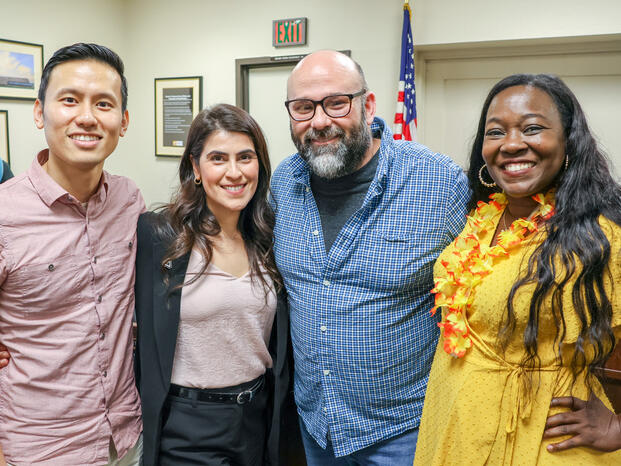
Flex is a program for faculty professional development related to staff, student, or instructional improvement administered by a Flex Program Coordinator through the Faculty Professional Growth (FPG) Committee.
A variety of activities are eligible for Flex credit. Examples include: On-campus workshops, Department activities such as program reviews, Individual projects such as new course/module development, Professional association conferences and coursework not for salary advancement.
Failure to complete and document your hours may result in loss of pay in the final pay warrant of the semester.
Faculty Professional Growth (FPG) Committee Page
Chancellor's Office Flex Category Guidelines
The three (3) listed categories are intended only as a guide. Flex Activities are not limited to these categories. Note that some activities may address more than one category and that many Library and PDC Workshops are "flex-eligible".
Employee Improvement
- Developing, enhancing or growing new programs and new courses (e.g., a workshop on designing curriculum/ programs)
- Full-time faculty, part-time faculty, classified staff, student employees, and administrators’ meetings to address areas of concern (e.g., academic advising, prerequisites, referring students for services
- Full-time faculty, part-time faculty, classified staff, student employees, and administrators’ (e.g., tutors, lab assistants) meetings to improve learning resource support services for students
- Workshops on how to mentor students or how to mentor faculty
- Orientation/education (e.g., new faculty; role of the academic senates; training students, staff, and faculty to serve on committees; changing role of technology in education)
- Student, faculty, and staff diversity (e.g., sexual harassment workshops, affirmative action conferences, cultural diversity seminars, multicultural activities)
- Meetings designed to improve a cohesive working relationship among members of the group (e.g., departments, divisions, committees, mixture of college constituencies)
- Workshops on how to write grants
- Workshops or individually designed activities to improve or enhance a person’s skills or knowledge in his/her own discipline
- Wellness activities that assist individuals to be physically and mentally better able to perform their jobs (e.g., humor in the workplace, stress reduction, self-defense, nutrition, exercise, weight reduction)
- Learning a second language to better communicate with the diverse student population
- Disaster preparedness (e.g., district procedures, first aid, review of facilities to determine areas of need)
- Improving or learning how to deal with computers and technology (e.g., Artificial Intelligence “AI”)
Student Improvement
- Developing a new program to meet changing student needs
- Full-time faculty, part-time faculty, classified staff, student employees, and administrators (e.g., tutors, lab assistants) meetings to improve services for students
- Review of learning resource materials to eliminate outdated items and make recommendations for additions
- Creating self-study modules and/or computer-assisted instruction
- Student advising (e.g., academic advising of students by part-time and full-time faculty)
- Mentoring of students
- Full-time and part-time faculty participation in student orientation programs
- Matriculation services (e.g., special orientation for ESL students, workshops in specific disciplines for students with undecided majors)
- Meetings (department/division/college-wide) specifically to discuss strategies for improving service to students
- Institutional research focused on meeting the needs of the students (e.g., job market surveys, transfer ratios, ethnicity data on students, gender equity, campus climate
- Writing grants aimed to improve services to students
- Articulation to improve transfer processes
- Outreach for special projects (e.g. Math, Engineering, and Science Achievement [MESA] program)
- Conducting special workshops for students (e.g. understanding the college schedule, transfer requirements, setting academic goals)
Instructional Improvement
- Attending workshops on teaching methods or techniques (e.g., classroom-based research training; Instructional Skills Workshops (ISW); local, regional, national Great Teachers Seminars)
- Development or revision of programs, course curriculum, learning resources and evaluation.
- Developing a new course
- Modifying an existing course to comply with changing institutional or discipline requirements (e.g., changing theories in a discipline, articulation with transfer institutions, critical thinking, multiculturalism, writing across the curriculum)
- Significant modification of a course to address the learning needs of diverse students (e.g., creating self-paced learning modules)
- Developing student readiness programs specific to course disciplines
- Faculty and counselor meetings to address areas of curriculum
- Review of learning resource materials to eliminate outdated items and recommend additions
- Creating self-study modules and computer-assisted instruction modules
- Student, faculty, and staff diversity (e.g., sexual harassment workshops, affirmative action conferences, cultural diversity seminars, multicultural activities)
- Departmental or division meetings to discuss overall curriculum and program review
- Institutional research (e.g., job skill requirements, research on transfer ratios, ethnicity data on students and staff. gender equity, campus climate)
- Grant writing to secure funds for improvement of instruction