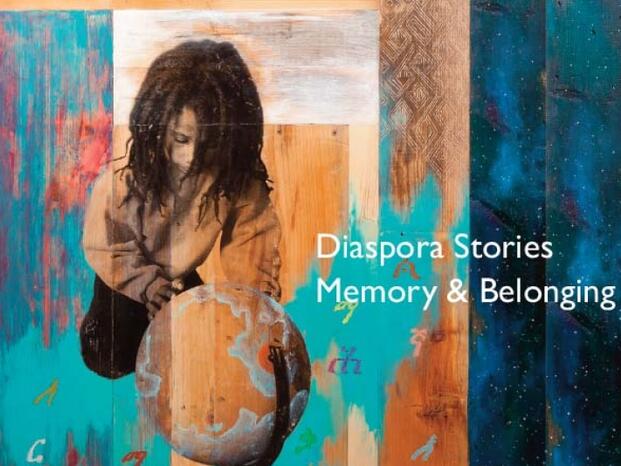
About the Exhibit
Diaspora Stories: Memory and Belonging exhibition present artists working in a
variety of creative processes that reflect on personal and historical diaspora stories, as
well as identity informed by cultural heritage and memories of their homeland. Their
work explores many common motives and histories for people to emigrate from their
ancestral homeland. References include immigration to the U.S. in search of
opportunity; the undocumented migrant experience of farmworkers and Dreamers; the
forced migration of enslaved Black people; and the WWII U.S. internment camps that
forced Japanese Americans to leave their homes to be interned for four years, simply
based on their country of origin.
Exhibiting Artists
For further information and to purchase artwork, please contact jan.marlese@deltacollege.edu
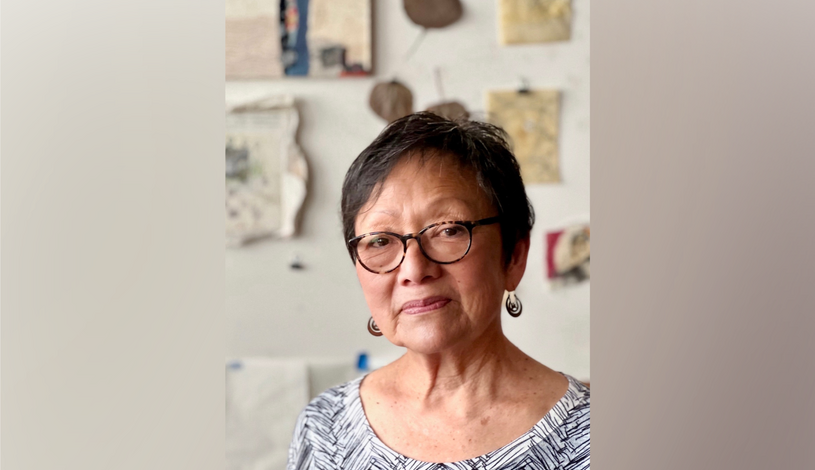
Ellen Bepp is a third-generation Japanese American mixed media artist based in
Oakland, California. Through art she confronts issues of social injustice and racism
against Black, Indigenous and People of Color. She was born in 1949 in San José,
California’s Japantown community, four years after her family returned from
incarceration at the Heart Mountain camp in Wyoming during World War II. She became
politicized by the Civil Rights and Black liberation movements of the 60s and joined the
Asian American political/cultural movement. In 1974 after training in taiko drumming
under Grand Master Seiichi Tanaka of San Francisco Taiko Dojo, she went on to
become a co-founder of San Jose Taiko and later a co-founder of Somei Yoshino Taiko
Ensemble. For her, taiko performance was a vehicle to express her Asian American
identity and self-empowerment as a woman drummer as was her journey developing
her own visual arts style. Her ties with folk art traditions of Asia and Latin America led
her to establish art-based relationships in Indigenous communities of Mexico,
Guatemala and Peru as well as humanitarian and cultural projects in Nicaragua and
Cuba.
Her work has been exhibited nationally, including at the Oakland Museum of CA; the de
Young Museum, San Francisco; Berkeley Art Center; Euphrat Museum of Art,
Cupertino; Jamaica Art Center, New York; Wing Luke Museum, Seattle; and the
Presidio of San Francisco. In the 1988 she co-founded 9-11 Studios, an artist-owned
live/work complex in Oakland where she lives and maintains her studio and continues to
remember and honor the legacy of her ancestors through artistic expression.
My work combines many cultural elements drawn from my Japanese ethnic origins,
working in collage, hand-cut paper and fiber art. I have a deep connection to traditional
Asian textiles and have also developed a kinship with those of the pre-Columbian era of
Latin America. From an early age I was surrounded by Japanese art and culture. As a
third generation Japanese American, I was raised with a sense of respect toward nature
and the notion that spiritual forces are "alive" in all objects: trees, rocks, rivers, and so
on. For me that spiritual force emanates from each scrap of fabric I utilize in my work,
like a metaphor for life, identity and personal history that is at the core of my art. Deeply
impacted by my family’s incarceration in American concentration camps during World
War II, I attempt to translate that legacy into peace, healing and community-building and
strive to address broader issues of social injustice today.
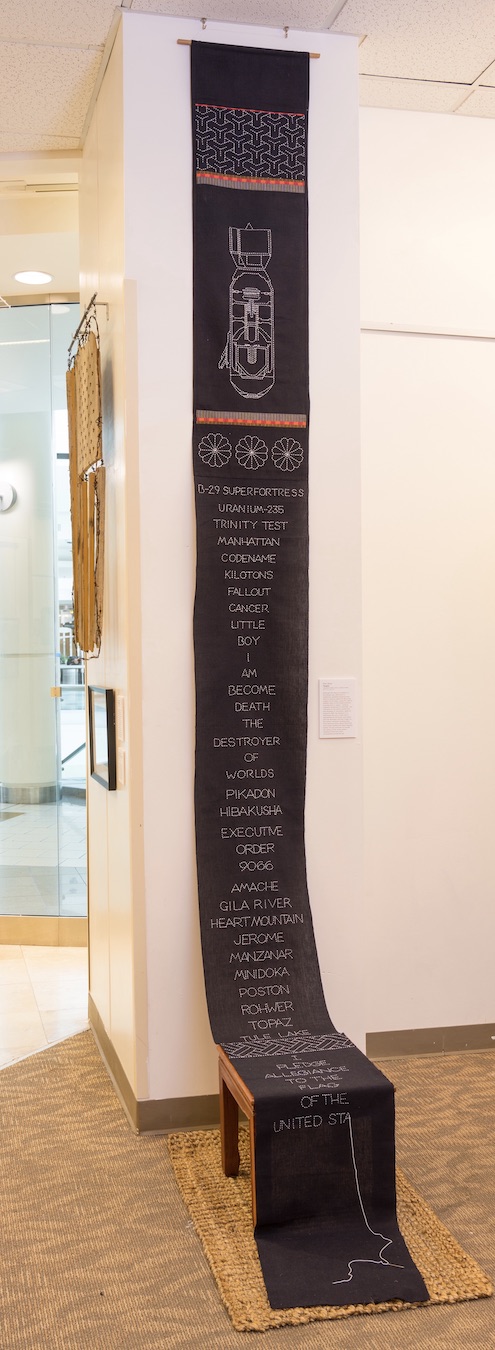
Targets (2022)
Japanese woven cotton fabrics,
Japanese-style sashiko hand-stitching
13-ft, 4” L x 14.5” W
NFS
This piece mimics the formal style of a traditional Japanese hanging scroll but with very
non-traditional subject matter. I chose this title referring to targets during war,
specifically during WWII in the form of the bombings of Hiroshima and Nagasaki, Japan
or targets of Japanese and Japanese American civilians who were arrested and
imprisoned in the United States.
I started at the top by using a rather staid design of Japanese woven and dyed fabrics
and embroidery work called sashiko. But gradually I juxtapose that against the subject
matter of death, destruction and injustice. To do so I embroidered a rendering of “Little
Boy” which was the codename of the type of atomic bomb used in the bombing of the
Japanese city of Hiroshima on Aug 6, 1945. That is followed by text highlighting some of
the terminology used at the time to describe the horrors of these actions followed by the
names of the 10 US concentration camps. The final lines of text are of the Pledge of
Allegiance, incomplete, but ending with a single thread trailing off and abandoned just
as Japanese Americans were forcibly removed from their homes.
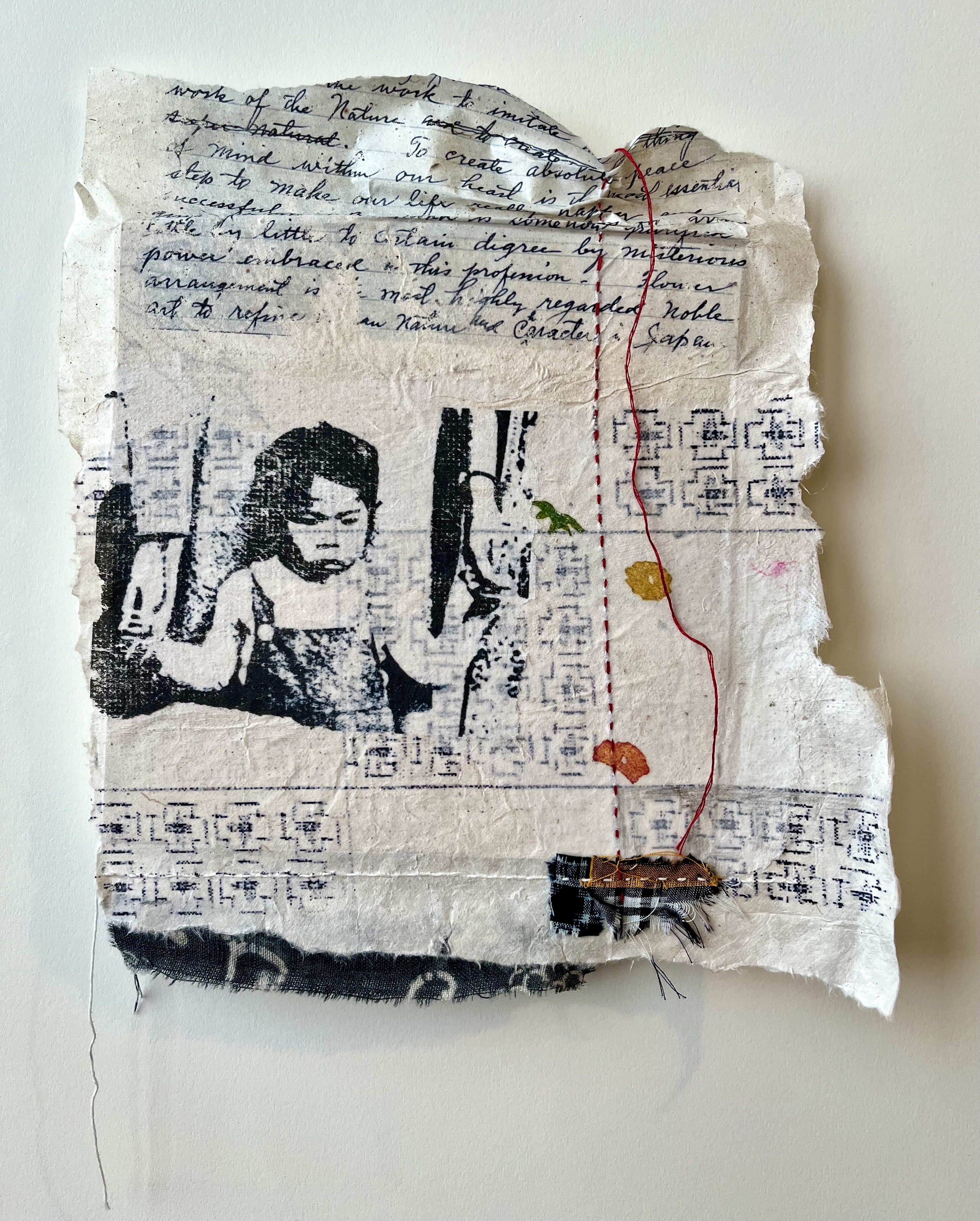
Celia Miyo Bepp
handmade paper, vintage fabrics, hand-stitching,
photo transfers, dried leaves, mounted on 3/4” studio board
12” x 11”
NFS
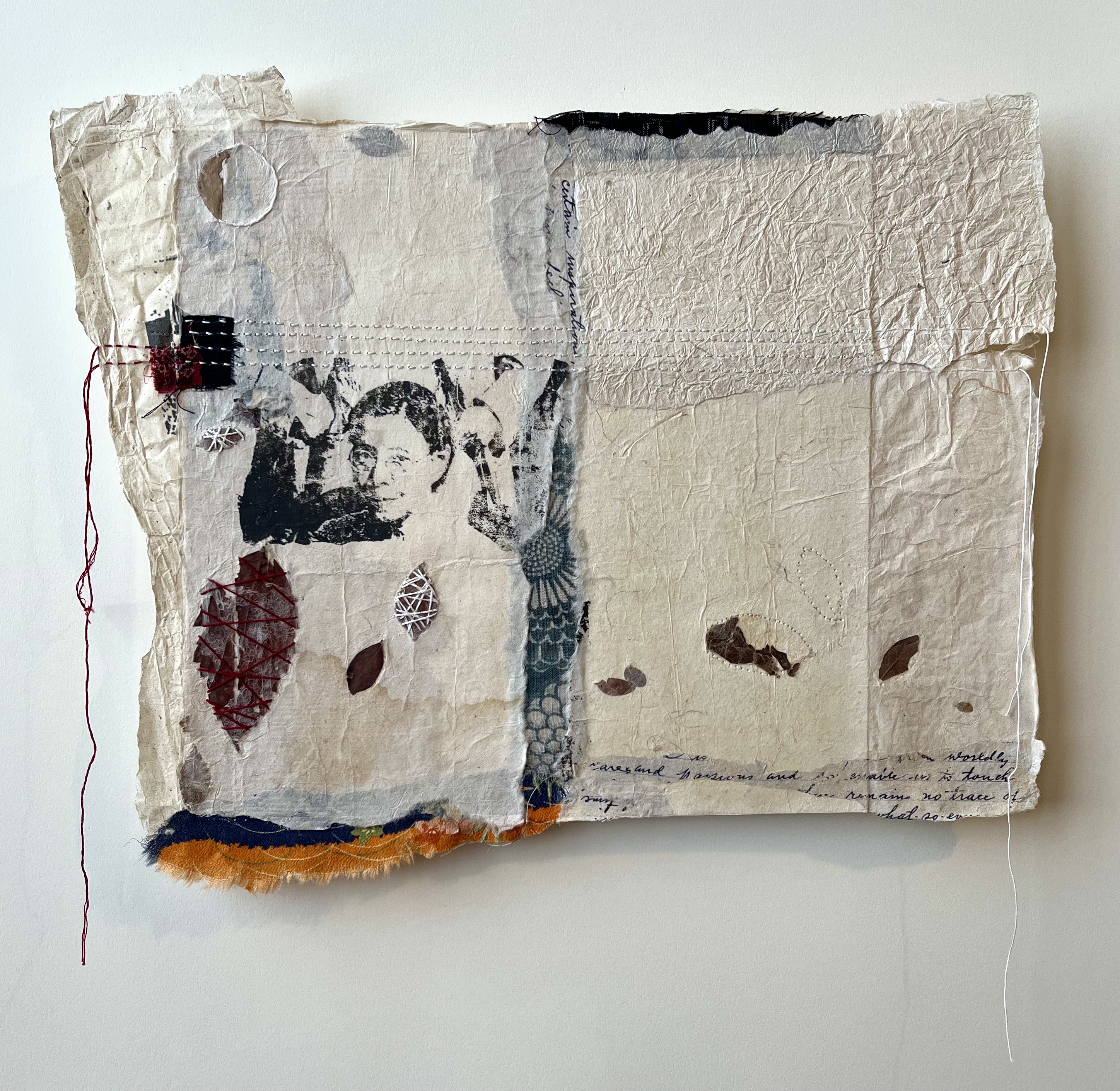
Sumi Bepp
handmade paper, vintage fabrics, hand-stitching,
photo transfers, dried leaves, mounted on 3/4” studio board
14” x 17”
NFS
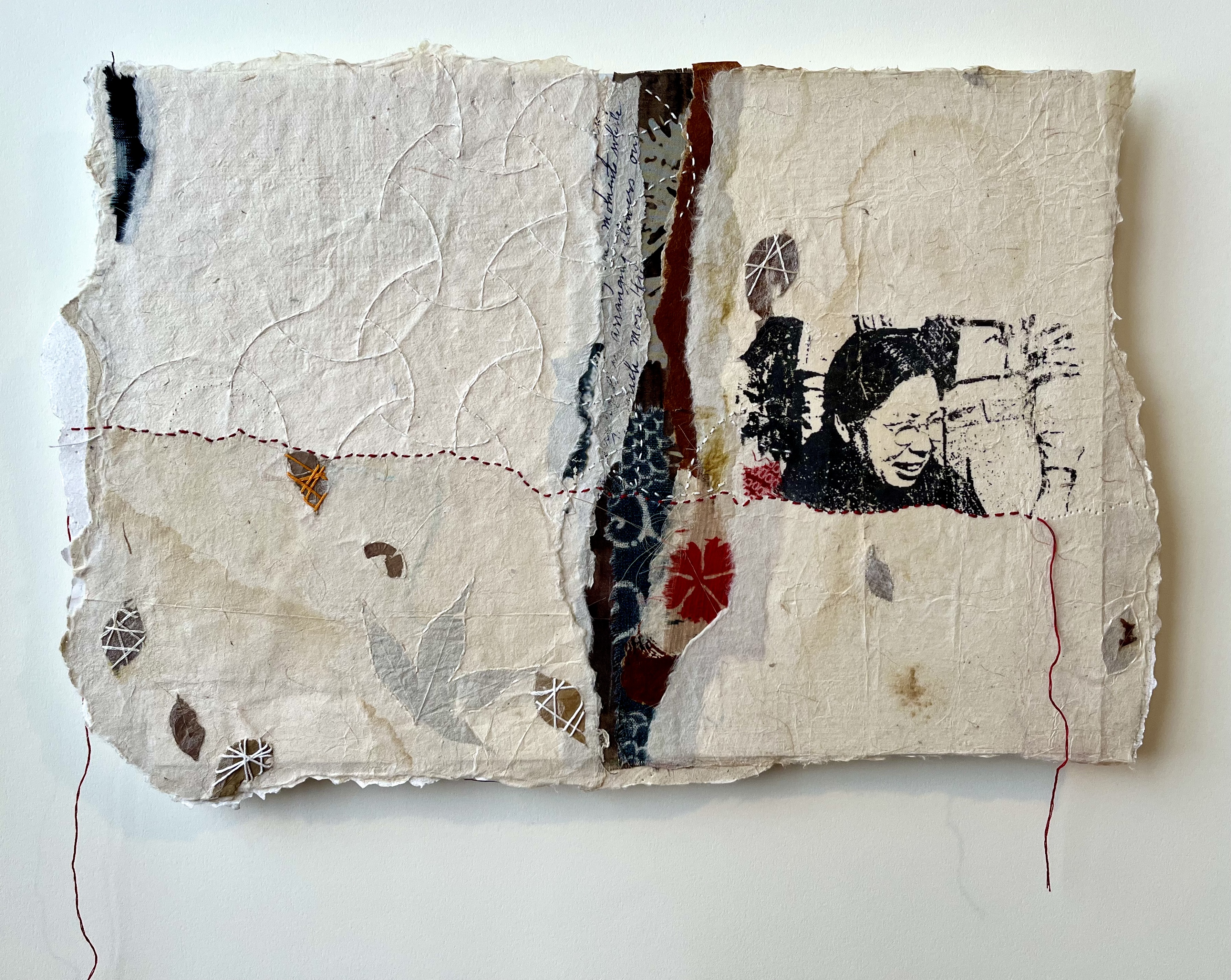
Haruyo Higuchi
handmade paper, vintage fabrics, hand-stitching,
photo transfers, dried leaves, mounted on 3/4” studio board
13” x 19”
NFS
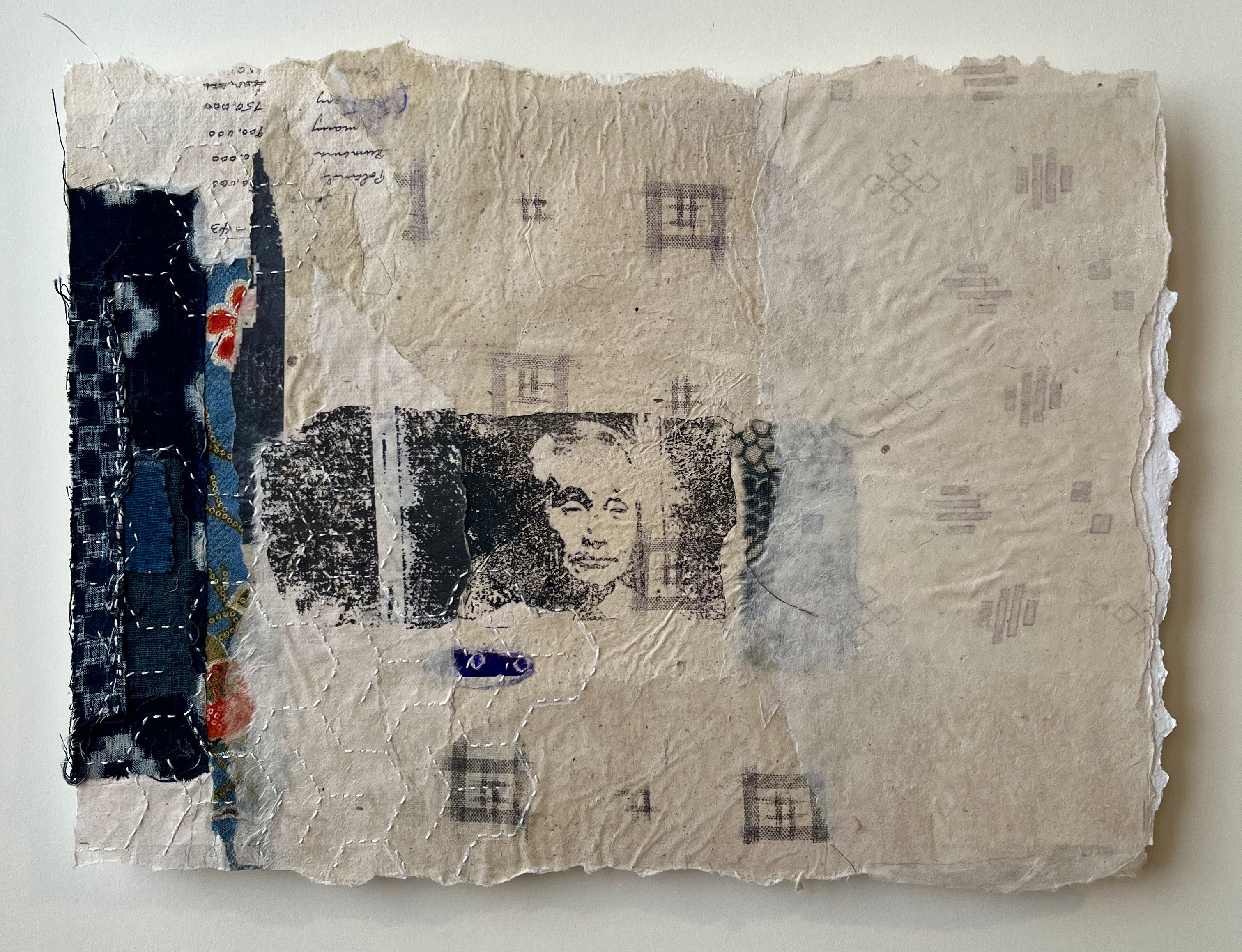
Hikoshichi Higuchi
handmade paper, vintage fabrics, hand-stitching,
photo transfers, dried leaves, mounted on 3/4” studio board
13.5” x 17.5”
NFS
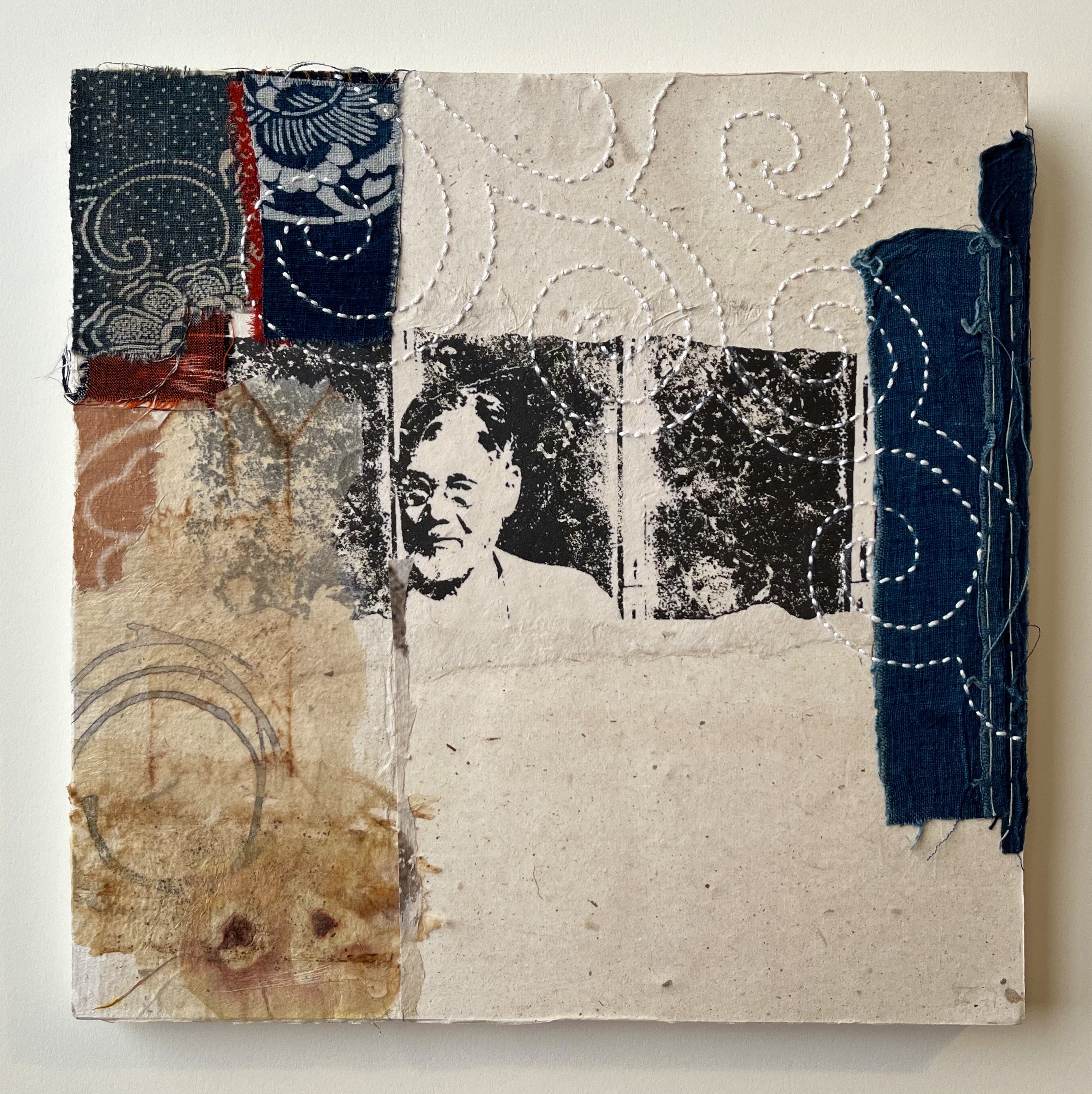
Kiroku Bepp
handmade paper, vintage fabrics, hand-stitching,
photo transfers, dried leaves, mounted on 3/4” studio board
12” x 12”
NFS
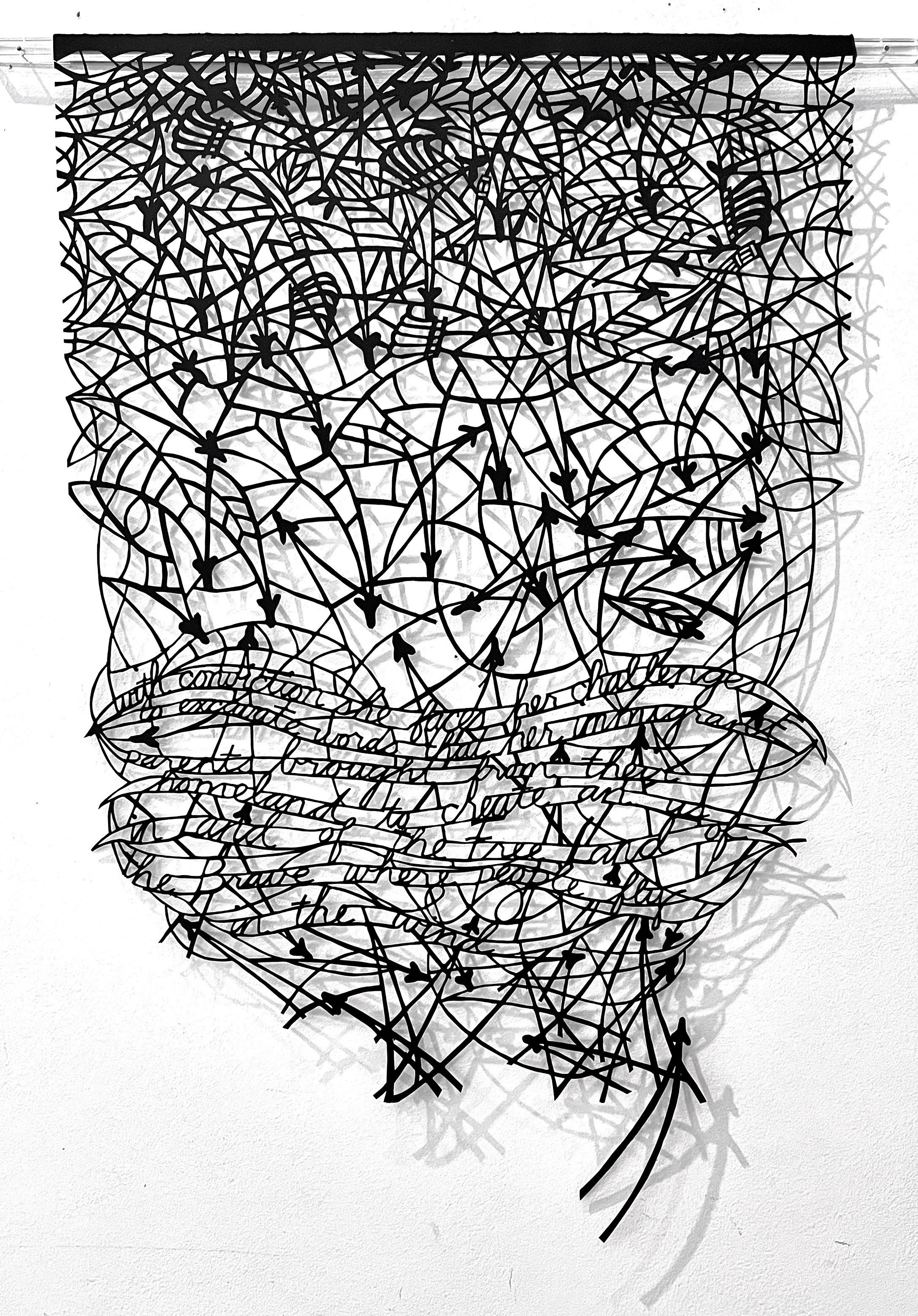
Her Words (2023)
hand-cut paper - 34.5” x 22”
plexi-box frame - 43” x 25” x 3”
This hand-cut paper piece honors the courage of my immigrant grandparents whose
personal visions spurred them to cross an ocean from Japan to the United States in the
late 1800s. I was inspired by the following poem by artist/poet Flo Oy Wong and
included her words in this piece. I use the pine needle motif which holds great power in
Japanese spiritual mythology. They are symbols of longevity, guardians of the living and
the dead:
Her Words Brought Us the Wind
With conviction she faces her
challenges to excavate words
that her immigrant parents brought
from their homeland to create an Us
in Land of the Free,
Land of the Brave
where people fly in the wind
(Poem by Flo Oy Wong, November 2022, inspired by a phrase written by Ellen Bepp
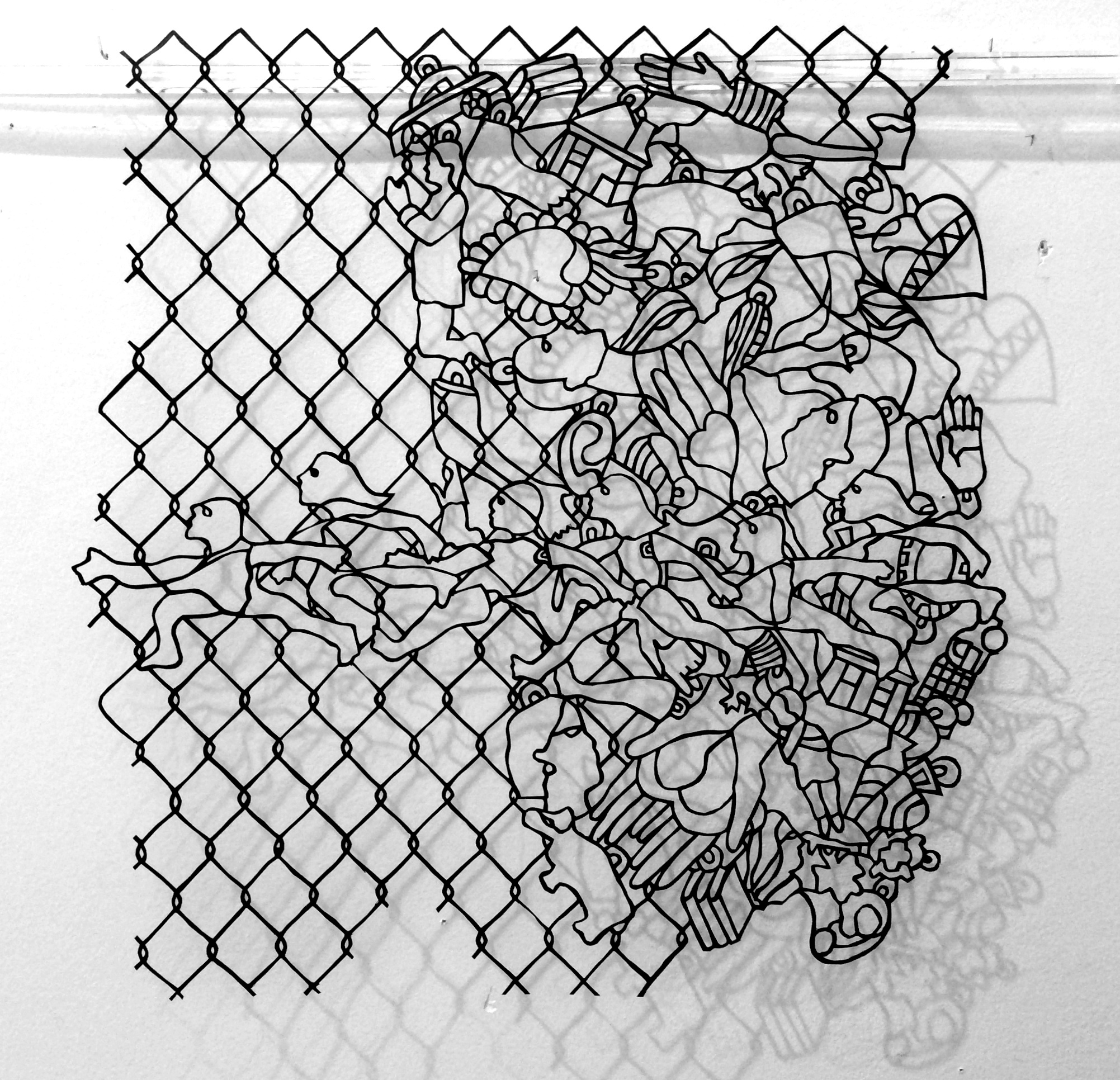
La Venganza de Los Milagros / The Revenge of the Miracles (2017)
hand-cut paper - 19” x 18”
plexi-box frame 25” x 24.5” x 2”
NFS
This handcut paper piece originated as a statement of resistance against the Mexico/US
border wall which the US administration has pushed for as far back as the 1990s. In
Spanish “venganza” means “revenge” and “milagro” means “miracle”. Specifically in
Mexico the milagro is a small metal votive offering usually in the shape of various body
parts or everyday objects, used for protection or as prayers for improvement. The
milagros I depict have transformed into a unified force against barriers between nations
and people. This piece pays tribute to the courageous migrants/refugees who have
broken through borders and continue to struggle to defy persecution.
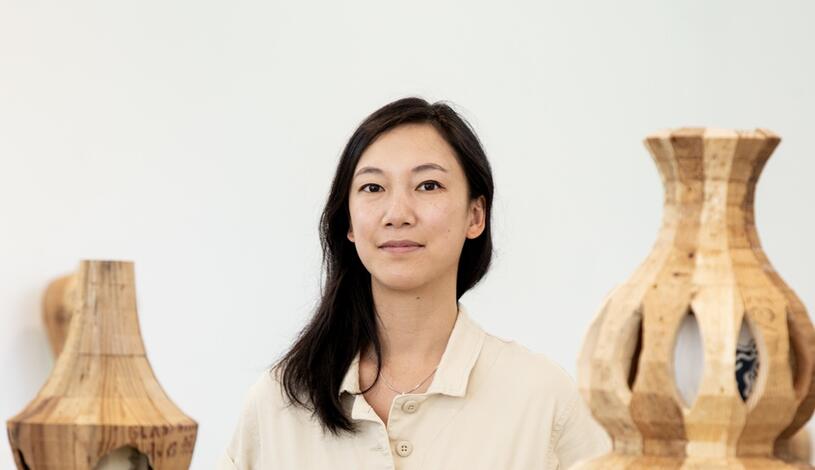
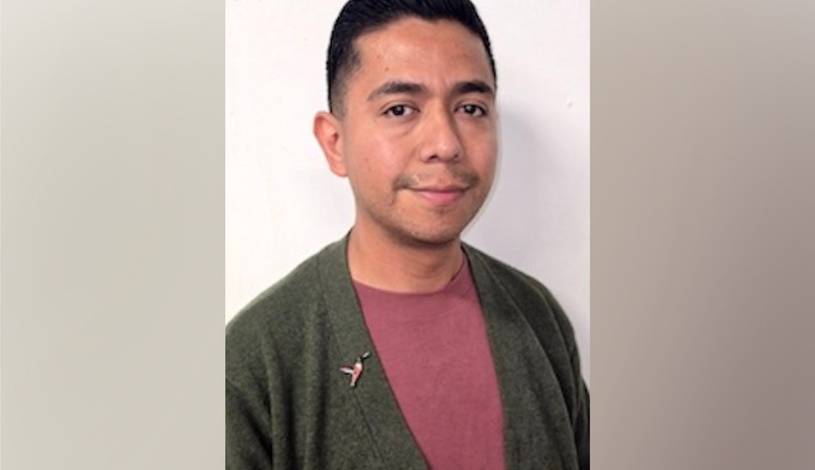
Vivian Chiu (b. 1989) was born in Los Angeles and emigrated to Hong Kong at the age
of three. Her interests in creating objects and the visual arts led her to attend the Rhode
Island School of Design (BFA '11 Furniture Design) and Columbia University (MFA '19
Sculpture). Vivian uses labor-intensive, repetitive processes to create optical sculptures
from wood. She has attended residencies such as Bemis Center for Contemporary Arts,
Penland School of Crafts, Houston Center for Contemporary Craft, Sculpture Space,
Haystack Mountain School, Anderson Ranch Arts Center, Center for Furniture
Craftsmanship, and the Museum for Art in Wood. She was awarded a 2020
NYSCA/NYFA Artist Fellowship in Craft/Sculpture, a 2023-24 VMFA Fellowship and was
a third place recipient of the Virginia A. Groot Award for Sculpture. Her work is part of
the permanent collections of Museum for Art in Wood, Museum of Fine Arts Houston
and the New York State Museum. Vivian currently lives and works in Richmond, VA.
Expressed through a continuous reconfiguration of wood, my work explores the
mechanics of identity formation. I create abstract optical sculptures and intricate self-
portraits that reveal and conceal the female body, investigating notions of
visibility/invisibility within the context of my identity as a queer Asian woman. My most
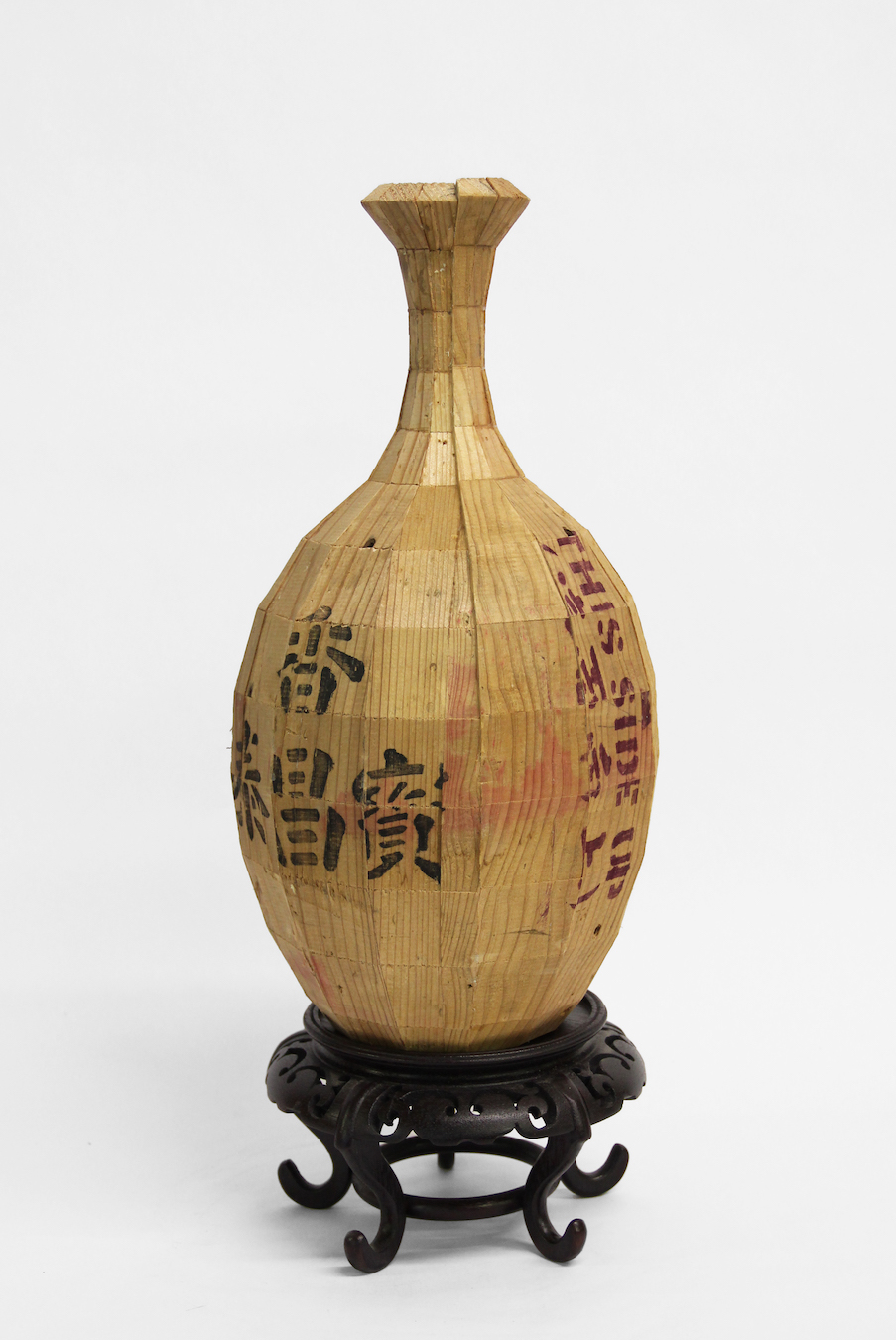
recent series of crate wood vessels titled “Passages (those that carried us)”, consists of
vessels crafted from reclaimed wooden crates gifted to me by Wing on Wo & Co.
(W.O.W.), the oldest storefront in Manhattan's Chinatown since 1890. For this series,
crate panels are carefully deconstructed, cut into faceted pieces, and reassembled to
echo the ceramic vessels they once held. This meticulous process preserves the crates'
stampings and markings, tangible traces of their journey from Asia to the United States,
symbolically reflecting the migration stories of the Lum Family at W.O.W. and my own.
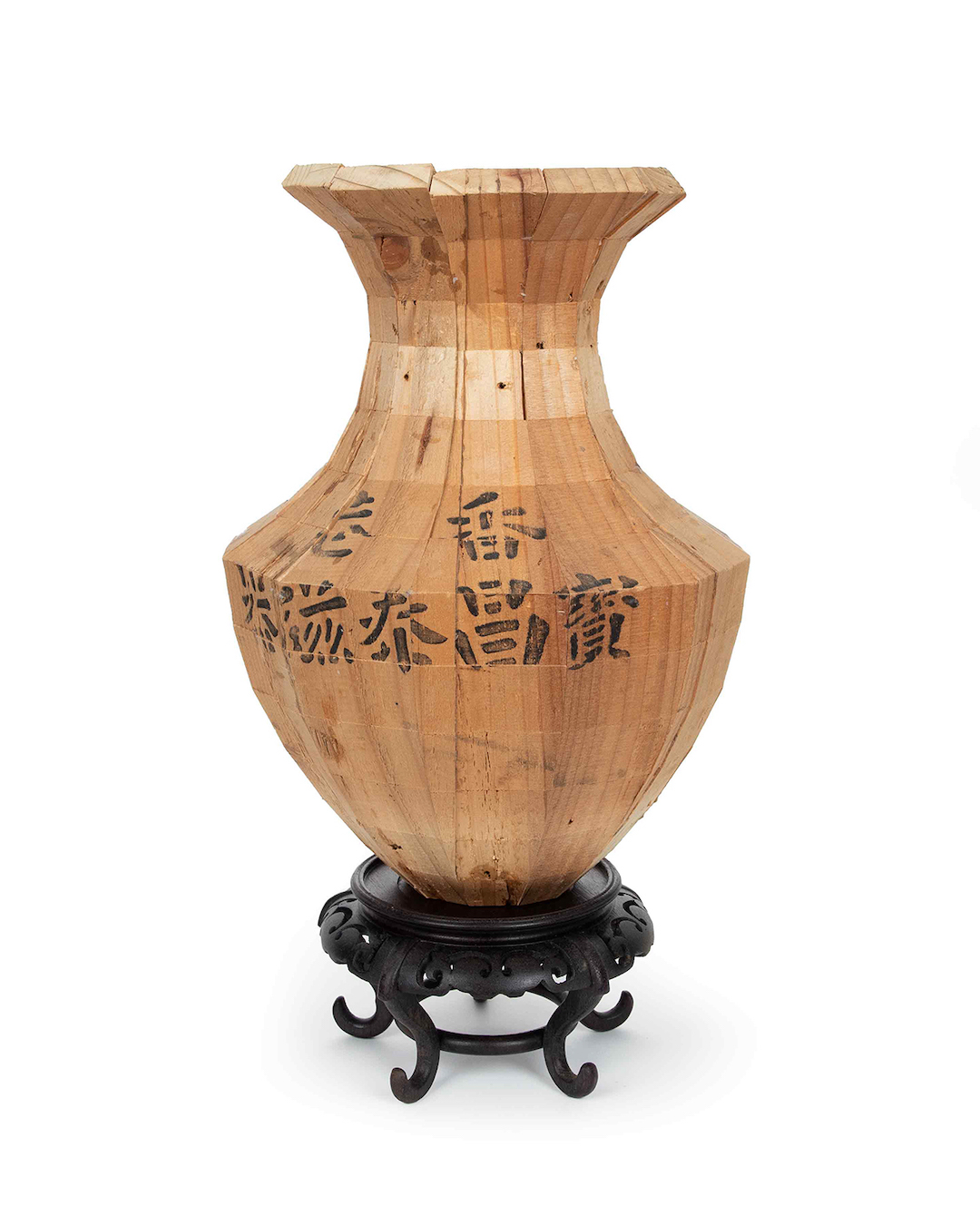
Thick Neck Vase II (2024)
Pine Crate Wood from Wing On Wo & Co., Rosewood Stand
16.5" x 12" x 12"
$8,888
Hanging Duck Vase (2024)
Pine Crate Wood from Wing On Wo & Co., Rosewood Stand
15.5" x 9" x 9"
$4,888
José Flores Nava (he, him, él) is a Southern California–based artist working primarily in
ceramics. Born in Mexico, he moved to the United States at the age of twelve. Although
his interest in visual art began at an early age, it was during college that he committed
to art as a field of study and a means of expression.
Using a combination of handbuilt ceramic forms, slip-cast objects, and brightly saturated
surfaces, Flores Nava creates sculptural work that reflects the lived realities of
undocumented immigrant communities. His practice examines the relationship between
labor, the body, and everyday objects that are often overlooked despite their central role
in sustaining daily life. Fruits, vegetables, and vessels function as surrogates for the
human body, referencing systems of nourishment and labor that move from the field to
consumption.
Many of the sculptures are nested within forms associated with outdoor utility or
domestic use, including buckets, cans and bowls. These materials and forms point to
labor, care, and repetition, inviting viewers to consider not only the systems that support
contemporary life, but also the individuals whose labor makes those systems possible.
Flores Nava holds a Bachelor of Fine Arts and a Master of Fine Arts from California
State University, Fullerton. He is a DACA recipient and is currently pursuing a career as
an educator. His work has been exhibited at institutions including the Grand Central Art
Center, Irvine Fine Arts Center, American Museum of Ceramic Art, Huntington Beach
Art Center, Brea Gallery, ALMA’S RVA, Eutectic Gallery, Northern Clay Center,
Companion Gallery and Rio Hondo Art Gallery.
As an artist and potter, I give meaning to the vessel beyond a function. The forms I
create act as surrogates for the human body. Containers that hold, endure and are
pressed by the weight they carry. These vessels echo outdoor utilitarian objects and the
systems of food production that shape our daily life. They trace a path from labor to
consumption, moving through hands that plant, harvest, transport, prepare and share
food. Along this path, bodies are repeatedly bent, compressed, and worn down in
service of their labor and abundance.
As an immigrant, I feel the responsibility to acknowledge the undocumented immigrants
whose bodies are pressed by the political realities of our time. Their labor feeds
communities while their presence is regulated, debated, and often persecuted. Often
dismissed as expendable and other times labeled essential, they remain excluded from
visibility and belonging. They’re spoken about through policy and statistics rather than
humanity. The pressure placed on their bodies reflects a broader climate of control, fear
and exploitation embedded within immigration and labor systems.
In my work, I reimagine familiar produce by casting fruits and vegetables in clay, a
material that is both strong and fragile. These forms are deeply connected to the land
and to the Americas. These crops carry long histories of cultivation, migration and
survival. Shaped by Indigenous knowledge, colonial extraction, and ongoing
displacement and resilience. The sculptures embody resilience under pressure. Their
surfaces are brightly painted to insist on presence, beauty and resisting disappearance.
The cast fruits and vegetables are nested within vessels associated with outdoor labor
and domestic use, including buckets, cans, and bowls. These objects reference work,
containment, and home. Together, they create a collection of bright and beautiful
sculptures that ask viewers to consider those whose bodies make abundance possible
and how systems of labor continue to push and press upon those bodies in our present
moment.
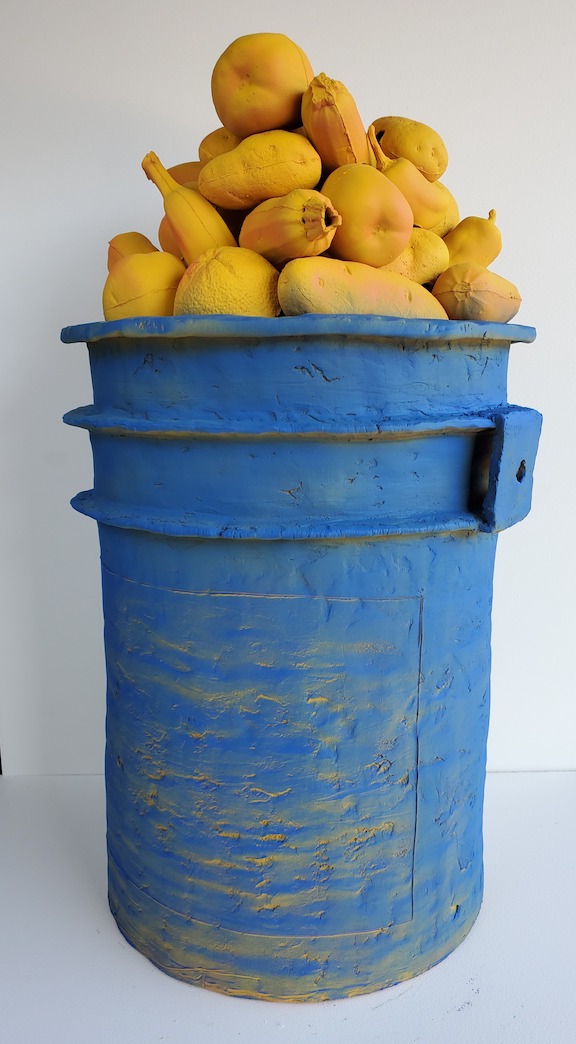
Half-full Bucket (2020)
Stoneware, terracotta, adhesive, house paint, wire mesh
25Hx 15W x 15D
$1000
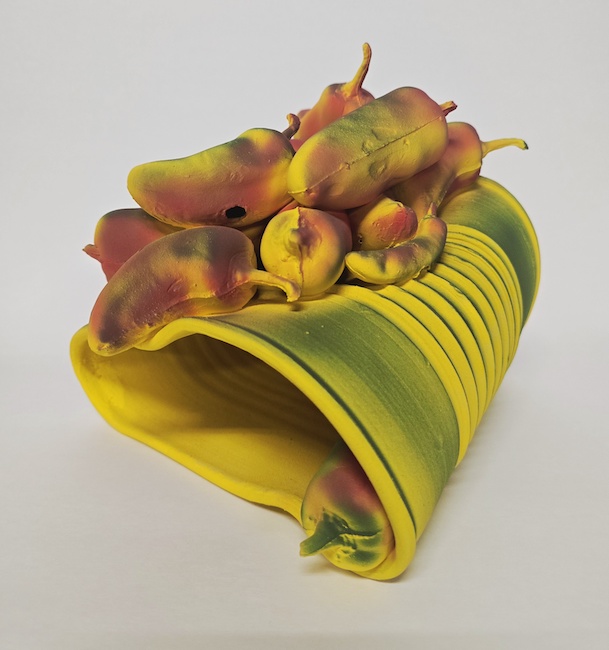
Canned Jalapeños (2024)
Stoneware, underglaze
8.5in x 8.5in x 8.5
$700
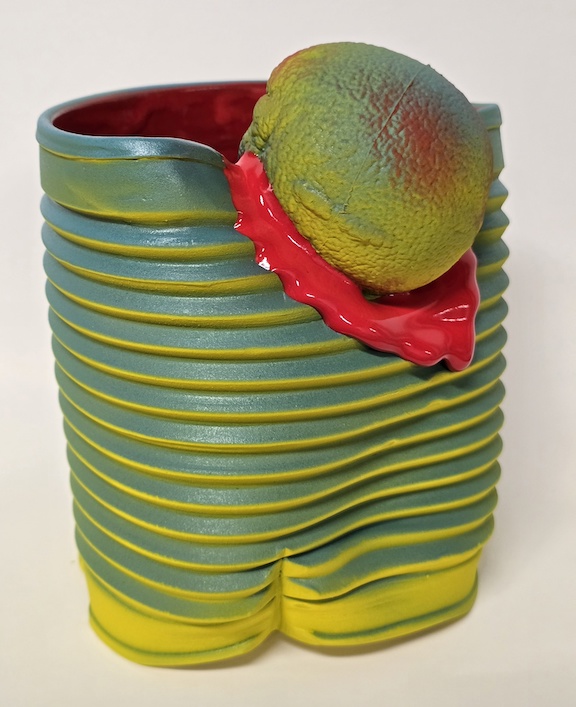
Pressed Bodies / Cuerpos Oprimidos–Red (2025)
Materials: Stoneware, underglaze, glaze
Dimensions: 9in x 7.5in x 7.5in
$400
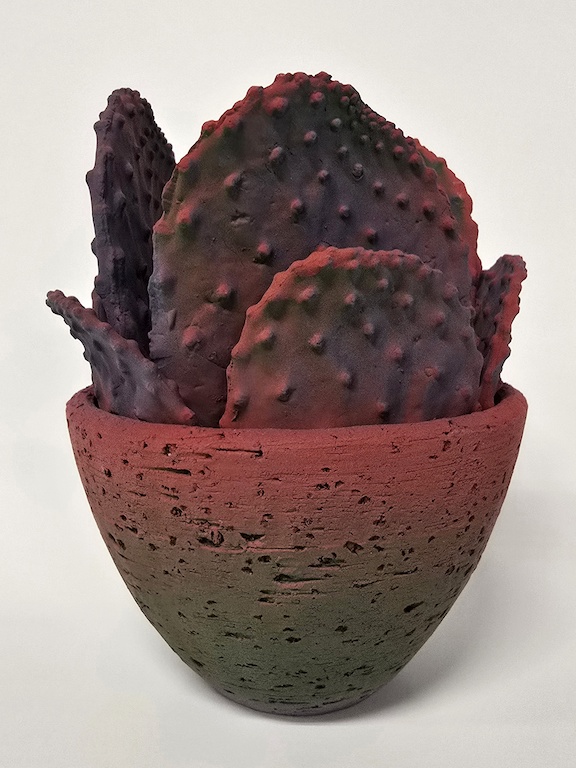
Nopales in Red (2025)
Stoneware, underglaze, adhesive
8.5in x 6.5in x 6.5in
$500
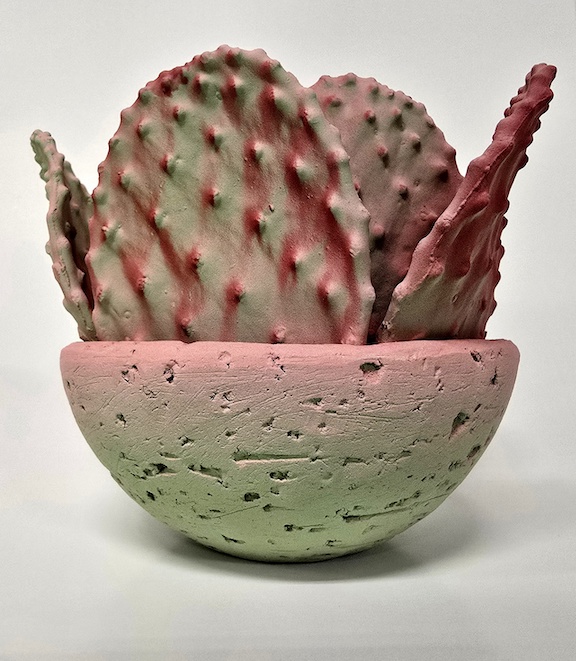
Pink and Green Nopales (2025)
Stoneware, underglaze
6H x 7W x 7D
$350
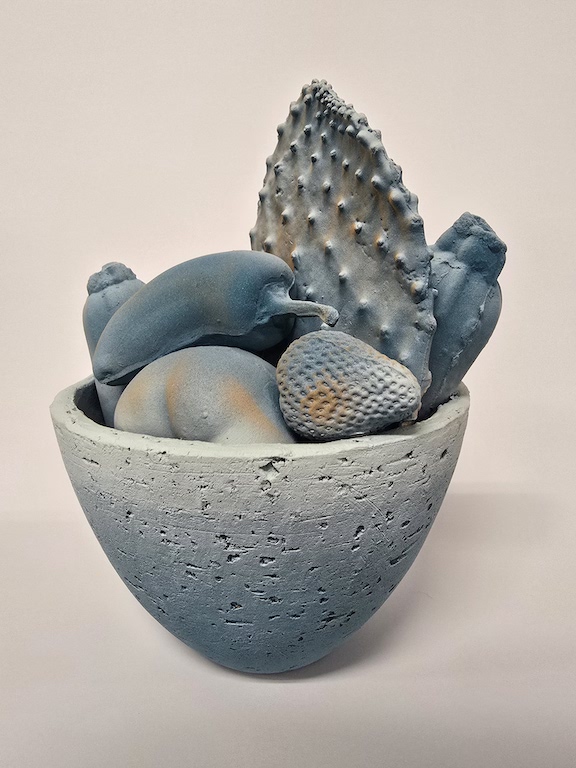
Frosty Composition (2025)
Stoneware, underglaze
8.5H x 6.5W x 6.5D
$400
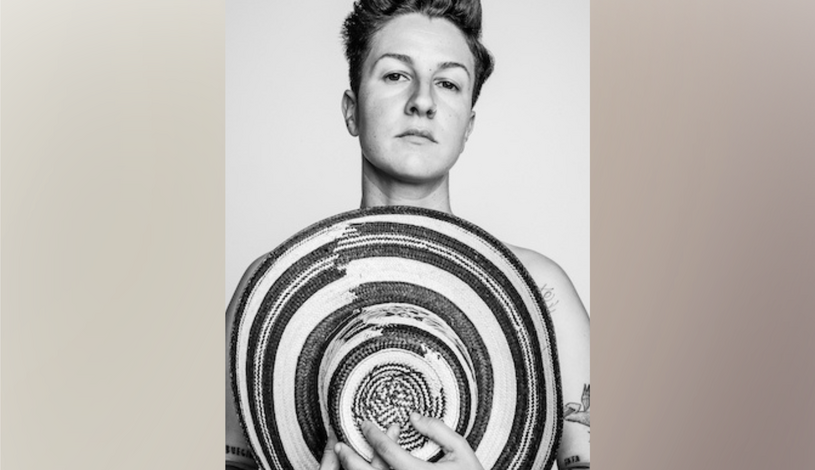
For first generation Colombian American graffiti artist, Jessica Sabogal, art serves as a
haven, a tribute, a creative outlet of adoration and exaltation for women with stories
often untold. Her pieces possess a vision of female identity that is revolutionary and
powerful, brave and beautiful. By utilizing a spray can, she aims to color her canvas by
unraveling stories she once heard, lived, struggled, and loved.
In the past she’s been inspired by literary works written by poets, authors, and women
of color, and have utilized their experiences and their existence as the sole muse for her
creations. But most recently, she has created a line of work that honores the woman
and female body as perfect. Her newest campain entitled, “Women Are Perfect (If You
Let Them)” attempts to spread this simple but necessary notion worldwide.
Throughout the years, Sabogal has consistently reinvented what it means to be a
female graffiti artist in a male-dominated medium. She has continuously pushed the
boundaries as an artist by utilizing her medium for social change, action, and
empowerment. Since 2011, Sabogal has made front page on CNN.com with her time-
lapse tribute to Egyptian revolution, designed the 20th Anniversary Cover for Plume
Book’s Bastard Out of Carolina, and is the first female artist commissioned to paint
murals at Facebook Headquarters.
Sabogal is an artist that continues to grow with resilience, prosper with purpose, and
paint without fear. She seeks to connect the world around us with art that reminds all
that women are to be valued, glorified, respected, and above all, loved.
This triptych is a sixteen-color serigraph depicting three members of Las Santas Locas,
an all-women lowrider club in San Francisco. The portraits are based on photographs
taken in 1979 by the artist’s late mentor, Chicana artist Yolanda López.
Imagery surrounding the portraits, including three Cihuateteo figures, was drawn from
López’s personal archive and the artist’s family collection. Many of these materials had
been stored in López’s basement for decades. The process of uncovering and printing
these images became a ritual of grief and remembrance.
Through the labor of printing each layer, the artist reflects on López’s legacy and the
conditions under which earlier generations of Latinx artists worked. López, like many of
her contemporaries, struggled to sustain herself through her practice. The work invokes
the Cihuateteo, spirits associated with women who died in childbirth, as a framework for
understanding artistic labor and sacrifice.
This triptych situates the artist’s practice within this lineage.
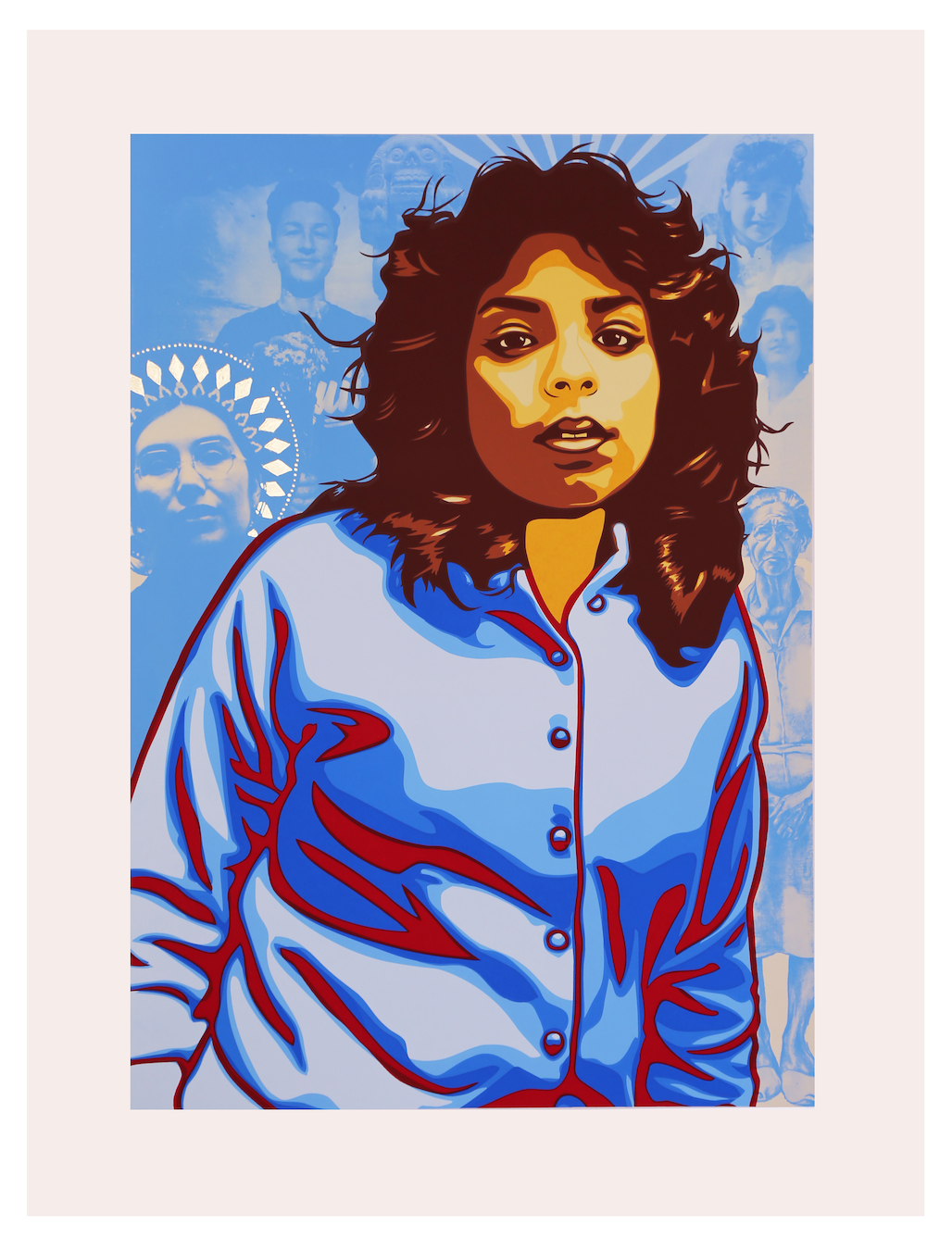
¿A Dónde Llegaste, Chicanx? I (2024)
Serigraph print
Edition of 10
26" x 35"
$3200 each
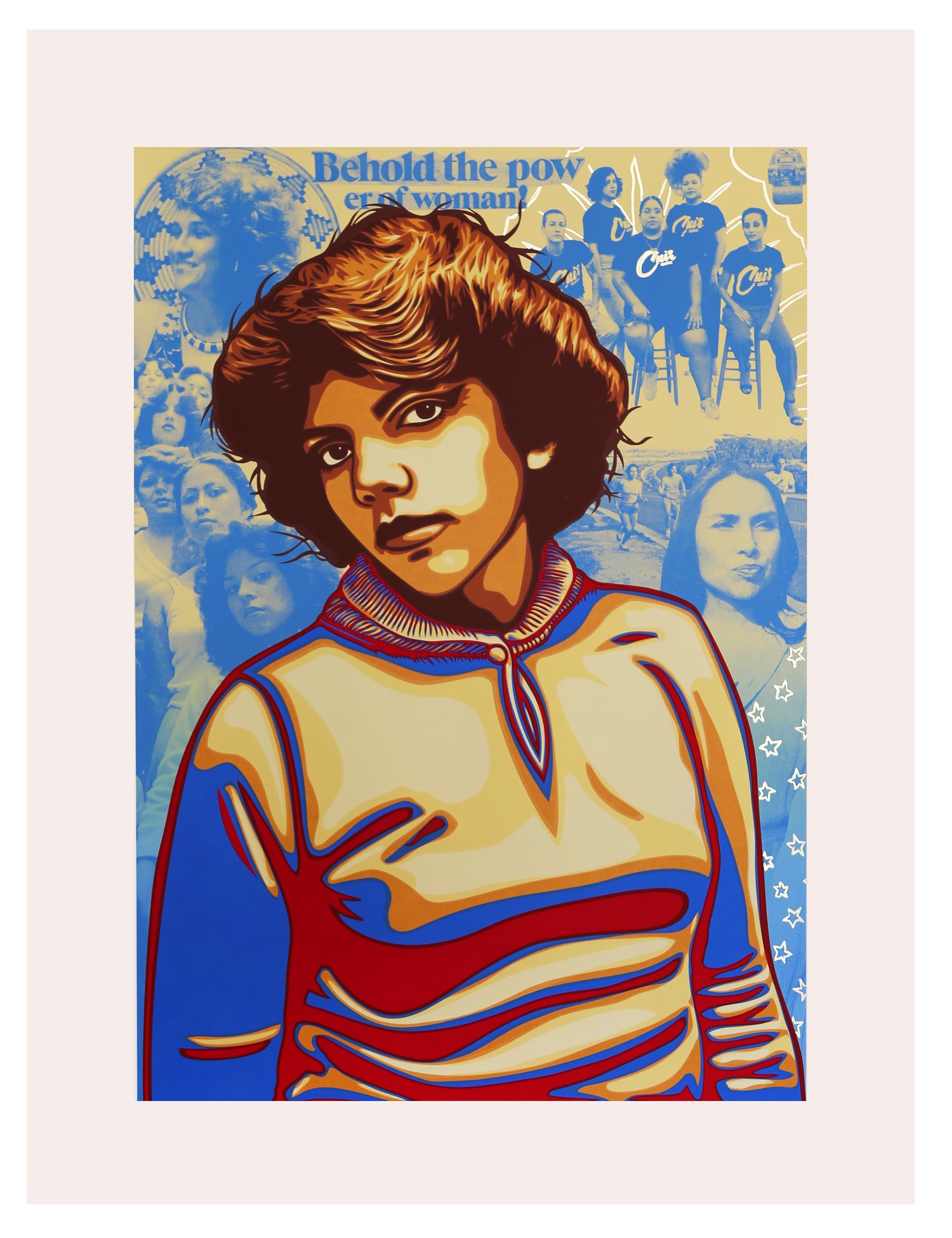
¿A Dónde Llegaste, Chicanx? II (2024)
Serigraph print
Edition of 10
26" x 35"
$3200 each
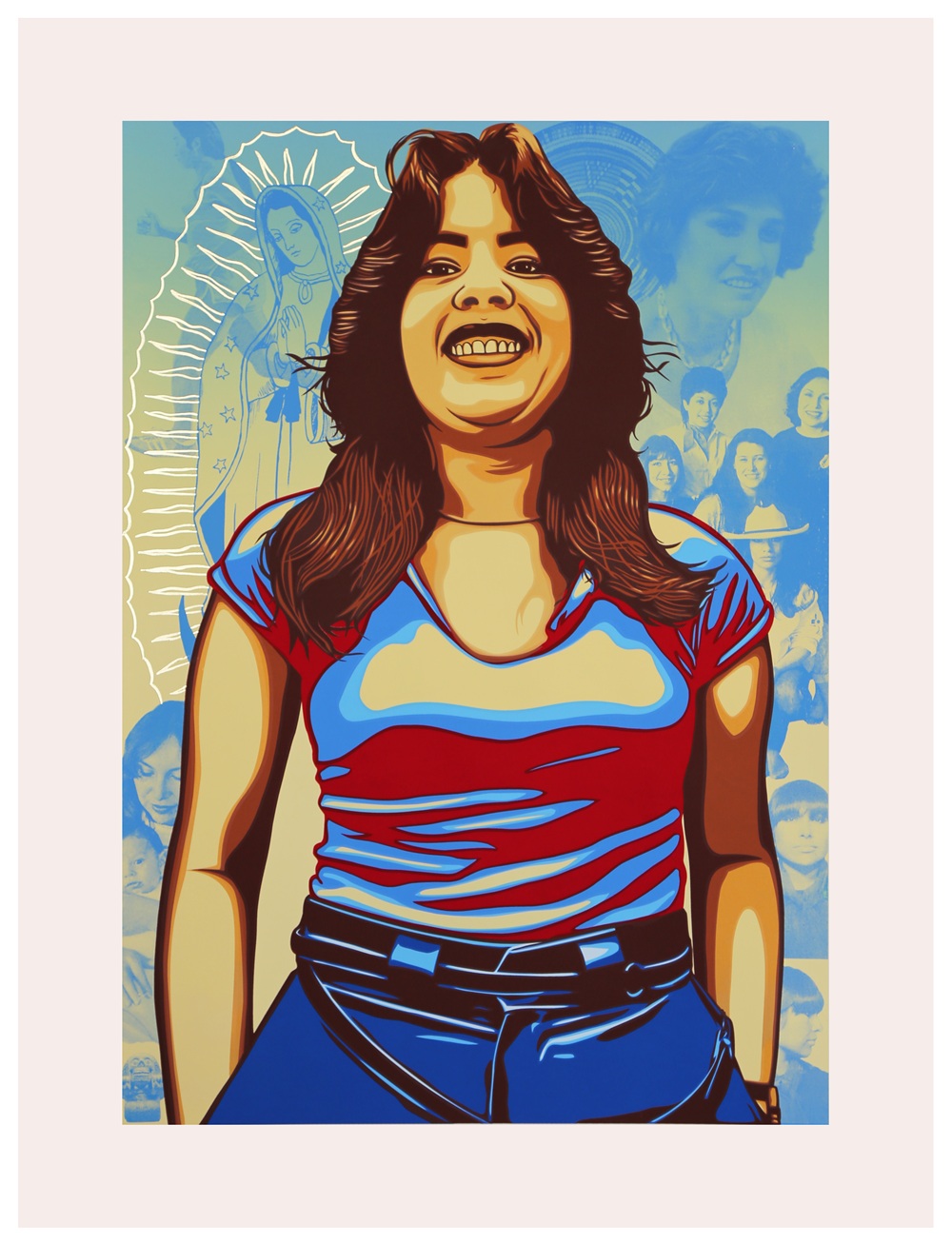
¿A Dónde Llegaste, Chicanx? II (2024)
Serigraph print
Edition of 10
26" x 35"
$3200 each
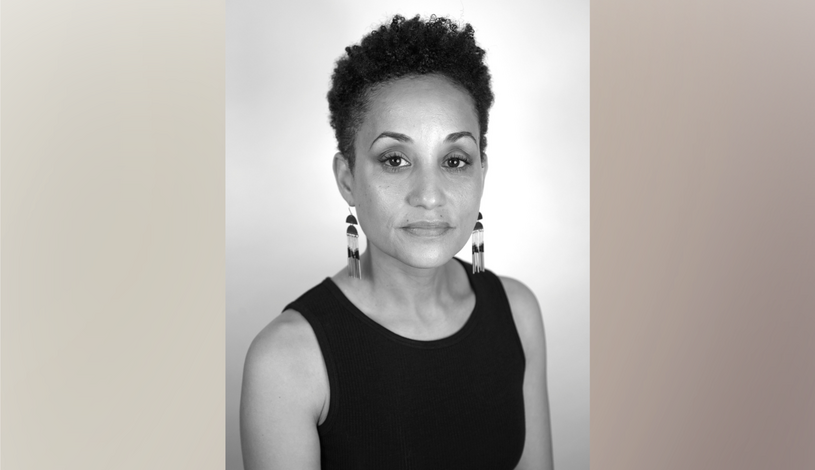
Shanna Strauss is a Tanzanian-American mixed media artist and printmaker currently
living and working on Ohlone unceded territory (Oakland, CA). Raised in Tanzania, she
later moved to Canada and eventually the United States. Her work explores oral
tradition, family legacy, ancestral memory, and spirituality within African diasporic
traditions, paying homage to the women in her family and the communities to which she
is connected.
Shanna holds a Bachelor of Fine Arts from the California College of the Arts and a
Master of Social Work from McGill University. She has exhibited nationally and
internationally, including the Montreal Museum of Fine Arts, the de Young Museum, Art
Toronto: Contemporary Art Fair, and Papier Contemporary Art Fair. Her work has been
featured in publications such as Canadian Art, The Washington Post, and the San
Francisco Standard.
Her work is part of private and public collections, including the Montreal Museum of Fine
Arts, the North Dakota Museum of Art, the Euphrat Museum of Art, the Library of
Congress, and San Francisco International Airport. She is the recipient of several
awards, including the Prix Powerhouse from La Centrale Galerie, the Kala Art Institute
Printmaking Fellowship, and the Denbo Publishing Fellowship at Pyramid Atlantic Art
Center.
Public art and community engagement are also central to her practice. Her commitment
to radical social transformation has inspired collaborative projects and large-scale public
murals that center the experiences and stories of BIPOC individuals and communities.
Her public artworks can be seen in Montreal, Tucson, San Francisco, El Cerrito, and
Sacramento.
My work begins with stories, those passed down to me, those I carry in my body, and
those I am creating to reflect who I am. I am constantly navigating the terrains of past
and present, the physical and the spiritual, and the spaces where they converge and
transform. Through an interdisciplinary practice, I explore the fragmented, layered and
ever-changing notions of self and home and belonging.
I am drawn to the tactile intimacy of materials: wood weathered by time, beads that
echo the hands of my ancestors, and fabrics that speak of home. Each piece becomes
a site of transformation, where inherited legacies are both preserved and reimagined.
This process is not simply about remembering; it is about reinventing, carving out space
for new narratives that honor my kinship and connection to the African diaspora.
For me, the act of creating is both a personal ritual and a collective offering. It is a way
to give form to the invisible: the resilience, spirituality, and continuity of those who came
before me. I see my work as a bridge, a way to weave together fragmented histories
and transform them into something whole, empowered, and alive.
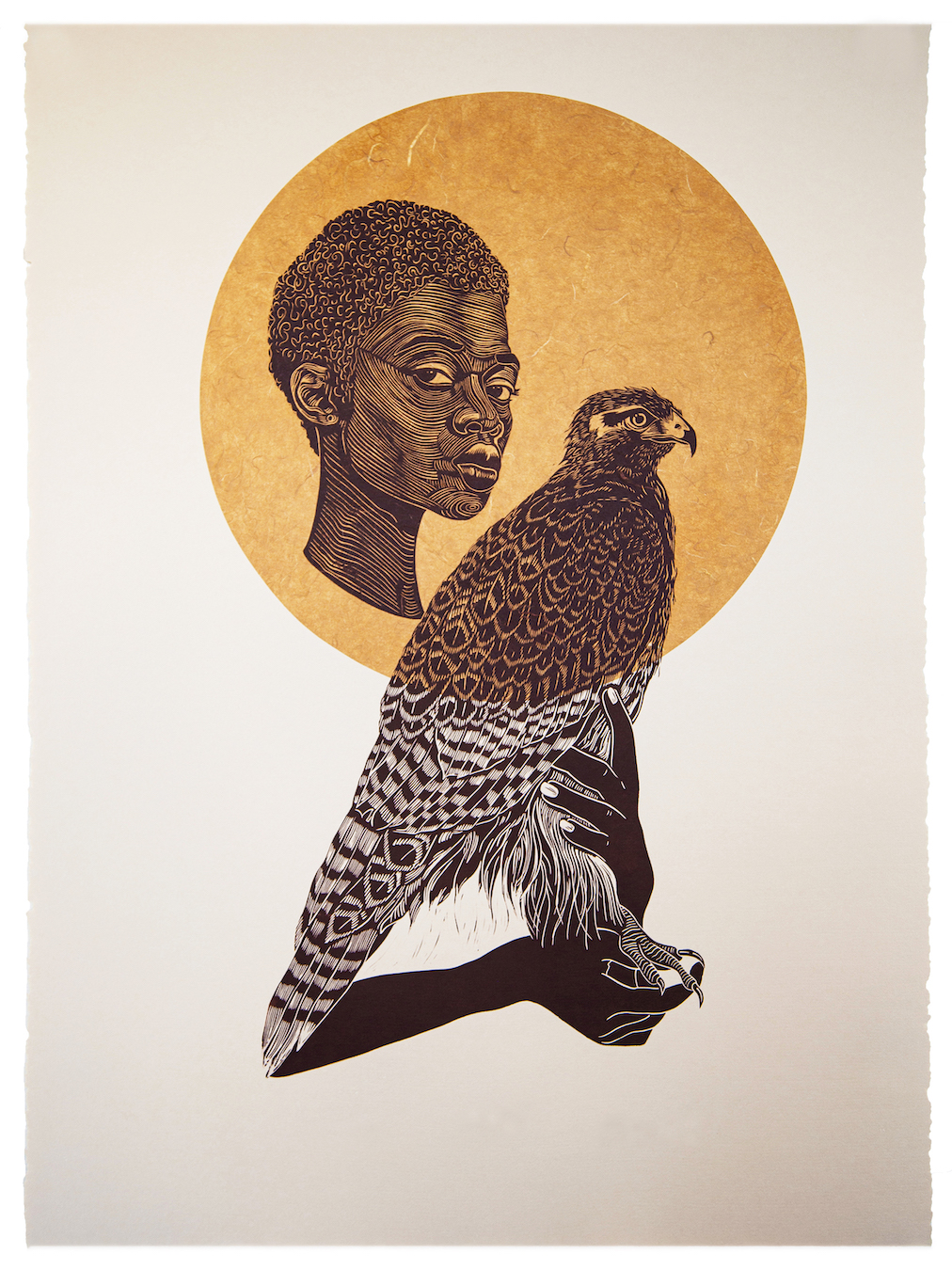
Nia (2021)
Linoleum Block with Chine-Collé
Deckled edges
Varied edition of 25
30” x 22” print / 34” x 26” framed
$1500
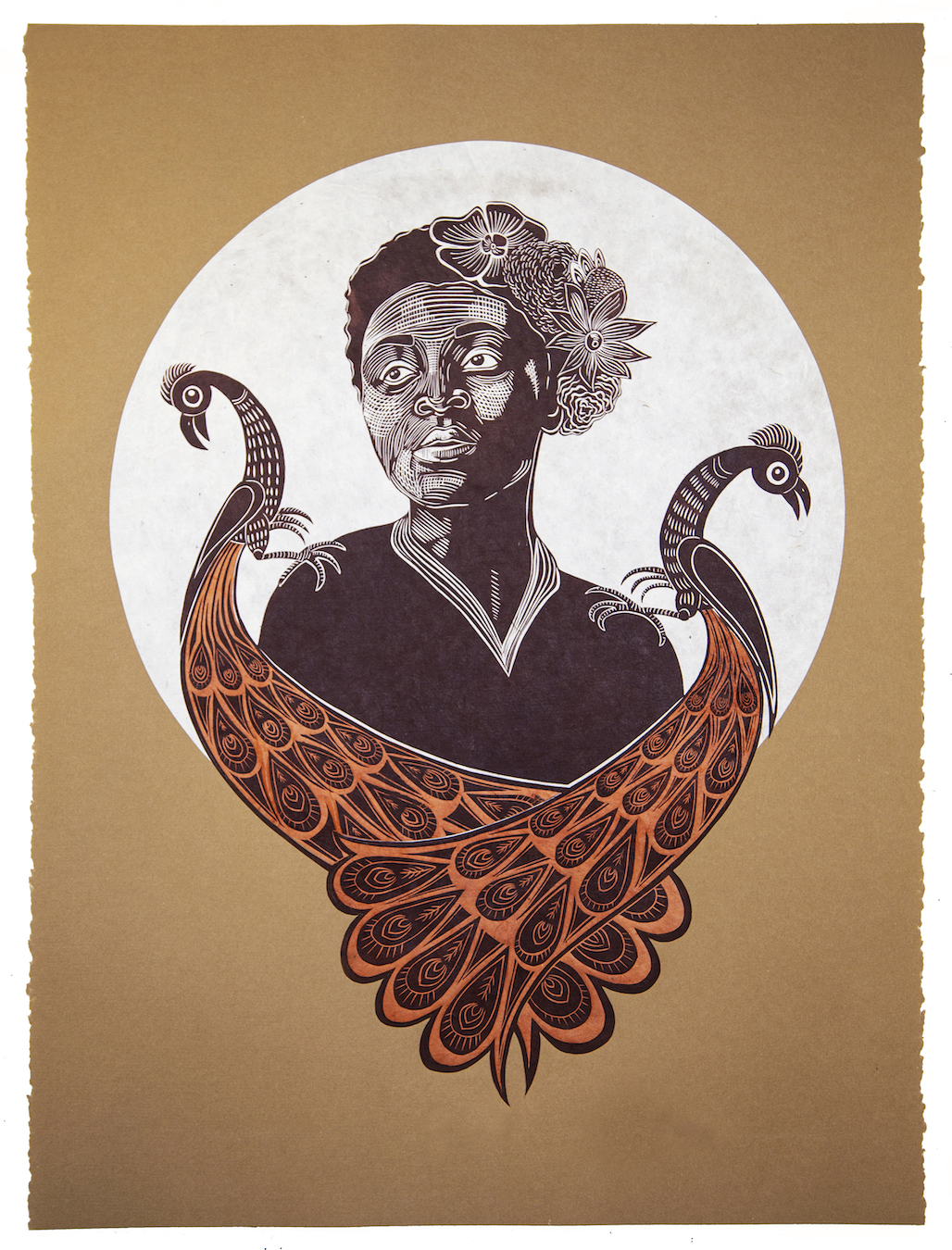
Guardians (2021)
Linoleum Block with Chine-Collé
Deckled edges
Varied edition of 25
30” x 22” print / 34” x 26” framed
$1500
Guardians is a linocut print that reflects the presence of ancestors, attentive and guiding
across time. The work portrays an ancestral figure with peacocks perched on each
shoulder. The birds, symbolizing protection and guidance, are carved with patterns
inspired by Tanzanian Tinga Tinga art. Facing in opposite directions, they echo the
Akan Sankofa symbol: the wisdom of looking to the past to navigate and imagine
liberated futures. This work reflects the principle that ancestors are not behind us, but
alongside us, guiding us toward worlds yet to be built.
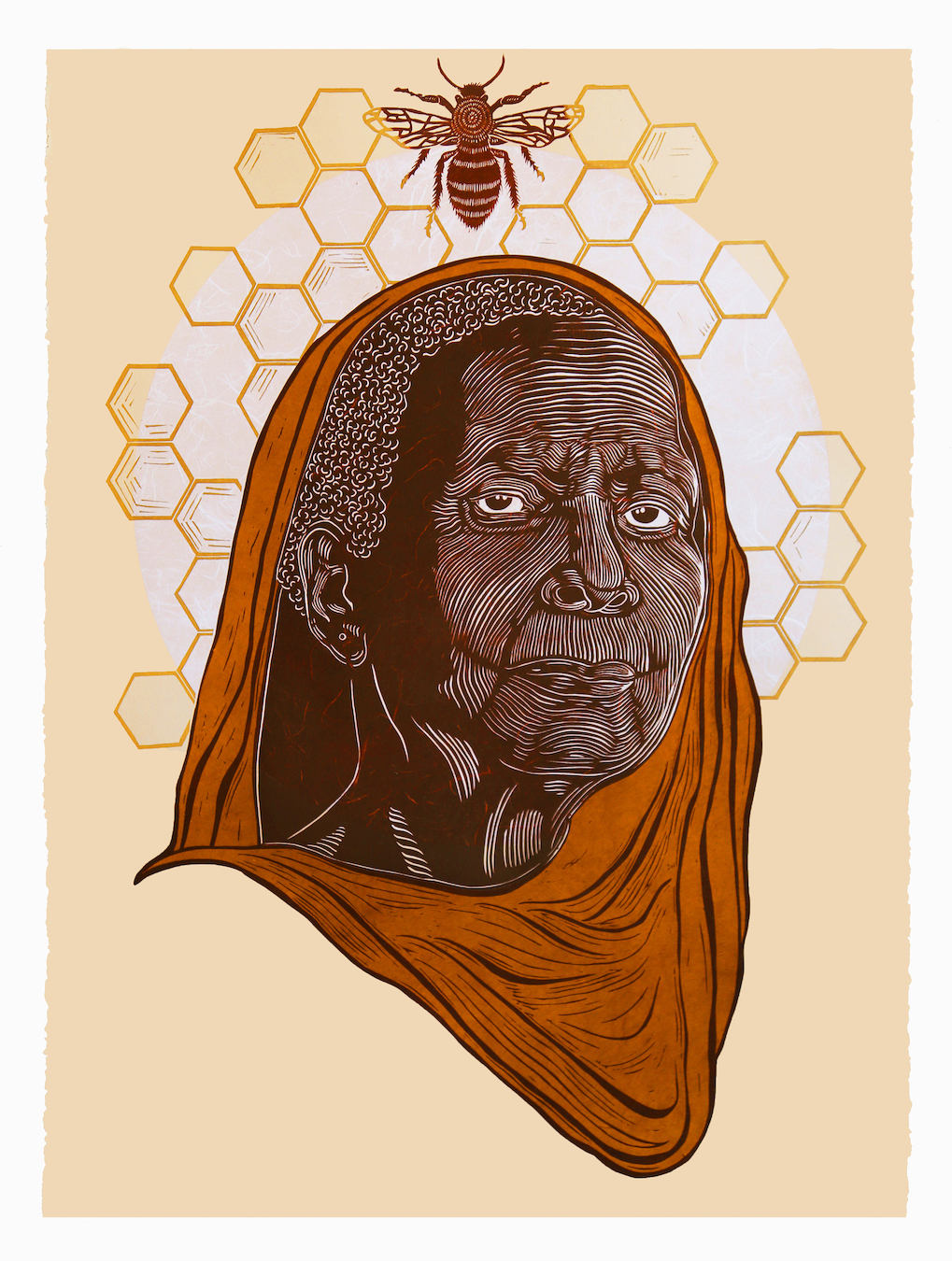
Ajabu na Nyuki (Wonder and Her Bees) (2022)
Linoleum block print with chine collé
Deckled edges
Varied edition of 15
30” x 22” print / 34” x 26” framed
$1500
Ajabu na nyuki (Wonder and Her Bees) pays homage to Leti, a revered community
leader and beekeeper who inspired the Nyaturu people of north-central Tanzania in
their struggle against German colonizers in the early 1900s. This portrait is part of a
series that explores the artist's ancestral wisdom, spirituality, and family roots.
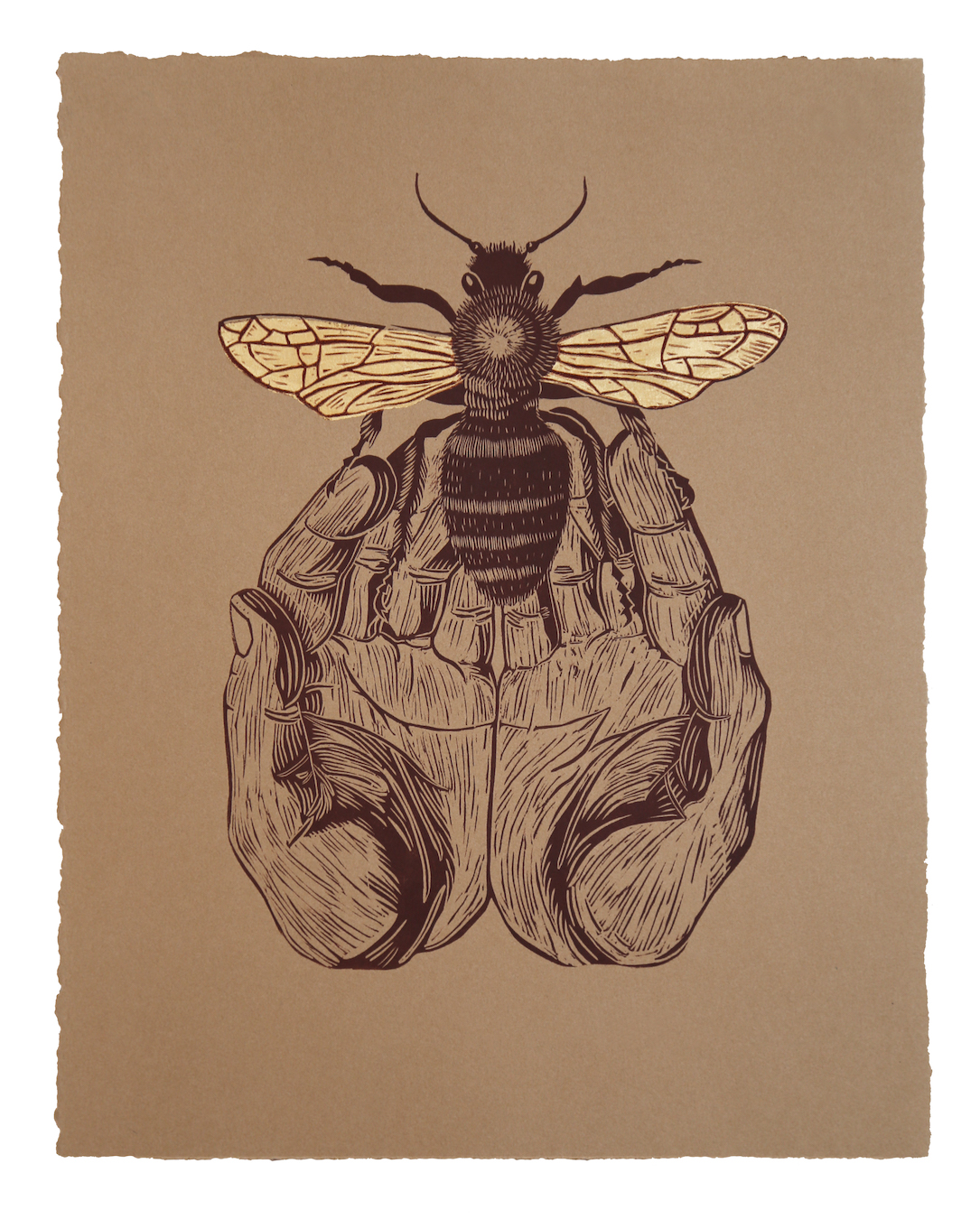
The Visit (2021)
Linoleum block print with gold leaf
Deckled edges
Edition of 20
14” x 11” print / 18” x 15” framed
$650
The Visit is a linocut print that centers on a quiet moment of ancestral communication,
an encounter that arrives softly, inviting attention and care. Created during a period of
uncertainty, the work embodies ancestral communication as a ritual and a gesture of
listening that spans generations.
The bee, a recurring messenger in my practice, carries guidance, protection, and
continuity. The Visit speaks to trust in unseen support and the act of remaining open to
messages that move between the spiritual and the everyday.
Rashod Taylor
Instagram -> @rashodtaylorphoto
Website -> www.rashodtaylor.com
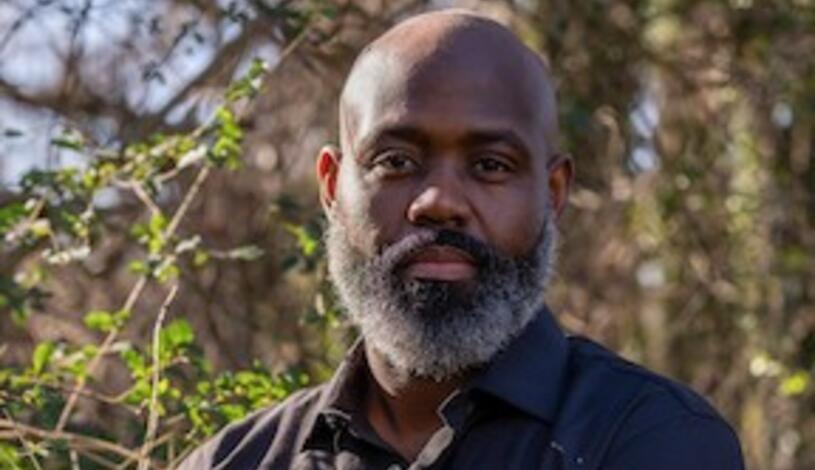
Profile photo by Nydia Blas
To purchase artwork, please contact: jdc Fine Art, San Diego, CA (619) 985-2322
info@jdcfineart.com
Rashod Taylor is a fine art and portrait photographer whose work address themes
of family, intimacy, legacy, and the black experience. He attended Murray State
University and received a Bachelor’s degree in Art with a specialization in Fine Art
Photography. Since then, he has exhibited and published his work across the
United States and internationally. His photographs are part of the permanent
collections of the Smithsonian’s National Museum of African American History &
Culture, Library of Congress, Prints and Photographs Division. The Museum of Fine
Arts Houston and The Nelson-Atkins Museum of Art. Rashod is the 2021 recipient
of the Arnold Newman Prize for New Directions in Photographic Portraiture. Taylor
has taught numerous workshops at Anderson Ranch Art Center and other venues
around the country. He has lectured at Stanford University, George Washington
University, Savannah College of Art and Design, School of the Art Institute of
Chicago, Massachusetts College of Art and Design, Maine Media Workshop +
College, Los Angeles Center of Photography, among other venues. Editorial clients
include National Geographic, The New York Times, Essence Magazine, ProPublica
and Buzzfeed News. His work has been featured in CNN, The Atlantic, The New
Yorker, The Guardian, Hulu, Forbes, Feature Shoot and Lenscratch among others.
My America is an examination of what it's like to live in America as a Black man.
The wet plate collodion process was first introduced in the 1850’s. I use this
process to connect the past to the present, and to explore the atrocities of slavery,
Jim Crow and the institutional and systematic racism that remains so tightly woven
into the fabric of American society. The American Dream is founded on the idea
that equality of opportunity is accessible to all people, but it is a dream which
continues to be out of reach for a majority of Black Americans. By capturing the
Black America that I live every day, I hope to shed light on what people unfamiliar
with Black lives either don’t want to see or refuse to acknowledge.
My exploration of the land extends beyond visual documentation; It extends into the
intricate layers of history, memory and human experience. Ossabaw Island,
situated off the coast of Georgia, serves as a poignant backdrop for this exploration.
Capturing the ethereal beauty of Ossabaw’s landscapes is the surface of my artistic
endeavor. Beneath the lush foliage and sweeping vistas lies a profound narrative of
struggle and resilience for my ancestors who endured the brutality of enslavement
on this very land. I strive to evoke the presence of those who came before me,
whose labor and suffering have left indelible imprints on the island’s terrain. I seek
to honor the lived experiences of the enslaved individuals who toiled on these
planation’s, their stories intertwined with the very soil I stand. Each image becomes
a testament to their resilience, humanity, and their enduring connection to the land.
To purchase artwork, please contact: jdc Fine Art, San Diego, CA (619) 985-2322
info@jdcfineart.com
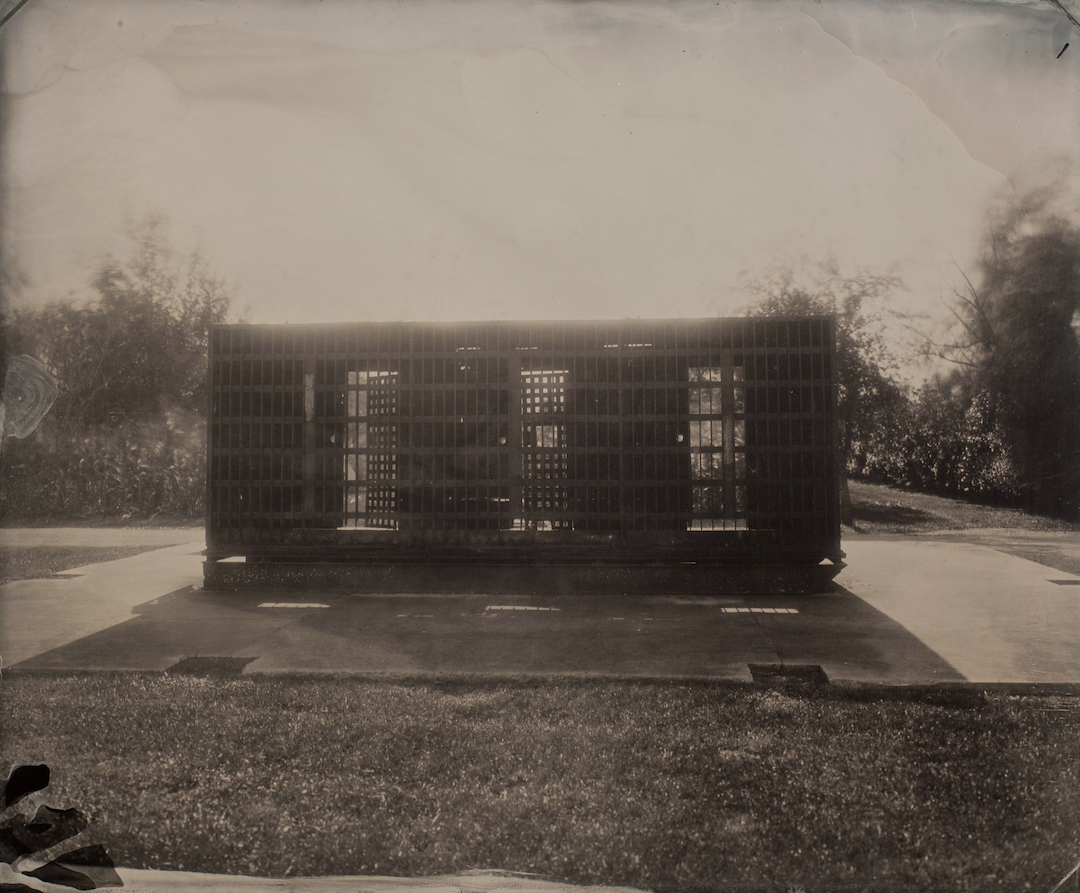
Jail, Whitney Plantation, (2024)
Unique Tintype*
20” x 24” print / 24” x 28” frame with mat
The wet plate collodion process was first introduced in the 1850’s. It’s a process
that requires tin, glass, or photographic medium to be coated, sensitized, exposed
and developed within about fifteen minutes. If working in the field, it requires a
portable darkroom for development. Though the overall experience can be delicate
and cumbersome, it renders each platea one-of-a-kind art piece.
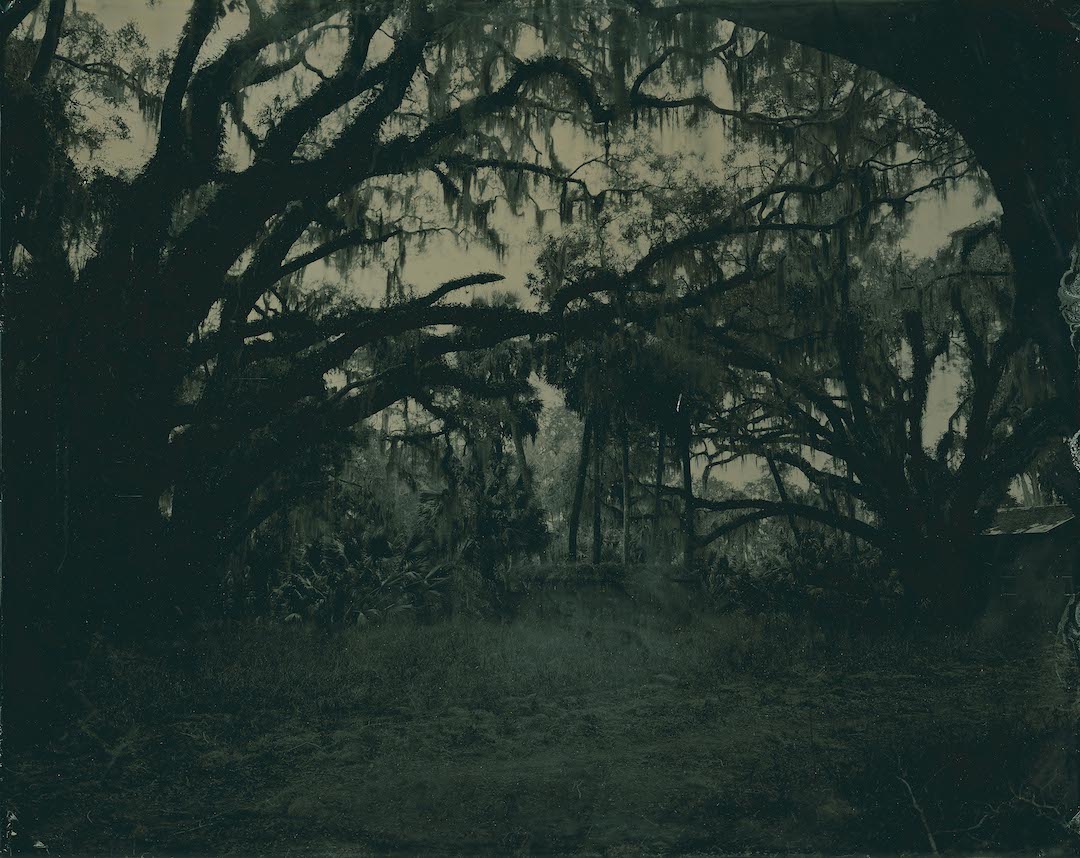
Chicken Coop (2024)
Archival Inkjet Print
Ed of 10 with 2 AP
20” x 24” print / 22” x 26” frame
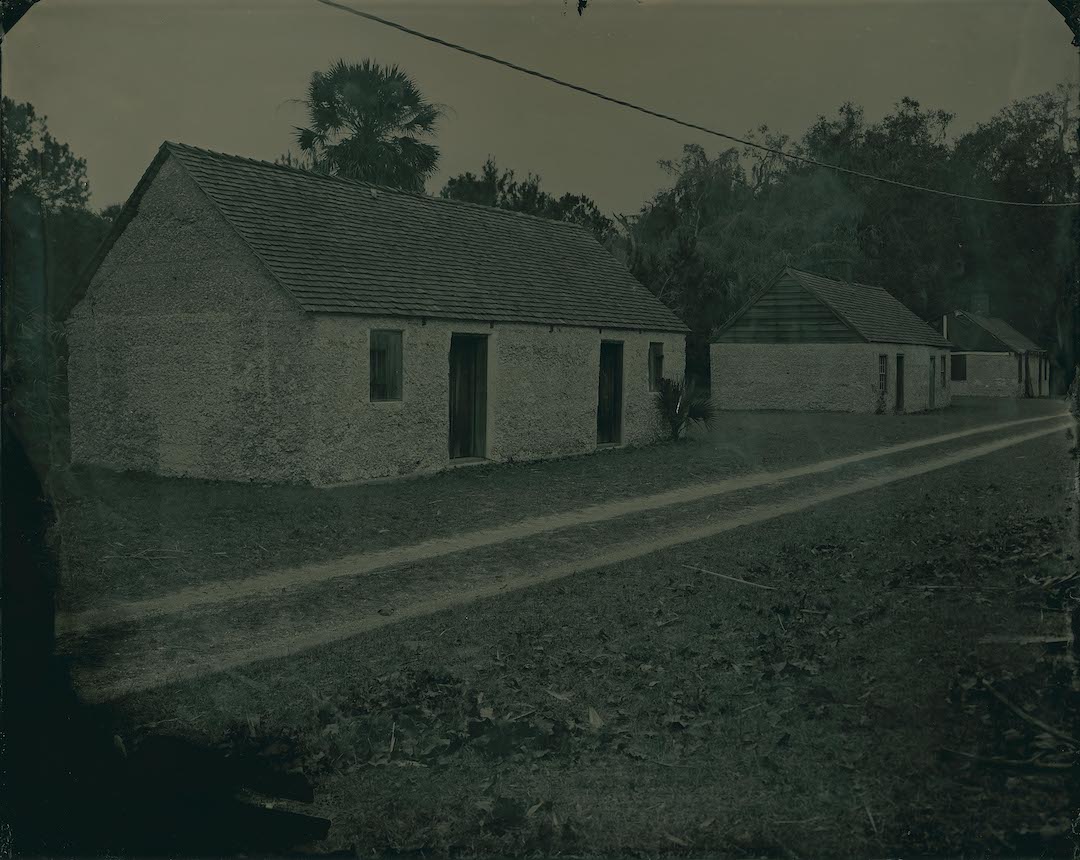
Tabby Houses (2024)
Archival Inkjet Print
Ed of 10 with 2 AP
20” x 24” print / 22” x 26” frame
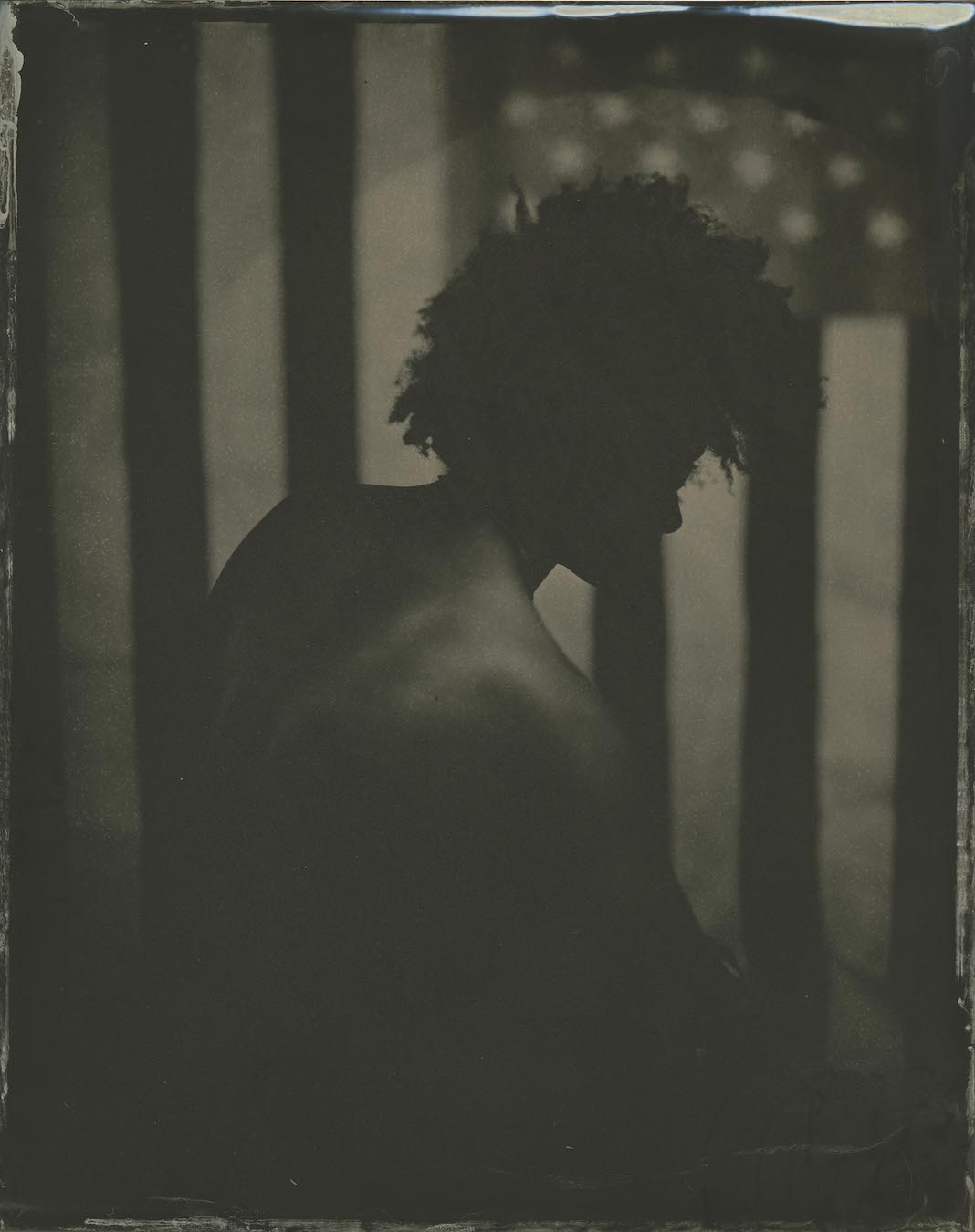
The Past (2019)
Archival Inkjet Print
Ed of 10 with 2 AP
24” x 20” print / 26” x 22” frame
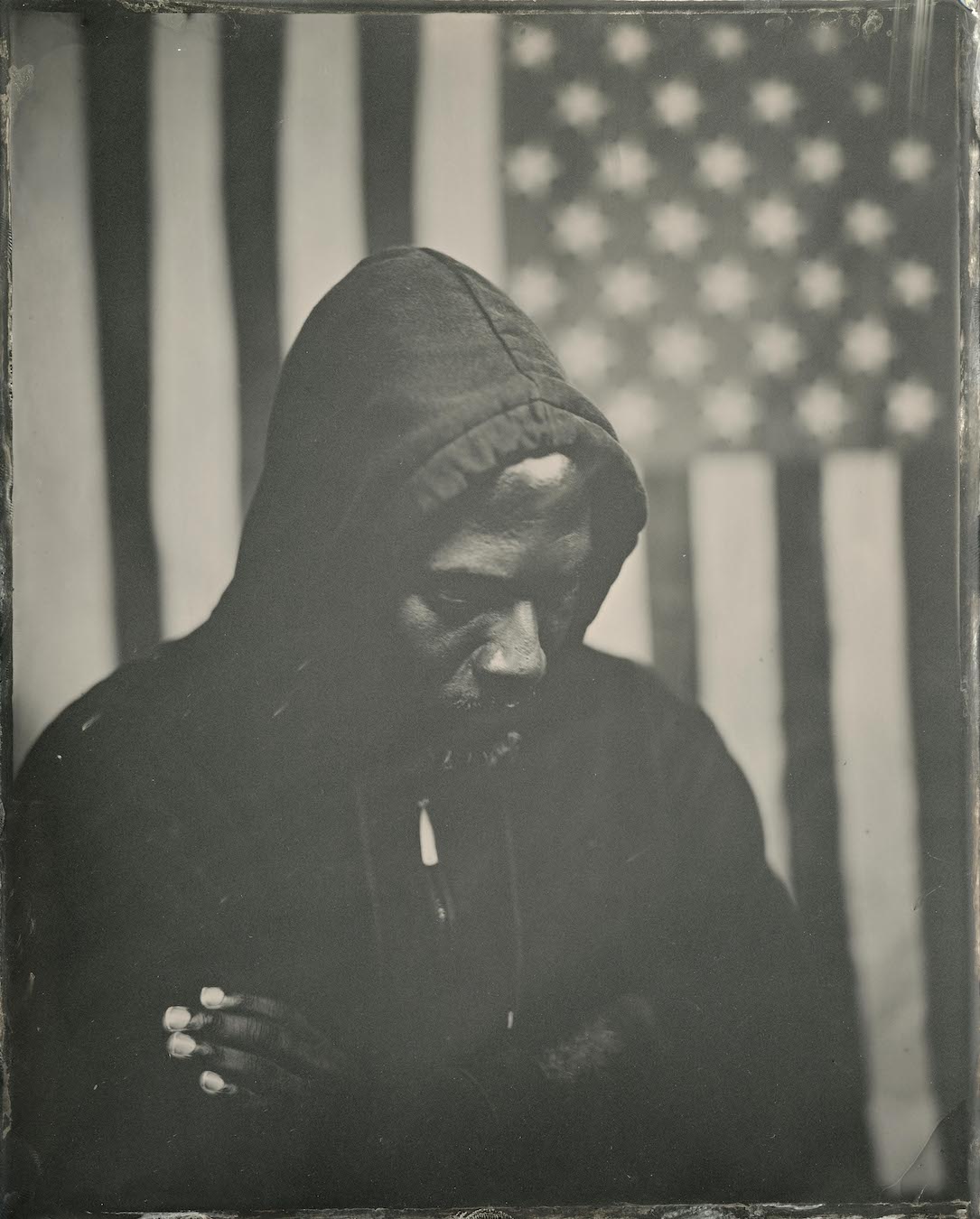
The Present (2018)
Archival Inkjet Print
Ed of 10 with 2 AP
24” x 20” print / 26” x 22” frame
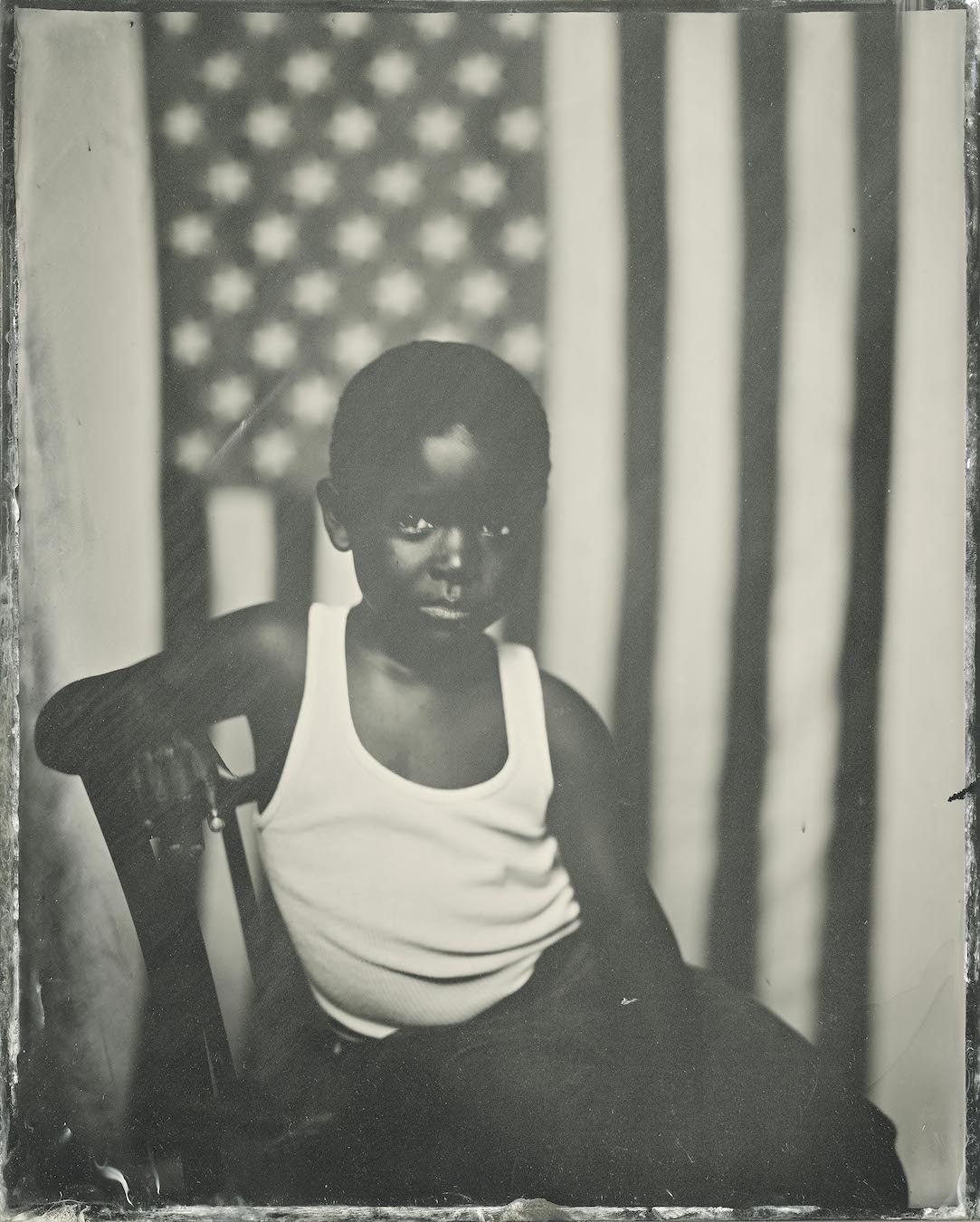
The Future (2019)
Archival Inkjet Print
Ed of 10 with 2 AP
24” x 20” print / 26” x 22” frame
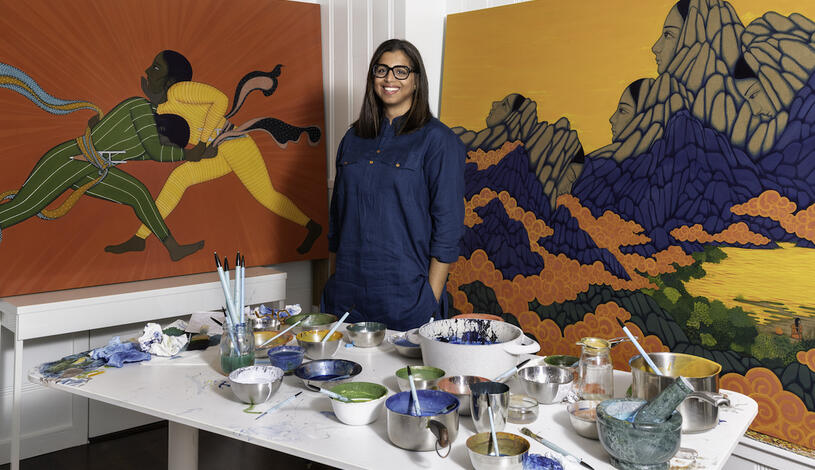
Rupy C. Tut (b. 1985, Chandigarh, India) has a BS in Evolutionary and Ecological Biology
from UCLA and an MPH from Loma Linda University, CA. She studied traditional Indian
painting for eight years, including time at King’s Foundation School of Traditional Arts in
London. Tut has enjoyed solo exhibitions at SFMOMA, CA; ICA San Francisco; Crown
Point Press, SF; and Triton Museum of Art, Santa Clara, CA. Her work is in the permanent
collections of SFMOMA, CA; de Young Museum, SF; Asian Art Museum, SF; Crocker Art
Museum, SF, and Cantor Arts Center, Palo Alto, CA, among others. She has been featured
in group exhibitions at the Asian Art Museum, SF; Phoenix Art Museum, AZ; Fowler Art
Museum, Los Angeles; Kala Art Institute, Berkeley and Eiteljorg Museum, Indianapolis,
among others. Tut was a 2024 recipient of SFMOMA’s SECA Art Award, as well as the
Joan Mitchell Foundation Fellowship. She is included in “Making Moves: A Collection of
Feminisms” at Crocker Art Museum, Sacramento (November 2, 2025–December 2026) and
the “Outwin Boochever Portrait Competition” at National Portrait Gallery, Washington, D.C.
Tut has been chosen by Arion Press to create paintings that illustrate their hand-crafted,
limited edition letterpress version of Alice in Wonderland, to be published in 2026. She lives
and works in Oakland, CA and is represented by Jessica Silverman, San Francisco.
Tut migrated from India to the U.S. at age 12, following in the footsteps of her Sikh
ancestors, who were repeatedly uprooted and transplanted. As an environmentalist and
Indian-American woman, she never takes place for granted. Tut’s paintings depict lush
natural territories, often graced by feminine figures. The works variously suggest idyllic
paradises, the confinements of gender, and fears of climate disaster. Tut uses her mastery
of traditional Indian painting to tell stories the all-male practice never told. As she explains,
“I question traditional roles and labels while preserving traditional practices.”
Interview excerpt from the Joan Mitchell Foundation
In the Studio: Rupy C. Tut
April 21, 2025
Joan Mitchell Foundation - In the Studio: Rupy C. Tut
One of my favorite feelings to create through my work is nostalgia, because it is a beautiful
emotion to be able to survive with. My notion of personhood comes from stories of survival—
from my family’s experience with Partition and growing up with bedtime stories my
grandparents told of losing something they remembered for the rest of their lives. And then
seeing my parents as immigrants, still reminiscing and thinking about things that never made
it into their suitcases—like my mom’s college textbooks, her notes that she never found again.
Or even me, moving to the US when I was 12, thinking of all the friends, the toys and all the
little projects I must have done that I never saw again.
[My Grandmother’s Home series reflect on] understanding the home as a character in either
developing, encouraging, or limiting our dreams. I think it's important to start with hope, but it's
also important to know the facts of the patriarchal limitations that some of us navigate to just
be able to do what we love, hold onto hope, to dream, or to yearn for something more for
ourselves.
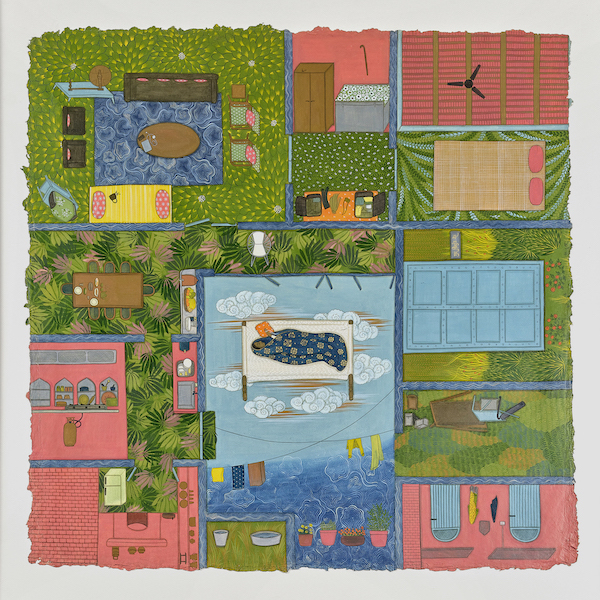
Beeji de Ghar (My Grandmother’s Home for Me), 2023
Handmade pigments on hemp paper
Frame: 43 x 43 inches / 109.2 x 109.2 cm
Paper size: 37 x 37 inches / 94 x 94 cm
Courtesy of the artist and Jessica Silverman, San Francisco
Photo: Elon Schoenholz
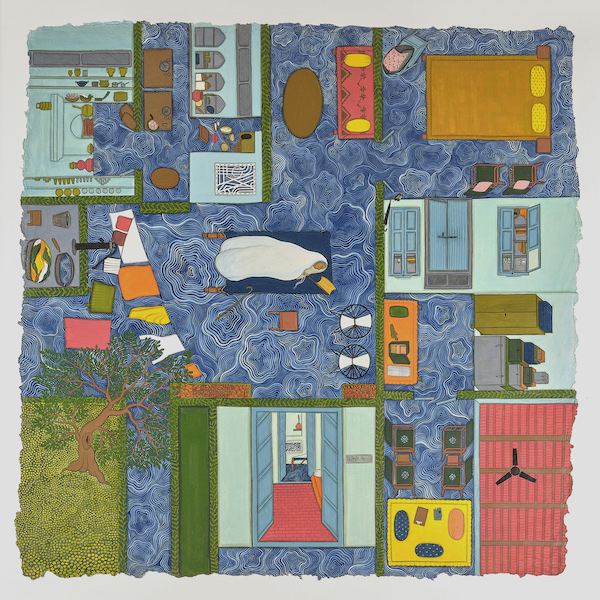
Beeji de Ghar (My Grandmother’s Home), 2023
Handmade pigments on hemp paper
Frame: 43 x 43 inches / 109.2 x 109.2 cm
Paper size: 37 x 37 inches / 94 x 94 cm
Courtesy of the artist and Jessica Silverman, San Francisco
Photo: Elon Schoenholz
Arleene Correa Valencia
Instagram -> @arleenecorreavalencia
Website -> www.correavalencia.com/
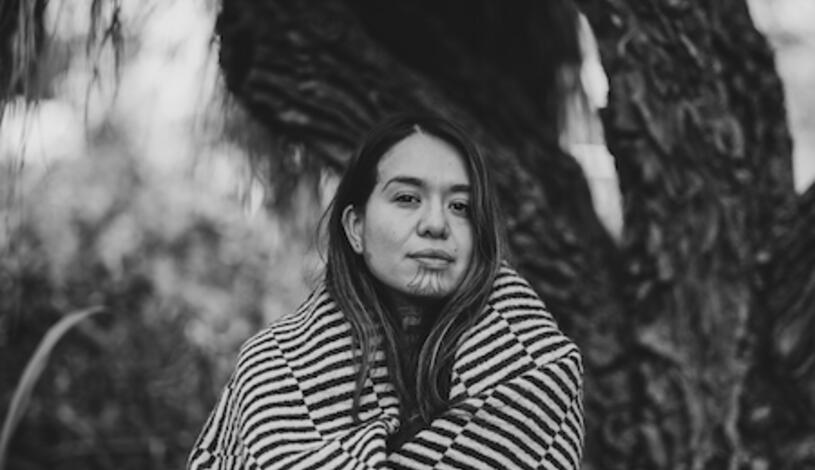
Profile photo by Paul Gallo
To purchase artwork, please contact Anton Stuebner at director@cclarkgallery.com
Arleene Correa Valencia (b. 1993, Michoacán, Mexico) is an artist based in Napa Valley, California.
She is an inaugural recipient of the Bay Area Fellowship at Headlands Center for the Arts and
received a regional Emmy award for the KQED Arts feature REPRESENT: Portraits of Napa
Workers: Arleene Correa Valencia.
In 2023, Correa Valencia was named a Eureka Fellow by the Fleishhacker Foundation and a Finalist
for the SECA Award through the San Francisco Museum of Modern Art. Correa Valencia’s work has
been exhibited extensively. In 2025, following her solo exhibition Codice del Perdedor / The Losing
Man's Codex, the Fine Arts Museums of San Francisco, Denver Art Museum, and Amon Carter
Museum of American Art acquired major works for their permanent collections. In 2024, she was
the subject of solo museum exhibitions at the Bolinas Museum and the Utah Museum of Fine Arts.
In 2023, her work was featured in BAN9: Bay Area Now 9 at Yerba Buena Center for the Arts; a two-
person presentation (alongside Stephanie Syjuco) for Focus at The Armory Show, curated by Candice
Hopkins; and exhibitions at the Pacific Northwest College of Art, the San Francisco Arts Commission,
Lower Manhattan Cultural Council in New York City, and Alfred University in New York.
Her solo exhibition Llévame Contigo, Yo Quiero Estar Contigo was held at the Trout Museum of Art
(2021-2022). In 2022, she mounted several major solo presentations, including Aveces Quiero Llorar
Porque Te Extraño... at Catharine Clark Gallery; her first international solo exhibition, (in)visibles En
La Oscuridad (De Regreso A Casa), at the Benemérita Universidad Autónoma de Puebla in Mexico;
and Por favor, no me olvides / Please, don’t forget me at MCA Gallery in Ontario, Canada.
Correa Valencia received her MFA from the California College of the Arts. Originally from Arteaga,
Michoacán, she is one of four children whose family fled to the United States in 1997, settling in
California’s Napa Valley. Correa Valencia is a DACA (Deferred Action for Childhood Arrivals) recipient
and is on the path to U.S. citizenship.
Her work is held in the permanent collections of the Fine Arts Museums of San Francisco, Denver
Art Museum, Amon Carter Museum of American Art, Cantor Arts Center at Stanford University,
Crocker Art Museum, Utah Museum of Fine Arts, Nerman Museum of Contemporary Art, Grand
Valley State University Museum of Art, Ulrich Museum of Art, and 21c Museum Hotels. Correa
Valencia has been represented by Catharine Clark Gallery since 2022.
Having grown up undocumented in California I’ve always been fascinated by the idea that an
immigrant body could be labeled “invisible,” something that I, as a DREAMER, do not identify
why. The notion of being both present and absent has led me to create portraits of my family
that use discarded clothing, traditional textiles and reflective fabrics to explore conversations
about my undocumented/migrant experience. The works explore the relationships between
parents and children, visibility and invisibility as well as family separation. Through embroidery
and sewing each works attempts to heal the pain of our collective experience as a marginalized
community.
Artwork images courtesy of the Artist and Catharine Clark Gallery, San Francisco.
Copyright © the Artist.
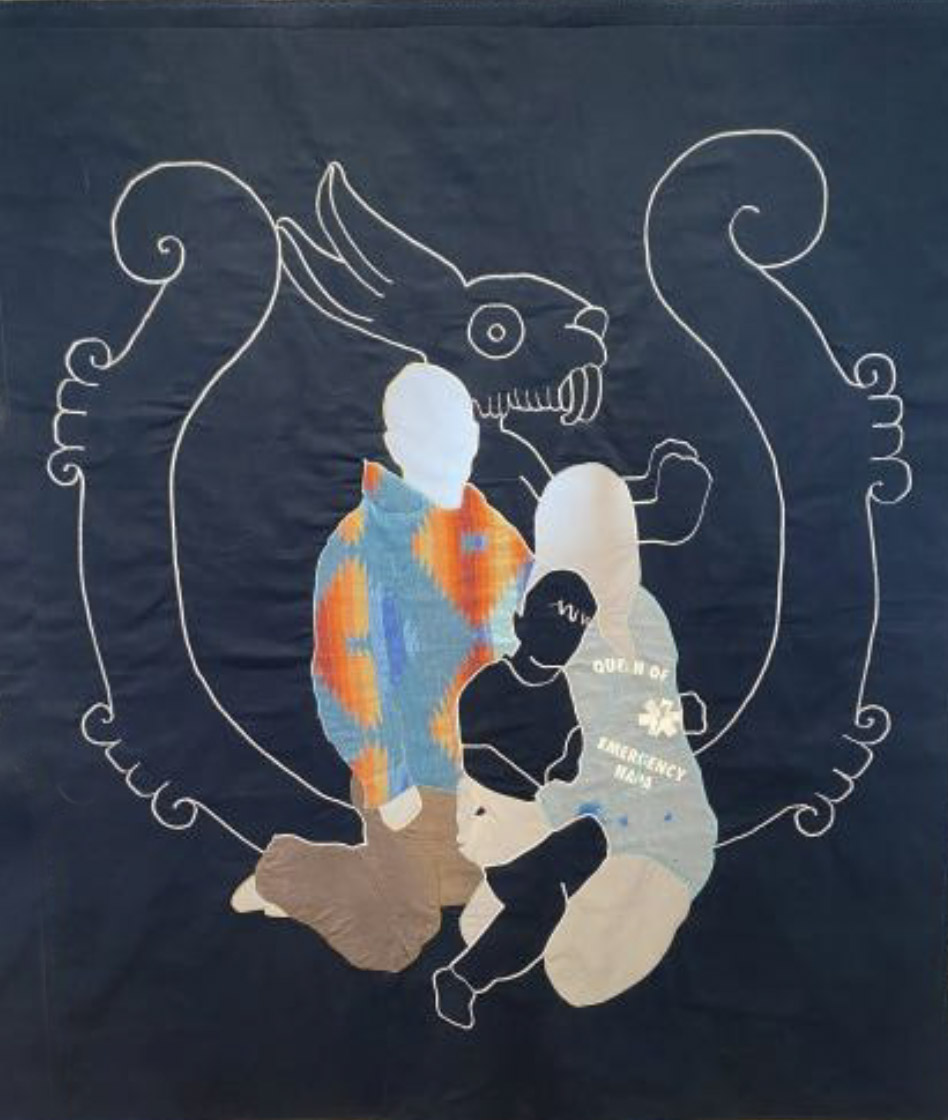
Si Te Tienes Que Ir, Llévanos Contigo /
If You Have To Leave, Take Us With You, 2024
Textiles and thread on canvas
82” x 69”
$12,000
Artwork images courtesy of the Artist and Catharine Clark Gallery, San Francisco.
Copyright © the Artist.
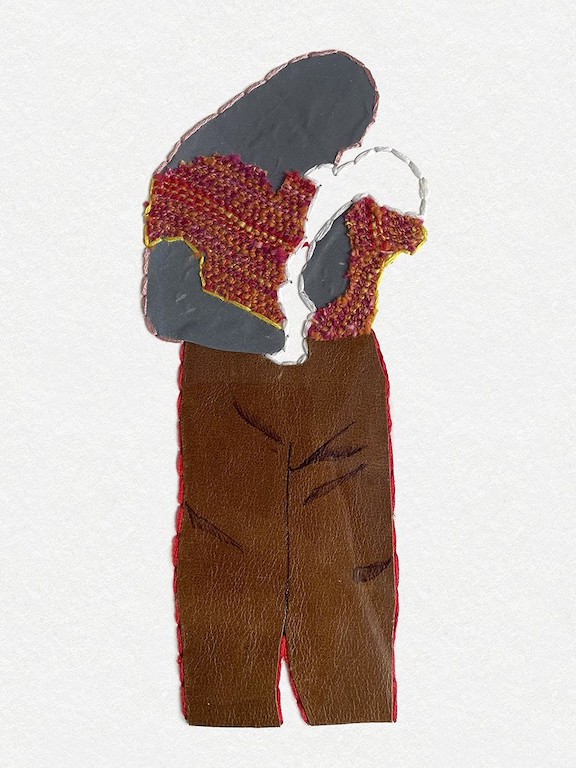
Volveré A Verte / I Will See You Again, 2021
Repurposed textiles embroidered on paper
Sheet: 14” x 11” / Frame: 15” x 12”
$3500
Artwork images courtesy of the Artist and Catharine Clark Gallery, San Francisco.
Copyright © the Artist.
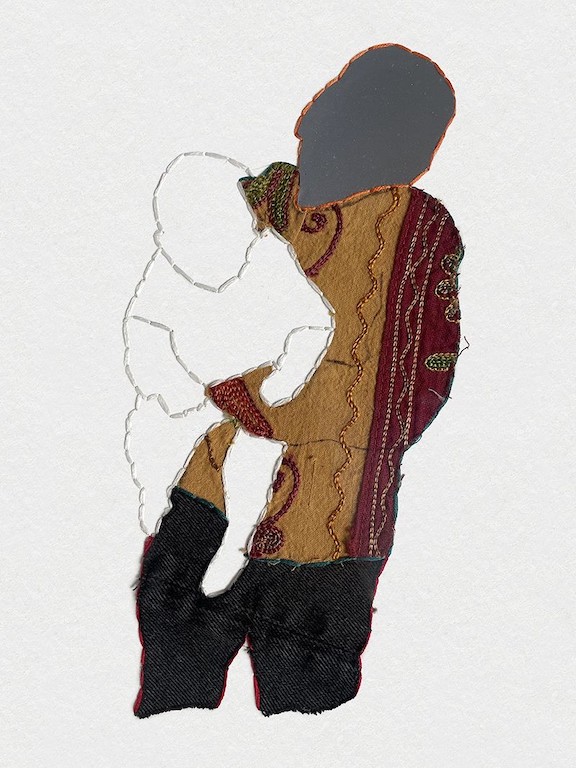
Te Espere / I Waited for You, 2021
Repurposed textiles embroidered on paper
Sheet 14” x 11”
Framed 15” x 12”
$3,500
Artwork images courtesy of the Artist and Catharine Clark Gallery, San Francisco.
Copyright © the Artist.
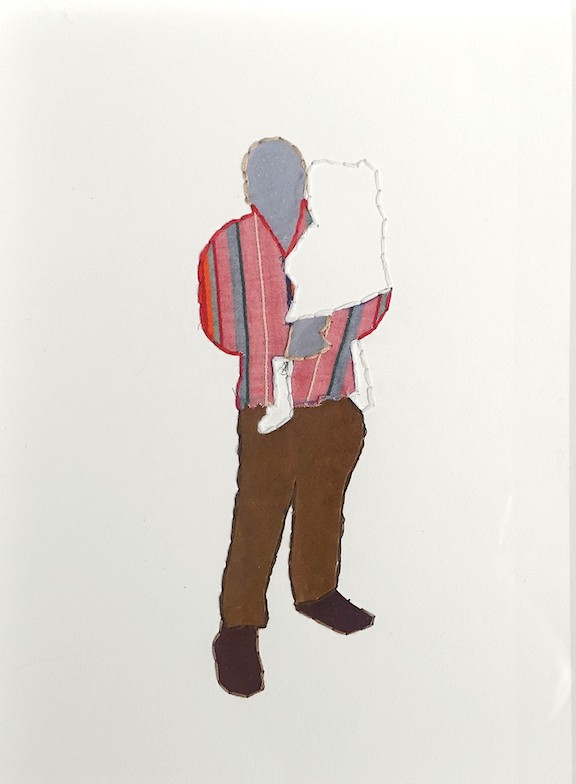
¿Aun Estas En Mexico? / Are You Still In Mexico?, 2023
Repurposed fabric embroidered on paper.
Sheet: 14” x 11”
Frame: 15” x 12”
$3,500
Artwork images courtesy of the Artist and Catharine Clark Gallery, San Francisco.
Copyright © the Artist.
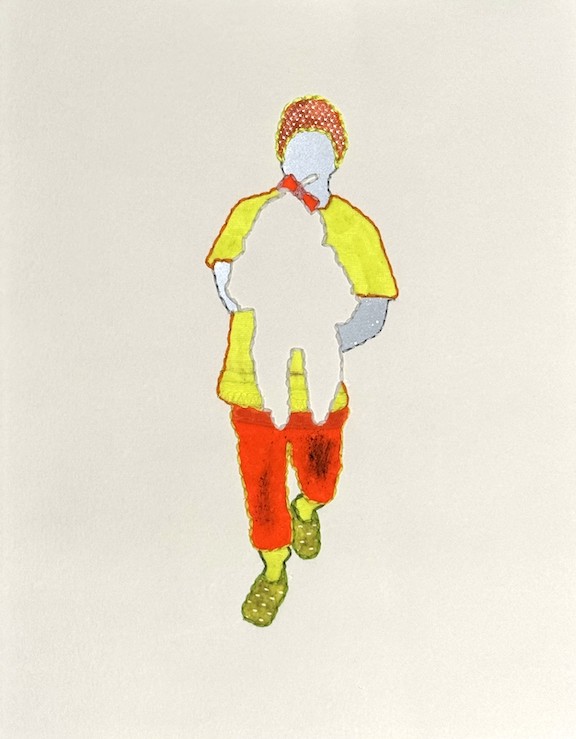
Caminaría por Siempre / I Would Walk for Eternity, 2021
Repurposed textiles embroidered on paper
Sheet: 14” x 11”
Frame: 15” x 12”
$3,500
Artwork images courtesy of the Artist and Catharine Clark Gallery, San Francisco.
Copyright © the Artist.
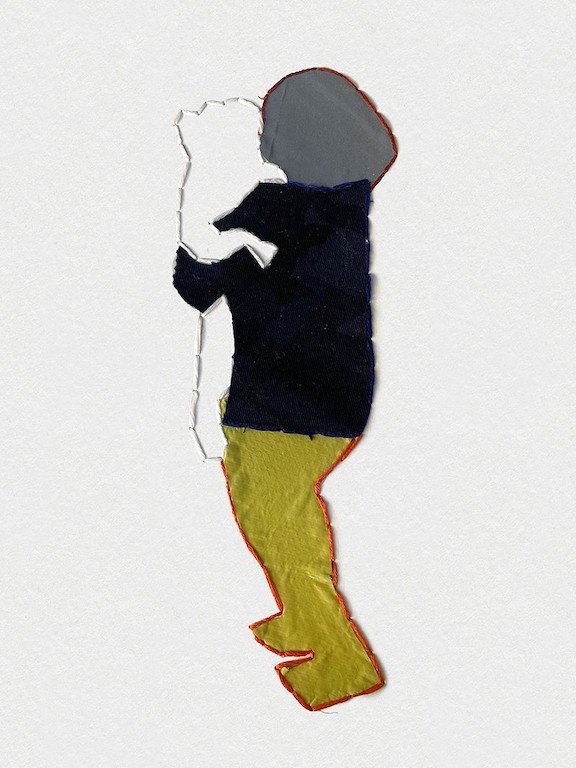
Hoy Te Extra Demasiado / I Miss You Extra Today, 2021
Repurposed textiles embroidered on paper
Sheet: 14” x 11”
Frame: 15” x 12”
$3,500
Artwork images courtesy of the Artist and Catharine Clark Gallery, San Francisco.
Copyright © the Artist.