Biography
Born and raised in the migrant farmworker experience, Professor Mario Moreno began drawing Chicano images of resistance as a child while sketching on the sides of the agricultural fruit boxes he helped harvest. Foundationally trained in the traditions of the Barrio Art Program under the tutelage of José Montoya at Sacramento State University, Professor Mario Moreno, now in his 31st year as a Professor of Art at San Joaquin Delta College, teaches drawing theory and application as well as Chicano(a) Art: Resistance and Affirmation through Painting. He has created public artworks for the Dreamer Success Center, the Shima Building, the Goleman Library, and the Tillie Lewis Theater on campus, taught painting in the Arts in Corrections Program, and served as a member of the third squadron of the Royal Chicano Air Force (RCAF). Professor Moreno believes deeply in using art as a tool to advance social movements. He is the 2019 recipient of the campus Distinguished Faculty Award and, through his service on the campus Social Justice and Equity Committee, a recipient of the statewide 2020 Stanback-Stroud Diversity Award.
Artist Statement
The cultural artworks in this exhibition emerge from his 2024 sabbatical journeys through Mexico, Panama, Colombia, Costa Rica, and New York. Shaped by the harsh realities faced by immigrants, enriched by deep historical memory, and inspired by the places and people encountered along the way, these works call forth revolutionary figures of Mexican history to help immigrant students reconnect with their cultural inheritance, dignity (sense of inherent self-worth), and collective resilience. The artworks presented here feature two large-scale paintings, Francisco “Pancho” Villa and Adelita, alongside two handcrafted ceremonial drums, or huehuetls in the Aztec/Nahuatl tradition, accompanied by related mixed-media pieces that extend the visual and cultural narrative.
Back in his studio, Professor Moreno began preparing the canvases, constructing the drums, and mentoring student assistants in the process of priming, gridding, and proportion studies. Choosing Payne’s Gray and deep indigo tones to create a living contrast between light and shadow, his work reveals the ongoing tension and duality of struggle and hope. Each piece required dozens of labor-intensive hours of sanding, layering, and repainting. The drums were carved from raw logs, repeatedly dried and sanded to create resonance. Professor Moreno treated this as a dialogue with the living material, a metaphor for the resilience of our communities.
The two dominant revolutionary images of Pancho Villa and Adelita stand as timeless mythical warriors, unyielding and unapologetic, yet also alive and radiant with warm love for their people and their communities, carried by an intense longing for tierra, libertad y justicia that echoes across generations. At first, the third and center painting intentionally appears empty: Who is supposed to be there? That central vibrant yellow ochre canvas is reserved for… You, the viewer. It is an invitation for the audience to take a stand. Professor Moreno states, “The creative artworks honor personal and collective courage, persistence, and faith in the transformative power of education as a reciprocal memory of revolution.”
As his artwork declares, “Education is revolution.” That phrase, and this artwork, reaffirm that when we stand together in creativity and purpose, we carry forward not only the trauma of history, but also its courage.
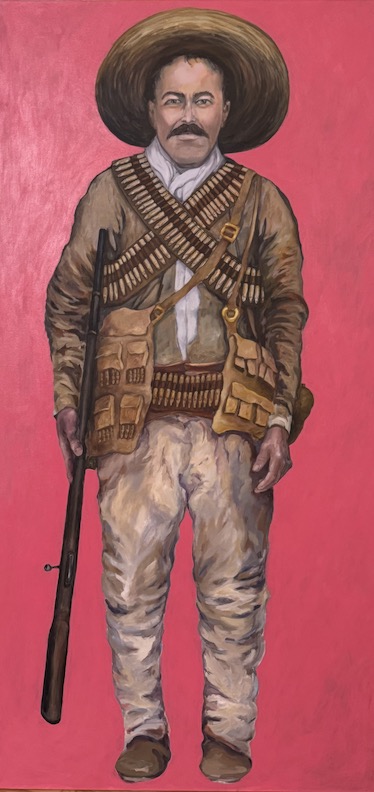
Francisco "Pancho" Villa, 2024
Acrylic on canvas
72” x 36”
$7,000
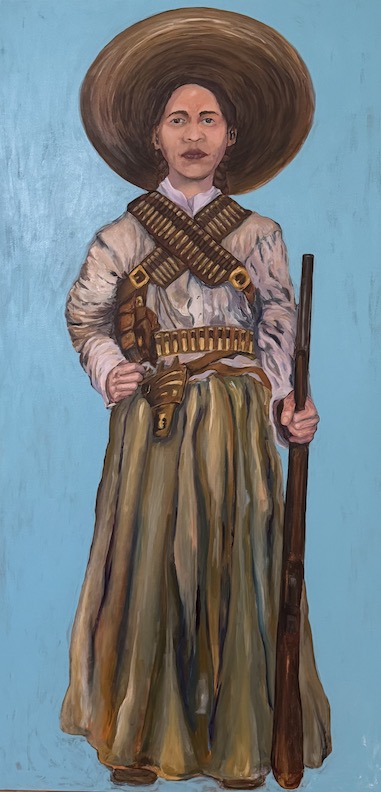
Adelita, 2024
Acrylic on canvas
72” x 36”
$7,000
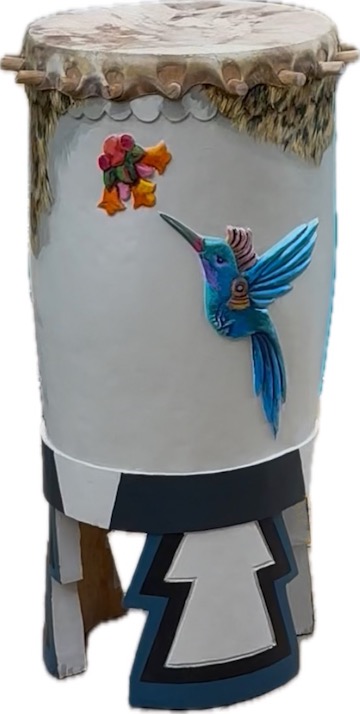
Huehuetl – Huitzillin, 2024
(Drum – Hummingbird)
NFS
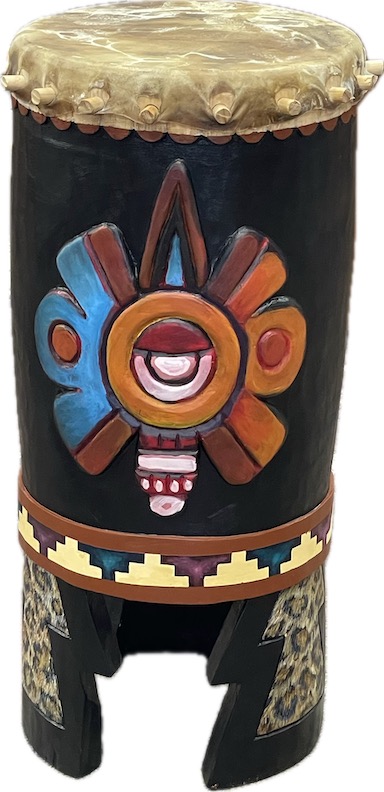
Huehuetl – Nahui Ollin, 2024
(Drum – Four Movements)
NFS